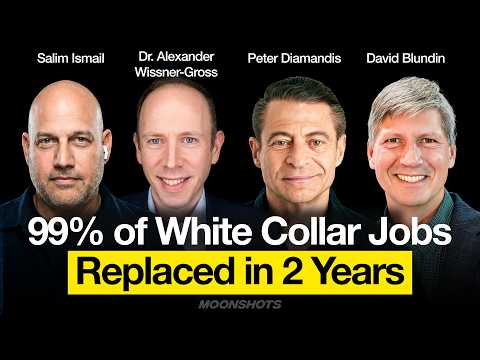
Elon Musk is overhauling xAI's leadership and training models up to 10 trillion parameters while suing OpenAI for $100B, with a trial starting April 27.
2
Anthropic's agent strategy and projected $100B ARR by 2026 could make it the first trillion-dollar AI company, as OpenAI's valuation faces secondary market skepticism.
3
AI job displacement is real but Marc Andreessen argues net job creation will follow; a new social contract with reskilling mandates may be needed.
4
Breakthroughs in AI-driven drug discovery, vertical farming, iron-air batteries, and cancer immunotherapy signal accelerating abundance despite geopolitical tensions.
Protocols
Concrete recipes — what, when, how much, and why
7 items
Entrepreneurship over employment
WhatInstead of seeking traditional employment, start a company using AI tools to lower the barrier.
WhenNow, especially for young graduates.
For whomAnyone facing job displacement or entering the workforce.
WhyAI reduces the skills needed to start a company; the risk is lower than ever.
Peter and Dave argue that the traditional job market is being disrupted, but entrepreneurship is more accessible. Dave emphasizes that you don't need incredible skills, just desire and purpose. They reference their last podcast where they discussed this. The advice is a direct response to AI job loss fears.
The advice is really simple. I mean, for God's sake don't go get a job, go build a company.
Also said
“You don't have to have all these incredible crazy skills that you needed to have before. You just need to have a desire, a purpose and just get going with building a company.”— Dave elaborates.
AI spending target for companies
WhatAim to spend as much on AI tools/tokens as you do on employee payroll by end of year, then optimize.
WhenBy end of 2026.
DoseMatch payroll dollar-for-dollar in AI costs.
For whomCompany leaders.
WhyForces rapid adoption and familiarity; optimization can come later.
CaveatsDon't worry about perfect use initially; just hit the target.
Dave shares that he told his team to target a one-to-one match of payroll to AI cost by year-end. He argues that once people use AI heavily for a month, they never go back. This is a practical way to overcome resistance and accelerate the learning curve. He contrasts it with token leaderboards, which are primitive; a better metric like 'machine leverage per employee' will emerge.
Personal experience
Dave says: 'I told all of our guys to target one-to-one match of payroll to AI cost by the end of the year.'
I told all of our guys to target one-to-one match of payroll to AI cost by the end of the year. And don't worry about it if it's not perfect use, don't worry. Just get to that target and then we'll optimize it next year.
Also said
“I've never met a person who hammers Claude or hammers open AI for a month and then comes back and says I'm never going to do that again. It's a one-way path.”— Dave's observation on stickiness.
Open prompt sharing
WhatEncourage employees to share their AI prompt histories to help everyone learn faster.
CaveatsMay be embarrassing initially, but it's necessary.
Dave laments that Meta employees pulled out of the Claude leaderboard because they didn't want to expose their prompt history. He argues that sharing is how everyone improves together. He sees it as disheartening but believes it's the right thing to do.
Personal experience
Dave says he loves it when companies gamify AI usage and treat it as a badge of honor.
I really don't like the part where people are afraid to share their prompts and their history. Because like, okay, you know, maybe it's a little embarrassing that you're not using it well, but get used to it because it's going to get exposed anyway in the long run, but that's how you help other people improve.
Reskilling mandate for layoffs
WhatBefore terminating employees due to AI, companies should provide a reskilling package (education) to help them transition.
WhenWhen AI automates roles.
For whomMedium and large companies.
WhyEthical safety net to mitigate job displacement backlash.
CaveatsChina already has such a policy; US may adopt it.
Peter pitched this idea to Michael Kratsios, the science advisor to the president. He suggests it as part of a new social contract. Alex notes that China already has a similar policy, which would be ironic for the US to adopt. This is positioned as an alternative to simple UBI checks.
Personal experience
Peter says: 'I had lunch with Michael Kratsios... I pitched him was a new social contract will be before any employee gets terminated by a medium or large-size company, that company has to give them reskilling.'
Before any employee gets terminated by a medium or large-size company, that company has to give them reskilling. In other words, instead of a golden parachute, it's a golden education package.
Also said
“Based on public reporting, China already has that policy. So it would be a weird future if the US is adopting policy prescriptions from the Chinese Communist Party for AI reskilling.”— Alex adds context.
AI-powered personalized education
WhatReplace or supplement traditional teaching with AI tutors that adapt to each child's learning style, pace, and interests.
WhenNow, for any subject.
For whomParents, educators.
WhyAI can provide infinite patience, multiple explanations, and personalization that a human teacher cannot, leading to 2x learning gains.
CaveatsMay not motivate unmotivated students without embodiment or gamification.
The Wharton study showed a 5-month coding course with AI tutors was equivalent to 69 months of additional schooling. Dave argues it's cruel to force-feed lectures when AI can adapt. Alex notes that for self-motivated students, AI is already a Diamond Age primer, but for others, we need AI embodiment that holds attention. Peter suggests gamifying education like video games.
Personal experience
Dave says: 'I think it's downright cruel to kids to try to teach complicated things in any way other than AI.'
I think it's downright cruel to kids to try to teach complicated things in any way other than AI.
Also said
“A five-month coding course was equivalent to 69 months of additional schooling compared to peers with fixed curriculum.”— Quantifies the benefit.
“AI is going to be the ultimate educator, understands your child's abilities, understands what they do and do not know, their favorite sports star, their favorite color and can optimize it.”— Peter's vision.
Build recursively self-improving AI startups
WhatWhen pitching to investors, demonstrate that your AI startup can use its own AI to improve itself, not just be an AI company.
WhenNow, for fundraising.
For whomAI startup founders.
WhyInvestors increasingly expect this as the bar for AI startups; it's what frontier labs do.
CaveatsMust also have revenue traction.
Alex argues that just being an AI startup is no longer enough; you must be recursively self-improving. He cites OpenAI, Anthropic, xAI, and Waymo as examples. This is the new standard investors are looking for.
I no longer even think if you're a startup that just saying that you're an AI startup or even actually being an AI startup is sufficient. Increasingly, what I'm seeing across the board is an expectation that you not just be an AI startup, but that you be a recursively self-improving AI startup.
AI-powered preventive health screening
WhatUse services like Fountain Life that employ AI analytics on CT angiography and other tests to detect early signs of disease, especially heart disease.
WhenAnnually or as recommended.
For whomAdults concerned about heart health.
Why50% of heart attacks occur with no warning; AI can detect soft plaque missed by traditional calcium scores.
CaveatsAffiliation: Peter is founder of Fountain Life.
This is a sponsored segment. Dr. Dawn Mussallem explains that 88% of people coming in have detectable coronary artery disease, and 23% have soft plaque. The message is to be the CEO of your own health.
Mechanism
CT angiography with AI analytics identifies soft plaque that wouldn't be seen on standard calcium scoring.
Personal experience
Peter shares that heart disease has been personal for Dr. Mussallem, whose husband died of sudden cardiac death.
When we do this CT angiography with AI analytics, we are actually finding that 88% of people coming in have detectable coronary artery disease... 23% of those individuals had soft plaque.
What's new
Personal practice updates, fresh positions, predictions
8 items
xAI rebuild and 10T parameter models
early in episode
Elon Musk is rebuilding xAI from the ground up, replacing leadership with SpaceX engineers, and training seven models including a 10 trillion parameter frontier LLM.
Why this matters: Signals that xAI is behind and Musk is applying his crisis management style to catch up, while parameter scaling may be plateauing.
Background
xAI previously had Grok models that were suspected of being benchmarked rather than genuinely capable. Musk admitted the company was not built right the first time.
The hosts discuss how Musk's management style, effective for hardware like rockets, may not translate to AI training where bugs can waste hundreds of millions in compute. They note that parameter count doesn't directly correlate to capability, and that other labs have stopped reporting parameters. Alex suggests the 10T model may serve as a teacher for distillation. The reorganization includes eight founding engineers leaving and the president of xAI coming from Starlink. The IPO is expected this summer with a $2T valuation, raising questions about rebuilding while pricing an IPO.
xAI was not built right the first time around. So it's being rebuilt from the foundations up.
Also said
“Elon is basically reorganizing the entire deck. Eight founding engineers left including three co-founders and he's using SpaceX engineers to fill the leadership gap.”— Details the extent of the overhaul.
“They're training up these seven models... a 6 trillion parameter frontier scale LLM and a 10 trillion parameter.”— Specifics on the model sizes.
Musk sues OpenAI for $100B
after xAI segment
Elon Musk's lawsuit against OpenAI, Sam Altman, and Greg Brockman for fraud and breach of contract goes to trial April 27, with Musk seeking Altman's removal and reversion to nonprofit status.
Why this matters: High-stakes legal battle that could reshape AI governance and set precedent for nonprofit-to-for-profit conversions.
Background
OpenAI started as a nonprofit, later created a for-profit arm. Musk was an early investor. A 2017 diary entry from Brockman allegedly called the nonprofit commitment a lie, which allowed the case to proceed.
The hosts discuss the geopolitical nature of the fight, the potential for settlement involving Altman stepping down, and the irony that Musk himself pushed for majority control of the for-profit in 2017. They note the New Yorker investigation published simultaneously. Alex expresses sympathy for OpenAI's governance evolution, comparing it to Singularity University's own flip from nonprofit to for-profit. The trial will feature testimony from Altman, Brockman, Satya Nadella, and Musk. The outcome could unlock value in other nonprofits like universities.
Personal experience
Peter shares that he and Salim went through a similar process with Singularity University, flipping from nonprofit to for-profit, and that it was incredibly complex.
The case gained momentum when the discovery process revealed Greg Brockman's 2017 diary entry that stated the nonprofit commitment was a lie.
Also said
“I kind of figured behind the scenes they don't actually hate each other. These guys actually hate each other to the extreme.”— Reveals the personal animosity.
“This is a governance war disguised as legal war. The real question is, who gets to steer these systems that have quasi-civilizational impact?”— Salim frames the deeper stakes.
Anthropic's $100B ARR and Claude agents
mid episode
Anthropic is projected to reach $100B annual recurring revenue by end of 2026 and a $1T valuation, driven by its new Claude managed agents for autonomous multi-step workflows.
Why this matters: If achieved, it would be the fastest revenue ramp in history, shifting the economic model from software licensing to outcomes.
Background
Anthropic has been competing with OpenAI, and its Claude models are gaining traction. The launch of managed agents is a pivot from answering to doing.
The hosts debate the plausibility of the numbers, with Dave suggesting 100B is a good target but 200B is possible, while the trillion the following year is unlikely. Alex ties it to the race to become the default 'Open Claw' provider—hosting 24/7 multimodal agents. He notes that Anthropic's product decisions are shaped by the looming expectation of an Open Claw-like functionality. The discussion also touches on the competitive landscape: OpenAI is tied up in lawsuits, Google is behind, and xAI is rebuilding, giving Anthropic a window.
Personal experience
Alex mentions he gets 5-10 emails per day from AI agents advocating for a 'lobster's bill of rights' and that he hasn't yet found a compelling reason to stand up a personal Open Claw agent, despite co-founding a company doing it at scale.
This is a huge pivot from AI that answers to AI that does... If this works, it's going to shift the economic center of gravity from software licensing to outcomes.
Also said
“Currently people are estimating that Anthropic's ARR will reach 100 billion by the end of 2026 and a trillion by the end of 2027.”— The specific revenue projections.
“I view Cloud managed agents... through the lens of Anthropic becoming Open Claw faster than OpenAI or other frontier labs can become the default Open Claw like provider.”— Alex's strategic analysis.
OpenAI Foundation $1B/year for science
biology and AI segment
OpenAI's nonprofit arm, holding $130B in equity, will spend $1B annually on curing disease and AI resilience, with initial $100M grants to six institutions.
Why this matters: Largest nonprofit on the planet, potentially funding breakthroughs in longevity, fusion, and more, while also serving as a defense in the Musk lawsuit.
Background
When OpenAI restructured, 26% of equity went to the nonprofit. The foundation is chaired by Bret Taylor, with Wojciech Zaremba leading AI resilience.
Dave speculates that Sam Altman moved top talent like Kevin Weihl to this initiative to generate world-changing breakthroughs that could influence the lawsuit's political outcome. Peter notes that breakthroughs from GPT-6 used for science could be worth trillions. Alex jokes that if the foundation cures Alzheimer's, it might have to become a for-profit again. The hosts see this as a strategic move to demonstrate the mission's success.
OpenAI Foundation... a billion dollars per year being dedicated to science... they've announced a 25 billion dollar long-term commitment to curing disease and AI resilience.
Also said
“If he can make world-changing headway into any of these big biological or physics problems, you know the outcome of this lawsuit is going to be very very political.”— Dave's insight on the legal strategy.
Anthropic buys Coefficient Bio
biology segment
Anthropic acquired a 10-person, no-revenue AI drug discovery startup for $400M, signaling its entry into biology and the 'intelligence explosion infecting biotech'.
Why this matters: Demonstrates the premium on top AI talent and the convergence of AI and pharma, echoing DeepMind's early acquisition.
Background
Coefficient Bio was founded by ex-Genentech scientists 8 months prior. Dario Amodei has a background in biology and has stated goals to solve neurological diseases.
Dave predicts more such deals, comparing it to Google buying DeepMind for $600M with no revenue. Alex argues this shows the AI boom is not a circular financial bubble but is metastasizing into real sectors like biotech. He ties it to collapsing timelines for curing all diseases, referencing Chan Zuckerberg Initiative's shift from end-of-century to next few years. The hosts see this as how Dario's vision of solving neurological disease by decade's end will be achieved.
Anthropic acquires Coefficient Bio... 10 people, no revenue, started 8 months ago, and Anthropic buys it for 400 million dollars.
Also said
“You're buying teams. And I think we as a society are getting better and better in predicting the success of a team.”— Dave's rationale for the price.
“When you start to see the intelligence explosion infect biotech... It's almost metastasizing into every sector.”— Alex's broader framing.
Eli Lilly-Insilico $2.75B AI drug deal
biology segment
Eli Lilly signed a $2.75B deal with Insilico Medicine, an AI drug discovery company, with $115M upfront, reflecting the industry's shift to AI-driven pipelines.
Why this matters: Validates AI-discovered drugs, with Insilico having 28 AI-discovered drugs, half in clinical trials, and success rates far exceeding traditional methods.
Background
Insilico is a Peter Diamandis portfolio company. AI drug discovery success rates: Phase I 85% vs 52%, Phase II 70% vs 38%.
Peter explains the old way of drug discovery (digging up plants) vs. AI's targeted approach. The hosts discuss the potential for virtual cell simulations to eliminate clinical trials within 5 years. Alex argues that classical computing, not quantum, will likely solve the virtual cell, as it's a data problem. Dave notes the biotech community's enthusiastic embrace of AI, contrasting with other industries.
Personal experience
Peter discloses Insilico is a portfolio company and expresses excitement. He also mentions his daughter works at Moderna and they love AI.
Eli Lilly signs a 2.75 billion-dollar AI drug deal with Insilico Medicine... 28 AI-discovered drugs, half in clinical trials, half in proof of concept.
Also said
“Phase one success rate of these AI-developed drugs at 85% compared to 52% and phase two success rates at 70% compared to 38%.”— Quantifies the improvement.
“The old way of drug discovery was going to Amazon, digging up some plants out of the dirt and seeing if they had any bioactive molecules.”— Peter's colorful contrast.
Google advances quantum decryption timeline
quantum and Bitcoin segment
Google now predicts quantum computers could break RSA encryption by 2029, six years earlier than previous estimates, requiring only 4,000 error-corrected qubits.
Why this matters: Accelerates the need for quantum-proof cryptography, especially for Bitcoin and other cryptocurrencies.
Background
Previously, breaking RSA was thought to need 20 million qubits; now it's 1 million, and for Bitcoin, under 500,000 qubits.
The hosts discuss the implications for Bitcoin. Michael Saylor dismisses the threat, saying Bitcoin will harden. Brian Armstrong is forming a $150M coalition for a quantum-proof upgrade (BIP 360). Salim is optimistic that the protocol will evolve. Alex argues the real threat to Bitcoin is not quantum but AI—either breaking hash functions or making Bitcoin irrelevant as AI agents create their own currencies. He also questions the need for a long-term store of wealth in a superintelligent economy.
Personal experience
Alex states he holds no Bitcoin or gold, only index funds and startup equity. Peter and Salim hold Bitcoin. Dave holds via MicroStrategy.
Google moves up their deadline by 6 years to 2029 for basically Q-Day... it's 4,000 error corrected qubits to break RSA.
Also said
“Quantum computing wouldn't break Bitcoin. It will harden it. The quantum risks are overblown.”— Michael Saylor's stance.
US bill to ban Chinese robots
robotics segment
A bipartisan bill proposes blocking Chinese-made robots from federal and sensitive facilities, citing data theft and surveillance risks, mirroring the Huawei ban.
Why this matters: Escalates the US-China tech war into robotics, potentially fragmenting the global supply chain.
Background
China dominates humanoid robot production; Agibot shipped 10,000 units, Unitree is IPOing. The US has stronger AI foundation models but lags in manufacturing.
Alex frames it as a race: China has manufacturing scale, US has AI models. He hopes the competition will spur US robotics. He mentions his own experience controlling a Unitree robot at MIT and the upcoming Professional Robotics League match. Dave notes the supply chain for physical robotics is miles behind, creating entrepreneurial opportunities. The hosts debate Mark Cuban's prediction that humanoid robots will merge into the environment and disappear as distinct entities.
Personal experience
Alex describes marching a Unitree robot around MIT Media Lab for an hour, with people taking selfies. Dave jokes about wanting to kick it.
US senators move to restrict Chinese robots. Bipartisan bill proposed to block Chinese-made robots from federal and sensitive facilities, citing data theft and surveillance.
Also said
“China is producing all of these humanoid robots, but the US is producing the strongest VLA vision language action foundation models.”— Alex's analysis of the competitive landscape.
“The entire supply chain to build out all this physical stuff is miles behind where it needs to be. It's entrepreneurial heaven.”— Dave on the supply chain gap.
Disclosed sponsorships5speaker disclosed
Blitzy
Tool Sponsored · disclosed
Blitzy uses thousands of specialized AI agents to understand enterprise codebases and deliver 80%+ of development work autonomously, claiming 5x engineering velocity increase.
DisclosureSponsor of the episode.
The ad describes it as a pre-IDE development tool that pairs with coding copilots. Enterprises use it to bring AI-native SDLC into their org.
Blitzy delivers 80% or more of the development work autonomously while providing a guide for the final 20% of human development work required to complete the sprint.
Reading is free for everyone. A free account adds the personal layer: save protocols, follow experts, and see how the other experts weigh in on this same topic.
Educational summary of the cited expert source — not medical advice. Open the source recording linked above and consult a qualified physician before acting on any protocol.