
UNFUCG
DashboardSearchChatBookmarksNotificationsActivityPremiumProfile
?
Home
Search
Chat
Saved
Profile
Episode
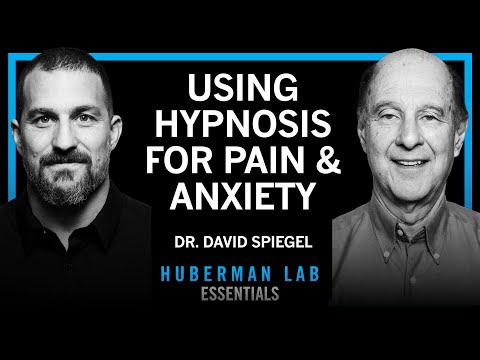
Essentials: Using Hypnosis to Enhance Mental & Physical Health & Performance | Dr. David Spiegel
~43 min
Episode Brief·YouTube

Essentials: Using Hypnosis to Enhance Mental & Physical Health & Performance | Dr. David Spiegel

Andrew Huberman
Watch on YouTube Add to chat My bookmarks← All sources

TL;DR

The four things you'd lose by not watching

4 items

TL;DR

The four things you'd lose by not watching

4 items
1

Hypnosis is a state of highly focused attention, akin to being deeply absorbed in a movie, and is distinct from stage hypnosis.

2

Brain imaging reveals that hypnosis involves decreased activity in the dorsal anterior cingulate cortex (DACC) for reduced distraction, increased connectivity between the dorsolateral prefrontal cortex (DLPFC) and insula for mind-body control, and inverse connectivity between DLPFC and posterior cingulate cortex (PCC) for cognitive flexibility and dissociation.

3

Hypnosis is effective for stress reduction, sleep improvement, phobias, and pain management, by allowing individuals to dissociate physical reactions from psychological ones and reframe traumatic memories.

4

The Revery app offers self-hypnosis exercises for various issues, and individuals can find licensed, trained hypnotists through organizations like the Society for Clinical and Experimental Hypnosis or the American Society for Clinical Hypnosis.

Protocols

Concrete recipes — what, when, how much, and why

4 items

Hypnosis for Stress Reduction (Floating Technique)

WhatImagine your body floating in a safe, comfortable place (like a bath or lake) while picturing the stressor on an imaginary screen, with the rule that your body remains comfortable regardless of what you see.
WhenWhen experiencing stress or anxiety.
For whomIndividuals experiencing stress or anxiety.
WhyThis technique dissociates the somatic (physical) reaction from the psychological reaction to stress, helping individuals feel more in control of their physical response, which then allows them to think through or visualize solutions to the stressor.

The expert explains that stress often creates a negative feedback loop: physical symptoms (like tension, sweating, increased heart rate) are perceived as bad, leading to more psychological distress. The 'floating technique' aims to break this cycle. By consciously separating the physical body's comfort from the mental engagement with the stressor, individuals learn to manage their physiological responses. This initial step of controlling one aspect (the body's comfort) empowers them to then address the stressor itself more effectively, fostering a sense of agency and reducing the overwhelming nature of the problem.

Mechanism

By dissociating the physical sensation from the emotional interpretation, it interrupts the negative feedback loop where physical stress symptoms exacerbate psychological distress. It leverages the mind-body connection to regain a sense of control.

So, we teach people to imagine their body floating somewhere safe and comfortable like a bath, a lake, a hot tub, or floating in space and then picture the problem that they're that's stressing them on an imaginary screen with the rule that no matter what you see on the screen, you keep your body comfortable.

Also said
“Hypnosis can be very helpful in dissociating somatic reaction from psychological reaction.”— Highlights the core principle of the technique.
“At least there's one thing I can manage. And then you can use it to think through or visualize through one thing you might do about that stressor.”— Explains the progression from physical control to problem-solving.

Hypnosis for Pain Management

WhatCategorize pain signals to understand their meaning (e.g., injury vs. healing) and modify the processing of pain based on this understanding, rather than treating all pain as a novel, urgent threat.
WhenWhen experiencing chronic or acute pain.
For whomIndividuals experiencing pain, particularly chronic pain.
WhyThe brain often treats all pain signals as novel threats, leading to heightened anxiety and suffering. By reframing the meaning of pain, individuals can gain more control over their experience and reduce distress.
CaveatsThis is not a substitute for medical diagnosis or treatment for serious conditions like a heart attack or broken bone, where immediate medical attention is necessary.

The expert explains that our brains are often programmed to react to all pain as if it's a new, urgent problem requiring immediate attention. This can be maladaptive for chronic pain or pain associated with healing. Hypnosis helps individuals differentiate between pain that signifies ongoing damage (which needs attention) and pain that is a part of a healing process. By consciously re-evaluating the pain's meaning, individuals can shift their emotional and physiological response, moving from a state of alarm to one of acceptance or even active management. This cognitive reframing allows for a more adaptive response to pain, enhancing control over one's internal state.

Mechanism

This approach leverages the brain's ability to interpret and modulate sensory input. By consciously assigning a different meaning to pain (e.g., 'this is healing' instead of 'this is dangerous'), the brain's emotional and physiological response to the pain signal can be altered, reducing perceived intensity and suffering.

I teach people to to to think of the pain and categorize it. See, is it does it does the pain mean that if you put weight on this, you're going to reinjure your ankle, for example, or does it simply mean that your body is healing and the pain is a sign that gradually things are getting back to normal?

Also said
“Our brain is sort programmed to treat all pain signals as if they were novel pain signals if it's a sudden new problem that needs to be attended to.”— Explains the default brain response to pain that this protocol aims to modify.
“And so you can modify the way you process pain based on what your brain tells you the pain means.”— Highlights the core principle of cognitive reframing in pain management.

Self-Hypnosis for Children (Distraction Technique)

WhatTeach children to imagine being in a favorite place (e.g., Disneyland, visiting a friend) while undergoing uncomfortable medical procedures, effectively dissociating their mind from their body's immediate experience.
WhenBefore and during uncomfortable medical procedures.
For whomChildren undergoing medical procedures, especially those that are lengthy or uncomfortable.
WhyChildren can be highly hypnotizable and can use this ability to reduce anxiety and pain during medical procedures, making the experience less traumatic and procedures easier for clinicians.
CaveatsRequires structure and guidance, often from a parent or clinician.

The expert describes a randomized trial where children undergoing voiding cystourethrograms (a potentially distressing procedure) were taught self-hypnosis. The children were instructed to 'play a trick on their doctors' by imagining their body was present but their mind was somewhere else, like Disneyland. This method significantly reduced their anxiety and pain, leading to procedures that were 17 minutes shorter on average. This demonstrates that while children might need more external structure than adults for self-hypnosis, their high hypnotizability makes them excellent candidates for using these techniques to manage difficult experiences.

Mechanism

This technique leverages the child's natural capacity for imaginative play and dissociation. By focusing their attention intensely on an imagined, pleasant scenario, their perception of pain and anxiety from the actual procedure is significantly reduced, as their conscious awareness is directed elsewhere.

Personal experience

The expert mentions a randomized trial he conducted, published in Pediatrics, demonstrating the effectiveness of this technique for children undergoing medical procedures.

We find out from the kids where they like to be and I'd say, 'You're going to play a trick on your doctors. Your body's there. You're somewhere else. Go visit your friend. Go to Disneyland. Do something else.'

Also said
“We found that these children were much easier to image 17 minutes shorter procedures. And that's a long 17 minutes for for a little kid.”— Provides concrete evidence of the protocol's effectiveness and impact.
“Children can be very hypnotizable and um I I know pediatricians who use it wonderfully all the time. They get them to focus on something else.”— Emphasizes the suitability of hypnosis for children.

Breathing for Hypnotic Induction

WhatTake a deep breath and then slowly exhale as part of a hypnotic induction.
WhenDuring the initial phase of hypnotic induction.
For whomAnyone undergoing hypnotic induction.
WhySlow exhalation, particularly in a cyclic sighing pattern, is believed to induce parasympathetic activity, promoting relaxation and signaling the brain to enter a more receptive state.

The expert highlights breathing as a unique bridge between conscious and unconscious control. While breathing is automatic, we can consciously regulate it, making it a powerful tool for modulating internal states. Incorporating a deep breath followed by a slow exhale into hypnotic induction is a deliberate way to leverage this mind-body connection. The slow exhale, similar to a cyclic sigh, is thought to induce a parasympathetic response, signaling relaxation to the brain and body. This conscious control over an automatic function serves as a demonstration of one's ability to influence internal states, which is a core principle of hypnosis.

Mechanism

Breathing patterns, especially those with longer exhalations, can increase pressure in the chest, which facilitates blood return to the heart and can slow heart rate, thereby activating the parasympathetic nervous system. This physiological shift promotes relaxation and helps transition the brain into a state conducive to hypnosis.

Personal experience

The expert states, "I do use it. I ask people to take a deep breath as part of the induction and then slowly exhale. And partly as a result of our research together, I'm emphasizing the slow exhale more as part of an some to enhance the idea in the induction that this is a period of relaxation."

I do use it. I ask people to take a deep breath as part of the induction and then slowly exhale.

Also said
“There are breathing patterns that may increase sympathetic arousal um or may decrease it may how we neocylic sighing seems to actually where you have more time spent exhaling than inhaling seem and there's reason to believe that it induces parasympathetic activity because you're increasing pressure in the chest and uh therefore um allowing the heart to slow down because blood is being returned to the atrium u more easily.”— Explains the physiological mechanism behind slow exhalation and its link to relaxation.
“Breathing is very interesting because it's right at the edge of conscious and unconscious control that it will go on automatically but we can control it and so it's a kind of way for us to demonstrate to ourselves uh it greater ways of an of modulating our internal state.”— Emphasizes breathing's unique role as a bridge between conscious and unconscious control.

What's new

Personal practice updates, fresh positions, predictions

4 items

Hypnosis as a state of focused attention

0:01:30

Hypnosis is defined as a state of highly focused attention, similar to being completely absorbed in an experience like watching a movie, where one is part of the imagined world rather than an observer.

Why this matters: This definition reframes hypnosis from a mystical or stage-show concept to a more relatable, everyday experience of deep engagement and altered perception.

Background

The common perception of hypnosis is often linked to stage hypnosis, which involves making people act foolishly and implies a loss of control. This expert aims to clarify the clinical understanding.

The expert distinguishes clinical hypnosis from stage hypnosis, emphasizing that the latter misrepresents the true nature of hypnosis by making people feel they are losing control. In reality, self-hypnosis is about enhancing control over one's mind and body. This state provides cognitive flexibility, allowing individuals to suspend critical judgment and view situations from a new perspective, which is therapeutically beneficial. However, this very ability to suspend judgment, if misused, can also be dangerous, highlighting the importance of proper application.

Hypnosis is a state of highly focused attention. Uh it's something like looking through the telephoto lens of a camera in consciousness. What you see, you see with great detail, but devoid of context.

Also said
“If you've had the experience of getting so caught up in a good movie that you forget you're watching a movie and enter the imagined world. You're part of the movie, not part of the audience. You're experiencing it. You're not evaluating it. That's a hypnotic-like experience that many people have in their everyday lives.”— Illustrates the concept with a common, relatable example.
“Self-hypnosis is a way of enhancing your control over your mind and your body.”— Directly contrasts with the common misconception of losing control during hypnosis.

Brain activity during hypnosis

0:04:40

During hypnosis, specific brain regions show altered activity: decreased activity in the dorsal anterior cingulate cortex (DACC) reduces distraction, increased functional connectivity between the dorsolateral prefrontal cortex (DLPFC) and insula enhances mind-body control, and inverse functional connectivity between DLPFC and posterior cingulate cortex (PCC) promotes cognitive flexibility and dissociation.

Why this matters: This provides a neurobiological basis for the subjective experience and therapeutic effects of hypnosis, moving it beyond anecdotal claims.

Background

Historically, the mechanisms of hypnosis were poorly understood, often attributed to psychological suggestion without clear neural correlates.

The expert details three key brain changes during hypnosis. First, activity in the dorsal anterior cingulate cortex (DACC), a 'conflict detector' in the salience network, decreases. This reduction makes individuals less susceptible to distractions, allowing for deeper focus. Second, there's increased functional connectivity between the dorsolateral prefrontal cortex (DLPFC) and the insula. The insula is crucial for mind-body control and pain processing, and this enhanced connection allows for greater conscious regulation of bodily functions, as demonstrated by studies showing hypnotic control over gastric acid secretion. Third, an inverse functional connectivity occurs between the DLPFC and the posterior cingulate cortex (PCC), a part of the default mode network. This inverse relationship is associated with dissociation, where individuals can put things outside conscious awareness and reduce self-referential thinking, fostering cognitive flexibility and openness to new experiences without self-judgment.

The first is turning down activity in the dorsal anterior singulate cortex. So the DACC is in the central front middle part of the brain as you you well know and it's it's part of what we call the salance network. Uh it's a conflict detector.

Also said
“Two other things happen when people are hypnotized. One is that that DLPFC has higher functional connectivity with the insula, another part of the salance network. It's a part of the mind body control system sensitive to what's happening in the body.”— Explains the second key brain change and its role in mind-body control.
“The third thing that happens is you have inverse functional connectivity between the DLPFC and the posterior singulate cortex. The posterior singulate uh is part of the default mode network. It's in the back of the brain. Um, and it's it's an an area whose activity goes down, for example, in meditators.”— Describes the third brain change, linking it to dissociation and cognitive flexibility.

Hypnosis for trauma and phobias

0:12:00

Hypnosis helps treat trauma and phobias by enabling individuals to confront and reframe distressing memories in a controlled mental state, allowing for a restructuring of understanding and a reduction in negative associations.

Why this matters: This highlights hypnosis as a rapid and effective method for reprocessing traumatic experiences, often more efficiently than traditional talk therapy.

Background

Traditional approaches to trauma often involve prolonged exposure therapy, which can be difficult and slow. Hypnosis offers a way to accelerate this process by leveraging altered mental states.

The expert explains that hypnosis facilitates a process akin to 'unstatic desensitization' by changing mental states. This allows individuals to revisit traumatic memories or phobic situations from a different perspective, without the overwhelming emotional and somatic responses typically associated with them. By creating a safe mental space, individuals can confront the trauma, re-evaluate their role or response, and build new, less negative associations. This is particularly effective because trauma often induces dissociative states, and hypnosis can create a congruent mental state that aids in memory reprocessing. The goal is to regain a sense of control over the narrative and the emotional response, turning a passive experience of suffering into an active process of understanding and resilience.

Personal experience

The expert recounts a case of a woman who suffered an attempted rape. Using hypnosis, he guided her to visualize the event while feeling safe. She realized the attacker intended to kill her, which was initially more frightening, but also recognized her own fierce fight for survival, which she hadn't consciously acknowledged. This reframing helped her restructure her understanding of the trauma, making it more tolerable and empowering.

In a way, the principle, Andrew, is like you need to reconfront a traumatic situation before you can modulate your associations to it and then figure out how you can approach that problem or how you did approach that problem from a different point of view.

Also said
“And with hypnosis, if you can start people able to manage their anxiety enough that they can have more a wider array of experiences, they start to have a network of associations that isn't so negative and may even be positive.”— Explains how hypnosis helps build new, positive associations to overcome phobias.
“And so that is part of the dissociation that occurs with hypnosis. So it's how you put things outside of conscious awareness and don't worry about what it means. It also adds to cognitive flexibility.”— Connects dissociation in hypnosis to cognitive flexibility, crucial for reframing trauma.
“There is one randomized trial out of Israel that shows that adding hypnosis to PTSD treatment actually improves outcome.”— Provides evidence for the efficacy of hypnosis in trauma treatment.

Hypnotizability and the Spiegel Eye-Roll Test

0:22:00

Hypnotizability is an individual's capacity to experience hypnosis, with about two-thirds of adults being hypnotizable and 15% highly so. The Spiegel Eye-Roll Test, developed by the expert's father, assesses this by observing eye movement during eyelid closure while looking upwards; more sclera (white part) visible indicates higher hypnotizability.

Why this matters: This provides a quantifiable and observable measure for a subjective experience, offering a practical tool for clinicians.

Background

The concept of hypnotizability has long been recognized, but objective, quick assessment methods were less common or standardized.

Hypnotizability is a measurable trait, not a sign of weakness or gullibility. The expert notes that roughly one-third of adults are not hypnotizable, while 15% are highly hypnotizable. The Hypnotic Induction Profile (HIP) is a structured test used to measure this capacity, assigning a score from 0 to 10. The 'eye-roll' test, a component of this, involves looking upwards while closing the eyelids. If the eyes roll back significantly, revealing more of the sclera (white part), it suggests higher hypnotizability. Conversely, if the eyes move downwards, showing more of the iris (colored part), it indicates lower hypnotizability. This test is thought to work because keeping eyes up while closing them is an unusual state, signaling the brain to turn inward and maintain resting alertness, rather than falling asleep, which is the typical response to closing eyes.

Personal experience

The expert mentions his father, who used an eye-fixation induction, saying 'look up at the ceiling,' which formed the basis for the eye-roll test.

Hypnotizability is just a a capacity to have hypnotic experiences. And we have a test called the hypnotic induction profile where we give a highly structured hypnotic experience.

Also said
“About a third of adults are just not hypnotizable. Twothirds are about 15% are extremely hypnotizable. And we can measure that and give it a number from 0 to 10.”— Quantifies the distribution of hypnotizability in the population.
“You're asking the brain to do something difficult to to keep the eyes up while closing the eyelid. And eye movements have a lot to do with levels of consciousness.”— Explains the physiological rationale behind the eye-roll test.

Recommendations

Products, supplements, and tools mentioned in the episode

3 items

Licensed and Trained Hypnotists

Service

For those seeking clinical hypnosis, it's recommended to find professionals who are licensed and trained in their primary professional discipline (e.g., psychiatry, psychology, medicine, dentistry) and also have specific training and interest in using hypnosis.

The expert stresses the importance of seeking out qualified professionals for clinical hypnosis. This ensures that the hypnotist can properly assess the individual's problem, rule out underlying medical conditions that might be masked by hypnotic pain reduction, and provide appropriate guidance. While self-hypnosis is valuable, starting with a trained clinician allows for a safe and effective introduction, including an assessment of hypnotizability and personalized instruction on how to apply self-hypnosis techniques. The goal is often to teach individuals to use self-hypnosis independently after initial sessions.

vs alternatives

Contrasts with self-help apps or untrained practitioners, emphasizing the safety and efficacy benefits of professional guidance.

Personal experience

The expert states, "Most people start by coming to see a clinician like me. It's better to see someone who's l has licensing and training in their professional discipline, somebody who can really assess what your problem is and make sure that you're not talking someone into reducing their chest pain rather than getting their coronary artery problem."

It's better to see someone who's l has licensing and training in their professional discipline, somebody who can really assess what your problem is and make sure that you're not talking someone into reducing their chest pain rather than getting their coronary artery problem.

Also said
“And typically when I use it with people, I often only see them once or twice or periodically, but not every week and certainly not every day if they have a pain problem. And hypnosis is very helpful for pain.”— Illustrates the typical clinical approach of teaching self-hypnosis rather than continuous sessions.
“I give them a standard brief test of their ability to experience hypnosis and then going through a self-hypnosis exercise with them to deal with the problem, seeing how they respond to it, and then teaching them how to do it for themselves.”— Describes the process of working with a clinician to learn self-hypnosis.
Find Licensed

Society for Clinical and Experimental Hypnosis (SCEH)

Service

A professional organization that provides referral services for finding well-trained hypnotists.

There are two good professional organizations uh that will help you with that. One is the Society for Clinical and Experimental Hypnosis and I think that's us

Find Society

American Society for Clinical Hypnosis (ASCH)

Service

A professional organization that provides referral services for finding well-trained hypnotists.

and the American Society for Clinical Hypnosis and they both provide referral services for professionals in general.

Find American
Disclosed sponsorships1speaker disclosed

Revery App

Service Sponsored · disclosed

A mobile application designed to teach and guide individuals through self-hypnosis exercises for various issues like pain, stress, focus, insomnia, eating habits, and smoking cessation.

DisclosureThe expert, Dr. David Spiegel, is involved in the development of the Revery app.

The Revery app offers both longer (15-minute) and shorter (1-2 minute) self-hypnosis exercises. The expert notes that even the brief 1-2 minute refreshers are reported by two-thirds of users to make them feel better. This app serves as a practical tool for individuals to learn and practice self-hypnosis independently, making the benefits of clinical hypnosis more accessible. It's designed to provide immediate feedback on whether hypnosis is effective for a user, allowing them to quickly integrate it into their routine if it helps.

vs alternatives

Offers a scalable, accessible alternative to one-on-one clinical sessions, though initial guidance from a clinician is still recommended for assessment and personalized instruction.

Personal experience

Andrew Huberman mentions using the Revery app for sleep, finding it incredibly useful.

Now, we've developed an app uh Revery that that uh can teach people and step them through dealing with pain, stress, uh focus, uh in insomnia and help people eat better and and stop smoking.

Also said
“And we're finding that twothirds of the people find it even just the one minute refresher uh helps them feel better. They're reporting they feel better.”— Highlights the effectiveness of even short sessions on the app.
“The nice thing is you will know very quickly whether it's likely to help you or not. And if it is, you can learn to do it for yourself.”— Emphasizes the app's utility in self-assessment and independent practice.
Find Revery

Notable quotes

Lines worth pulling out — contrarian, specific, or perfectly phrased

5 items
You're gaining control. Self-hypnosis is a way of enhancing your control over your mind and your body.
This directly counters the common misconception that hypnosis involves losing control, reframing it as an empowering tool.
The brain has this amazing ability to control what's going on in the body in ways that we don't think we have ability to control.
Highlights the profound, often underestimated, capacity of the mind to influence physiological processes, a core theme of the discussion.
Just changing mental state itself has therapeutic potential and I think we underestimate our ability to regulate and and change responses to be cognitively, emotionally and somatically flexible.
Emphasizes the inherent therapeutic power of altering one's mental state, suggesting a broader application beyond formal hypnosis.
Hypnosis, which has this terrible reputation of taking away control, is actually a superb way of enhancing your control over mind and body.
A powerful reiteration of the central argument, directly challenging the negative public perception of hypnosis.
It's a matter not of you know absolute control but more control that that um we need to think of our brain as a tool and and our body signals as tools as well to help us understand um what's going on in the world, what we need, what matters, what's important, what isn't.
Offers a nuanced perspective on control, framing the brain and body as tools for understanding and management rather than absolute mastery.

Sign in to share feedback

Tell us if this brief hit the mark or missed it — feedback feeds back into the next iteration of the prompt.

Topics covered

hypnosis definitionfocused attentionstage hypnosis vs clinical hypnosisbrain areas in hypnosisdorsal anterior cingulate cortex (dacc)salience networkmind-body controlgastric acid secretiondlpfc-insula connectivityposterior cingulate cortex (pcc)default mode networkdissociationcognitive flexibilityadhd and hypnosisstress reductionmind-body interactionsleep improvementrevery applong-term potentiationphobias
Free account

Make this library yours

Reading is free for everyone. A free account adds the personal layer: save protocols, follow experts, and see how the other experts weigh in on this same topic.

Create a free accountSign in

Where the experts disagree — weekly

One email a week: the sharpest new disagreements and protocols from the library. No spam, unsubscribe anytime.

Educational summary of the cited expert source — not medical advice. Open the source recording linked above and consult a qualified physician before acting on any protocol.