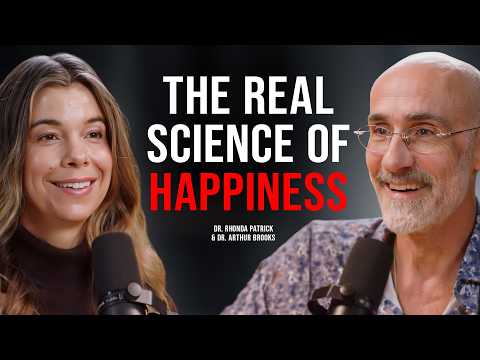
Happiness is composed of three macronutrients: enjoyment, satisfaction, and meaning. Understanding and balancing these is key to a happier life.
2
Avoid the 'four idols' of money, power, pleasure, and fame, as they lead to diminishing returns and regret. Identify your primary idol to guard against its pitfalls.
3
Cultivate gratitude through practices like a weekly 'gratitude list' and manage negative emotions by understanding your emotional baseline and engaging in healthy coping mechanisms like exercise and spiritual practices.
4
Combat the 'meaning crisis' by engaging both hemispheres of the brain, asking big 'why' questions, fostering deep relationships, seeking beauty, and embracing suffering productively.
Protocols
Concrete recipes — what, when, how much, and why
5 items
Gratitude List
WhatWrite down five things you are most grateful for every Sunday afternoon.
WhenEvery Sunday afternoon.
DoseFive items on the list; focus on each for a couple of minutes before bed each day; update the list every Sunday.
For whomAnyone, especially those who find themselves constantly focusing on what they lack.
WhyThis practice overrides the natural human tendency towards ingratitude, which is biologically wired for striving but leads to misery. Consciously focusing on blessings can significantly increase happiness.
CaveatsThe items on the list don't have to be profound; even 'stupid' things like a sports team's success are valid. The key is consistency and conscious effort.
The speaker explains that humans are biologically wired for ingratitude and resentment, which historically drove species advancement but now often leads to misery. This is evident in the brain's limbic system having more tissue devoted to negative emotions than positive ones. To counteract this natural tendency, a deliberate practice of gratitude is necessary. The protocol involves writing down five things one is grateful for each Sunday, then reflecting on each of these items for a few minutes before bed throughout the week, and updating the list weekly. This consistent practice, though unnatural, has been shown to increase happiness by an average of 12% after 10 weeks, by consciously overriding the brain's default negative programming.
Mechanism
By consciously engaging the prefrontal cortex to focus on gratitude, it helps to manage the limbic system's natural negative biases. This practice is a form of 'moral aspiration' that counteracts 'animal impulses' of resentment and ungratefulness. Studies show a measurable increase in happiness over time.
Personal experience
The speaker admits to his own struggles with ingratitude, citing an example of complaining about first-class airline service, despite teaching about gratitude. He uses the Seahawks' success as an example of a 'stupid' but valid item on his own gratitude list. The host also shares her personal gratitude for health, family, and love, acknowledging she doesn't think about it enough.
The way I ask my students to do it is to override their tendencies by writing a list of the five things you're most grateful for. Sunday afternoon.
Also said
“On average, the average person after 10 weeks will be 12% happier. It's just overriding your tendencies.”— Provides a quantitative measure of the effectiveness of the practice.
“We are made to be resentful, ungrateful, suspicious, hostile creatures. That, you know, there's literally more space in the brain, more tissue develop devoted in the limbic system to negative emotions than to positive emotions.”— Explains the biological basis for the need for gratitude practices.
Morning Protocol for Managing Negative Affect
WhatA five-part routine designed to lower negative affect and increase productivity and creativity, starting before dawn.
WhenDaily, starting before dawn (Brahma Muhurta, ~1 hour 36 minutes before sunrise).
DoseWorkout (4:45-5:45 AM), spiritual practice (6:30-7:00 AM), creatine (10g), delayed caffeine (350mg after 2.5 hours awake), high-protein breakfast (60g).
For whomIndividuals with high negative affect, especially 'mad scientists' or 'gym rats' who need to manage their mood and optimize productivity.
WhyThis structured morning routine leverages neurochemical and biological principles to proactively manage high negative affect, which is common in high-achievers, and optimize brain function for the day.
CaveatsThe specific timing of Brahma Muhurta is arbitrary from a scientific view, but the principle of waking before dawn and engaging in conscious activities is supported. Caffeine timing is contested but works for the speaker.
The speaker, identifying as a 'mad scientist' with high negative affect, developed a rigorous morning protocol to manage his mood and optimize his day. This routine begins 1 hour and 36 minutes before dawn, a time known in Vedic traditions as Brahma Muhurta, which he notes has scientific backing for increased productivity and creativity. His physical fitness component involves an hour of exercise (zone 2 cardio and resistance training) to manage negative affect and maintain long-term health. The metaphysical fitness involves daily spiritual practice (Mass for him, but can be meditation or philosophy for others) to foster transcendence. He then takes 10g of creatine monohydrate for brain benefits. Crucially, he delays his 350mg caffeine intake until 2.5 hours after waking, after adenosine has cleared, to avoid afternoon crashes. Finally, he consumes a high-protein breakfast (60g, often Greek yogurt for tryptophan) to sustain energy and mood. This comprehensive approach allows him to achieve 3.5 hours of concentrated creative work without being 'unbearable to live with.'
Mechanism
The routine aims to manage negative affect from the start of the day. Exercise (zone 2 cardio, resistance training) is a primary way to lower negative affect. Spiritual practice (transcendence) provides focus beyond oneself. Delayed caffeine intake (after adenosine clearance) prevents afternoon crashes. High-protein breakfast (e.g., Greek yogurt with tryptophan) provides sustained energy and mood stability. This holistic approach sets up the brain for concentrated creative work.
Personal experience
The speaker details his personal routine: waking early, working out from 4:45-5:45 AM, attending Mass from 6:30-7:00 AM, taking creatine, delaying caffeine, and eating a high-protein breakfast. He notes that this allows him to write for 3.5 hours and manage his negative affect. The host also identifies with high negative affect and works out first thing in the morning for her brain and mood.
I get up real early. And there's a lot of research on how the brain works. There's an ancient Vedic um science literature on on something called the Brahma Muhurta.
Also said
“I usually work out from 4:45 to 5:45 every morning. And I'm I'm a 7-day-a-week guy...”— Illustrates the consistency and intensity of his physical routine.
“I go to mass every day cuz I'm a Catholic. It's the most important thing in my life. Now, I also work I've studied Vipassana meditation and Stoic philosophy. Everybody's got to find their thing, something that they actually practice, which is a a form of transcendence.”— Emphasizes the spiritual component and its adaptability to individual beliefs.
“I'll drink 350 mg of caffeine. And I'll get that in the in a bolus right after I get back and before I eat anything. But that's two and 1/2 hours after I've gotten up at this point because of all that stuff about adenosine clearing and etc. etc.”— Details the specific timing and dose of caffeine and its rationale.
Managing Digital Device Use
WhatImplement specific boundaries and practices to reduce screen time and prevent technology from hijacking brain function and meaning-seeking.
WhenDaily, and periodically.
DoseNo phone in the first hour of the day, no phone in the last hour of the day, no phone during meals. Designate phone-free zones (classroom, bedroom). Conduct 3-5 day 'tech fasts' annually. Limit social media to 30 minutes a day in one or two focused sessions.
For whomEveryone, especially young people who grew up with constant digital exposure and those struggling with meaning or addiction to devices.
WhyExcessive screen time and constant digital distraction over-stimulate the left brain, prevent boredom (which is crucial for meaning), and hinder the brain's ability to process deeper questions of life and foster genuine human connection.
CaveatsThis doesn't mean abandoning technology entirely, but rather using it with discipline and intention. It's about managing devices, not being managed by them.
The speaker highlights that constant digital engagement, particularly with smartphones and social media, is 'literally changing our brain' and preventing us from ascertaining the meaning of our lives. This is because these devices are designed to stimulate dopamine pathways, creating a cycle of seeking rewards (notifications) and avoiding boredom. This constant distraction prevents the brain's default mode network, crucial for meaning-making, from activating. The recommended protocols are designed to re-establish control over device use and allow the brain to engage in deeper thought and connection. These include strict time boundaries (first/last hour of day, meals), designated phone-free zones (bedroom, classroom), and periodic 'tech fasts' to reset habits. Additionally, curating social media for learning and laughter, rather than comparison, and limiting consumption to focused sessions, helps to make digital interaction more life-affirming.
Mechanism
By creating boundaries, individuals can prevent the constant dopamine hits from notifications and the distraction from deeper thought. Limiting screen time allows the default mode network to activate, fostering self-reflection and meaning-making. Phone-free zones, especially the bedroom, improve sleep and intimate connection. Tech fasts reset the brain's relationship with devices. Changing screen to black and white can alter neurochemistry related to engagement.
Personal experience
The speaker mentions his own training to use his phone as an alarm without looking at it, indicating a disciplined approach. He also notes that his children, despite growing up with technology, are 'old-fashioned' and live intentionally, suggesting that early modeling and discipline can lead to healthier tech habits.
The best way to do it is no phone in the first hour of the day, no phone in the last hour of the day, and no phone during meals.
Also said
“There's a bunch of different reasons that that we get addicted devices and and misuse our devices. And that's a lot of what I'm writing about in this new book is actually how it changes our brain. It literally changes the way that we use our brain in such a way that we can't actually ascertain the meaning of our lives.”— Explains the profound impact of device misuse on brain function and meaning.
“Boredom is unbelievably important for the human brain. We're We're made to be bored. When When we become bored, in other words, when we put people into the fMRI and you say, 'Think about nothing.' You can't do it. You immediately your mind just starts wandering and the default mode network of the brain becomes active, which is important for you to understand the third macronutrient we'll talk about in a minute, which is meaning.”— Connects boredom avoidance to the inability to find meaning.
Rekindling Relationships (for Men)
WhatProactively reach out to old friends, especially college buddies, to rekindle friendships and combat loneliness.
WhenAs needed, particularly for men in midlife and older.
DoseSet aside dedicated time for connection, cold-call friends, text frequently, schedule meetups without a specific agenda.
For whomMen, particularly those in their 60s and older, or anyone who has let friendships lapse due to career or family focus.
WhyMen tend to atrophy their friendships as they age, often relying solely on their spouse for deep connection. This leads to profound loneliness, especially in widowhood. Rekindling old friendships provides crucial social support and prevents isolation.
CaveatsIt may feel awkward initially, but often the other person is also seeking connection. The key is taking the initiative.
The speaker notes that men, unlike women, tend to get worse at friendship as they age, often losing touch with friends after college or sports teams. This leads to a situation where many older men's 'best friend' is their wife, placing an undue burden on the spouse and leaving men profoundly alone if their wife passes away. He shares his personal experience of realizing his own friendships had atrophied during his demanding career and his deliberate effort to rekindle them. He advises 'cold-calling' old friends and dedicating time to these relationships, emphasizing that while it might feel awkward, the relief and mutual desire for connection are often present. He cites the 'men's sheds movement' in Great Britain as a somewhat dystopian but effective example of addressing male loneliness through structured social engagement.
Mechanism
Human connection, especially deep, non-transactional friendships, is a fundamental component of happiness and well-being. Rekindling these relationships provides emotional support, a sense of belonging, and combats the negative health impacts of loneliness. It also balances the over-reliance on a spouse for all social needs.
Personal experience
The speaker shares his personal journey of realizing his friendships had atrophied during his CEO years and his subsequent effort to rekindle them. He now dedicates time to making new connections and nurturing old ones, even cold-calling friends and scheduling meetups 'for no reason.'
Kind of and it sort of works with dudes. They're like, man, I've been thinking about you, too. That's great. It's like, you know, what are you up to these days? And just basically rekindle the friendship which is it sounds like it's weird and awkward, but it it kind of isn't as a matter of fact.
Also said
“60% of 60-year-old men, their best friend is their wife. Whereas 30% of their wives, their best friend is their husband. Which is this heartbreaking statistic of unrequited friendship in its way.”— Highlights the stark difference in friendship patterns between men and women and the resulting loneliness for men.
“I've I've helped groups of guys in their 60s start hanging out again with their college buddies. And it's such a relief for all of them, but somebody actually needs to take the initiative and inevitably they were all lonely.”— Provides evidence of the success and need for this protocol.
Four Pillars for a Strong Marriage
WhatImplement four key practices to strengthen and maintain a romantic relationship, especially as it cools over time.
WhenContinuously throughout the marriage.
DoseDaily eye contact, constant physical touch, regular fun activities, and joint spiritual/metaphysical practice.
For whomMarried couples, especially those experiencing a cooling in their relationship or seeking to maintain strong bonds.
WhyMarriages often cool due to 'torpor' and drifting apart. These practices are designed to re-fuse the right hemispheres of the brain, fostering deeper emotional and spiritual connection.
CaveatsThese practices require intentional effort, especially joint prayer/meditation, which can feel very intimate and awkward initially.
The speaker identifies 'cooling' as a major threat to marriages, leading to torpor and drifting apart. He proposes four practices to counteract this by re-fusing the right hemispheres of the brain, which are crucial for deep emotional and spiritual connection. First, eye contact is vital, particularly for women, as it significantly boosts oxytocin, the bonding hormone. Second, constant physical touch ('Always Be Touching') is more important for men, increasing oxytocin and vasopressin, fostering a sense of connection and strength. Third, having more fun together helps to 'cover a multitude of sins' by creating positive emotional experiences that reduce the significance of grievances. Finally, joint spiritual or metaphysical practice, such as prayer, meditation, or reading poetry to each other, is profoundly powerful. This shared experience, even if initially awkward due to its intimacy, fosters a deep, non-verbal connection that transcends analytical thought and strengthens the bond.
Mechanism
Eye contact (especially for women) boosts oxytocin, the bonding hormone. Physical touch (especially for men) increases oxytocin and vasopressin (associated with defense/strength). Shared fun activities create positive emotionality that can 'drown out' negative grievances. Joint spiritual or metaphysical practices (prayer, meditation, reading poetry) fuse the right hemispheres, fostering deep, non-verbal connection and shared meaning.
Personal experience
The speaker shares that his wife reminds him when he's 'doing that thing' (chasing honor), indicating accountability. He also mentions his wife is from Spain, implying a cultural difference that adds to the 'beauty' of their relationship. He notes that his wife reminds him of his own idol, honor, and helps him stay grounded. He also mentions that he and his wife attend Mass together daily when at home.
There's sort of like four things that you see in the literature that really, really, really work. And what it does is it fuses your right hemispheres again, refuses them.
Also said
“Number one is eye contact. And and when you're looking in your husband's eyes, that's actually more important to you than him because women get three times as much oxytocin as men.”— Explains the biological reason for eye contact's importance, especially for women.
“Two is always be touching. Touch touch touch touch. That's actually more important for men. More touch. More touch. More touch.”— Emphasizes the importance of physical touch, particularly for men.
“Number three is fun. Now, a lot of couples when they're cooling, they're they're they kind of just rehearse grievances again and again and again. And and if they go to couples therapy, a lot of that is like, okay, well, he said this thing and she did this and etc. etc. You can cover a multitude of sins, actually make them go away by reducing the significance of the problems by covering them in happiness, right?”— Highlights the role of shared positive experiences in mitigating conflict.
“Number four is praying together and this gets back to what you're talking about. Praying together for people who are really, really, really not religious, meditating together or reading actually to each other actually does much the same thing.”— Offers adaptable options for joint spiritual/metaphysical practice.
What's new
Personal practice updates, fresh positions, predictions
6 items
The 'Meaning Crisis' in Young Adults
0:30:00
The number one predictor of clinical depression and generalized anxiety in adults under 30 today is a feeling of meaninglessness, emptiness, or living in a simulation.
Why this matters: This highlights a significant and specific mental health challenge for a particular demographic, linking it directly to a lack of perceived meaning rather than just general unhappiness.
Background
Historically, people might have struggled with enjoyment or satisfaction, but the current generation, particularly those who grew up entirely online, are experiencing a profound lack of meaning.
The speaker posits that the modern, technologized world, especially for those under 30 who don't remember a time before pervasive digital technology, fosters an over-reliance on the left hemisphere of the brain. This left-brain dominance focuses on technical problems and 'how-to' questions that AI can answer, neglecting the right-brain functions of asking 'why' questions related to coherence, purpose, and significance. This imbalance leads to a life bereft of meaning, as individuals are not engaging the parts of their brain designed to seek and understand deeper existential questions. The constant distraction and lack of boredom further exacerbate this, preventing the mind from wandering into the default mode network, which is crucial for processing meaning.
The number one predictor of clinical depression and generalized anxiety today is saying my life feels meaningless.
Also said
“If you're in the matrix all day long, you're sitting on the left side of your brain and you're not even considering questions of meaning and your life is going to be bereft of the things that really matter. That's why you're depressed.”— Explains the mechanism by which excessive online engagement contributes to the meaning crisis.
“If AI can answer your question, it's not a meaning question. It's not a right-brain question. It's a left-brain question.”— Provides a practical test for distinguishing between technical and meaning-related questions.
The 'Striver's Curse'
0:18:00
Highly ambitious and successful individuals often fall victim to the 'striver's curse,' where achieving a goal leads to a temporary dip in satisfaction and a constant pursuit of 'more,' akin to a hedonic treadmill.
Why this matters: This concept explains why achieving significant life goals, even something as monumental as an Olympic medal, can paradoxically lead to unhappiness or depression, challenging the common assumption that success equals lasting happiness.
Background
Humans are wired for progress, and Mother Nature tells us that achieving a goal will bring lasting joy. However, this is a 'lie' from the limbic system, as the satisfaction from achievement is transient.
The striver's curse describes the phenomenon where individuals work tirelessly towards a goal, expecting permanent happiness upon its achievement. However, once the goal is reached, the satisfaction quickly diminishes, leading to a feeling of emptiness or meaninglessness. This is because humans are designed for the process of progress, not the arrival at a static goal. The brain's reward system is geared towards the pursuit, not the possession. This often results in an endless cycle of seeking 'more'—more money, more accolades, more achievements—without ever finding lasting contentment, as the 'goalpost keeps moving.' This constant striving without enduring satisfaction is a significant source of unhappiness for many successful people.
Most Olympic athletes who win a medal have a have a have a clinical depression in the wake of winning an Olympic medal.
Also said
“We're wired for progress. Progress brings tons and tons of of just absolute enjoyment and satisfaction. It's wonderful to make progress. We're designed for progress. And so, we incorrectly assert or or or believe that when we get to the goal toward our progress, the the you know, we get to Hispaniola with the ship, that and then we'll we'll have that ebullience, that joy forever, but that's not how the limbic system is supposed to work. That's a lie.”— Explains the biological basis for the striver's curse and the misconception about lasting satisfaction.
“The goal the goalpost keeps moving, and you get this diminishing satisfaction. That's why you need some metaphysics to solve that to sort that one out.”— Highlights the continuous nature of the problem and hints at the need for deeper solutions.
The Four Idols of Happiness
0:10:00
People often mistakenly pursue four 'idols'—money, power, pleasure, and fame—believing they will bring lasting happiness, but these ultimately lead to regret and dissatisfaction.
Why this matters: This framework, rooted in ancient philosophy but supported by modern behavioral science, provides a clear categorization of common misdirected pursuits of happiness and offers a path to self-awareness.
Background
Drawing from Thomas Aquinas's interpretation of Aristotle, these idols represent earthly distractions from what truly brings fulfillment. Modern science now validates these ancient observations.
The four idols—money (resources), power (influence), pleasure (comfort/security), and fame (admiration/prestige)—are things people intrinsically desire, believing they will lead to happiness. However, these pursuits are ultimately unsatisfying because they are transient and often lead to a 'hedonic treadmill' where more is always needed. The speaker emphasizes that everyone is most beguiled by one of these idols, and identifying one's primary weakness is the first step towards 'pure strength.' By understanding which idol one is most susceptible to, individuals can actively guard against its pitfalls and avoid the regret that inevitably follows its unbridled pursuit. For example, pleasure isn't just about feeling good, but also about comfort and security, which can manifest as checking stock portfolios or avoiding discomfort.
Personal experience
The speaker and host play a game to identify their own primary idols, with the host identifying pleasure and fame as her least important, leaving money and influence as her primary struggles. The speaker identifies honor (fame) as his primary idol, stemming from a childhood where attention was earned through achievement.
Money, power, pleasure, and fame, fundamentally. Everybody is most beguiled by one and when they know what their weakness is, they have pure strength.
Also said
“Pleasure, which we already talked about. And pleasure, by the way, is not just feeling good. It's also comfort, like the comfy covers instead of going to the gym, or security, which is checking your stock portfolio every day. Same thing.”— Expands the definition of 'pleasure' beyond immediate gratification to include comfort and security.
“If you know your weakness, you can actually fight against it, avoid a bunch of errors, and understand what you most regret.”— Highlights the practical benefit of identifying one's primary idol.
The Importance of Boredom
0:23:00
Boredom, though uncomfortable, is crucial for the human brain as it activates the default mode network, which is essential for processing meaning and asking deeper questions about life.
Why this matters: This challenges the modern tendency to constantly avoid boredom through digital distraction, revealing a hidden cost to perpetual stimulation and highlighting boredom's unexpected role in well-being.
Background
Humans are 'made to be bored,' but modern technology provides constant distraction, allowing us to avoid this uncomfortable state. This avoidance, however, prevents important brain functions.
The speaker argues that the pervasive use of smartphones and social media to avoid boredom is detrimental to our mental well-being. When people are forced to 'think about nothing,' their minds naturally wander, activating the default mode network (DMN). This network is critical for self-reflection, understanding one's identity, and processing questions of meaning. By constantly distracting ourselves, we prevent the DMN from engaging, thereby hindering our ability to connect with deeper aspects of our lives and find meaning. The speaker cites Dan Gilbert's Harvard experiments where people chose painful electric shocks over 15 minutes of boredom, illustrating the extreme aversion to boredom and its potential consequences.
Boredom is unbelievably important for the human brain. We're We're made to be bored.
Also said
“When we become bored, in other words, when we put people into the fMRI and you say, 'Think about nothing.' You can't do it. You immediately your mind just starts wandering and the default mode network of the brain becomes active, which is important for you to understand the third macronutrient we'll talk about in a minute, which is meaning.”— Explains the neurological process and its link to meaning.
“Dan Gilbert's experiments at Harvard on boredom, he shows that when people have to sit in a room and do with nothing to do except the option of pushing a button on a key fob to to self-administer a painful electric shock, that 25% of women choose to shock themselves rather than being bored, and 2/3 of the dudes shock themselves painfully rather than being bored for just 15 minutes.”— Provides a striking example of the human aversion to boredom and its intensity.
The Science of Suffering: Pain vs. Suffering
0:53:00
Suffering is not the same as pain; pain is a neurophysiological reality that happens to you, while suffering is your struggle against that pain. The formula is 'suffering = pain x resistance.' Reducing resistance to pain, even when pain is high, lowers suffering and fosters growth.
Why this matters: This reframe of suffering provides an actionable framework for navigating life's inevitable hardships, turning them into opportunities for meaning and growth rather than sources of prolonged distress.
Background
Humans naturally resist pain, but this resistance is what converts pain into suffering. Understanding this distinction, particularly from Buddhist philosophy, offers a path to managing adversity.
The speaker differentiates between pain, which is an unavoidable sensory and affective experience (e.g., burning your hand, feeling rejected), and suffering, which is the internal struggle against that pain. He uses the formula 'suffering = pain x resistance' to illustrate that while pain may be constant, suffering can be controlled by reducing one's resistance to it. This concept is likened to going to the gym: the physical pain of a workout is present, but because it's voluntary and resistance is low, it doesn't lead to suffering; instead, it leads to strength. Applying this to emotional and life challenges means embracing difficult experiences rather than fighting them. By consciously choosing to 'bring it on' and lower resistance, individuals can transform involuntary stress into voluntary stress, leading to post-traumatic growth and a deeper sense of meaning, even when the pain itself remains high.
Personal experience
The speaker relates this to his own gym routine, noting that he experiences physical pain during workouts but doesn't suffer because his resistance is low. The host also shares her experience with heavy weightlifting, where the mental hardship and fear are overcome by intentionally engaging in the 'pain,' which then helps her deal with other life stressors.
Suffering is your struggle when that happens. Pain is the experience. Suffering is the struggle. The The ancient Buddhist formula for understanding the relationship between suffering and pain, which is very valid, scientifically valid in the way that we think about it as Westerners, suffering equals pain multiplied by resistance. Pain times resistance to pain.
Also said
“You know you're doing well in life when your pain is high, but your but your suffering is low.”— Provides a clear metric for assessing one's ability to manage adversity.
“Turn all stress into voluntary stress through non-resistance, and it'll make you stronger and better.”— Offers a concise strategy for transforming negative experiences into positive growth.
Hemispheric Lateralization and Meaning
0:32:00
The brain's two hemispheres are specialized: the left for 'how-to' technical problems and the right for 'why' questions of meaning. Modern life, especially online, over-stimulates the left brain, leading to a deficit in meaning.
Why this matters: This neuroscientific explanation provides a biological basis for the 'meaning crisis' and offers a clear direction for how individuals can rebalance their brain activity to find greater fulfillment.
Background
The idea of hemispheric lateralization, though simplified in the past, has been re-examined by researchers like Iain McGilchrist, revealing distinct functions for the 'why' and 'how' aspects of thought.
The speaker, drawing on the work of Iain McGilchrist, explains that the left hemisphere of the brain is adept at analytical, technical tasks and 'how-to' questions, while the right hemisphere is responsible for processing meaning, coherence, purpose, and significance—the 'why' questions of life. The problem in the modern era, particularly for younger generations, is an over-reliance on and constant stimulation of the left hemisphere due to technology and online engagement. This 'life in the matrix' keeps individuals focused on trivial, technical problems that AI can solve, effectively sidelining the right hemisphere's crucial role in asking and engaging with deeper existential questions. This imbalance prevents the brain from functioning as it was designed, leading to a life that feels empty and devoid of meaning, even if it's technically efficient.
Our culture today, especially for people under 30 who don't remember the before times like you and me, it's all left brain. It's a technologized engineered world. The tip of the spear is life online, life in the matrix. That's all left hemisphere.
Also said
“If you're in the Matrix all day long, you're sitting on the left side of your brain and you're not even considering questions of meaning and your life is going to be bereft of the things that really matter. That's why you're depressed.”— Directly links left-brain dominance to depression and lack of meaning.
“If AI can answer your question, it's not a meaning question. It's not a right-brain question. It's a left-brain question.”— Offers a practical test to differentiate between left- and right-brain questions.
Recommendations
Products, supplements, and tools mentioned in the episode
5 items
From Strength to Strength
Book
A book about how to design the second half of your life, focusing on proactive adaptation and growth rather than clinging to past successes.
This book provides a framework for navigating the transition from the first half of life, often characterized by achievement and striving, to the second half, which requires a different approach to happiness and fulfillment. The core idea is 'jumping'—proactively building a different future rather than trying to extend past glories. It emphasizes that unwelcome change (liminal spaces) is a fertile ground for creativity and generativity, and that individuals must choose to learn and grow from these changes rather than resist them. The book outlines four principles: jump, serve, worship, and connect, all aimed at building a more fulfilling later life.
Personal experience
The speaker wrote this book because he realized he was on the 'wrong track' in his own life, having prioritized success over happiness. He was inspired by an encounter with a famous man who, despite his past glory, felt his life was meaningless in old age, prompting the speaker to make changes to avoid a similar fate.
From strength to strength which is a book about how to design the second half of your life. Um and being prepared for that in the first half of your life is is actually jumping is is recognizing that the past is in the past and you need to proactively build a different future for yourself.
The Meaning of Your Life: Finding Purpose in an Age of Emptiness
Book
A new book by the speaker addressing the crisis of meaning, particularly among young adults, and offering ways to find purpose and live a more fulfilling life.
This book delves into the 'meaning crisis' prevalent today, especially among those under 30 who report feeling their lives are meaningless or simulated. It aims to help readers understand what meaning is (coherence, purpose, significance) and how to overcome barriers to finding it. A key theme is the importance of engaging both hemispheres of the brain, particularly the right hemisphere, which is responsible for asking 'why' questions, in contrast to the left-brain dominance fostered by constant digital engagement. The book provides protocols for managing technology use and cultivating practices that foster meaning.
Personal experience
The speaker wrote this book primarily for his 28-year-old graduate students who are struggling with meaning, and because he wanted to 'crack the code on the neurobiology of emptiness.'
I have a book um that's coming out March 31st which is the meaning of your life finding purpose in an age of emptiness.
Also said
“That's why I wrote this new book. Is because I wanted to figure out what's going wrong, where do you have to go to find meaning and how do you have to live differently?”— States the motivation and goal of the book.
Used by the speaker as part of his morning protocol for brain benefits.
The speaker mentions taking 10g of creatine monohydrate as part of his early morning routine, specifically noting that the 'second 5g is really good for your brain.' He emphasizes that the research supporting creatine's benefits is 'unbelievably strong.' This is integrated into his broader strategy for managing negative affect and enhancing cognitive function.
Personal experience
The speaker takes 10g of creatine monohydrate every morning.
I haven't ingested anything except uh you know, electrolytes and with some creatine monohydrate, 10 g, because I don't I don't want the just, you know, you know, the the second 5 g is really good for your brain, yeah, etc. etc. That research is unbelievably strong at this point.
Identified as one of the seven key factors for being happy and healthy in old age, based on the Harvard Study of Adult Development.
The Harvard Study of Adult Development, which has followed a cohort for 85 years, found that lifelong learning is a critical predictor of happiness and health in older age. This isn't just about formal education but about maintaining curiosity and a 'life of the mind.' The speaker attributes the benefits to neuroplasticity, suggesting that continuous learning keeps the brain adaptable and resilient, even in the face of physical or cognitive degradation. It also makes life more interesting, combating the 'meta boredom' that can arise from constant, shallow digital stimulation. People who are lifelong learners find opportunities for growth everywhere, making their lives inherently more engaging and less prone to boredom.
Number one is is is continuing to learn. And and people who are lifelong learners, they're healthier and they are happier.
Also said
“I think neuroplasticity is the key. People who have a lot of very, very active, uh have a life of the mind, and are highly neuroplastic, they're just happier and healthier.”— Explains the biological mechanism behind the benefits of lifelong learning.
“Do you think there um like part of that has to do with like the fact that changes will continue to happen in your life, and because you have that neuroplasticity You can adapt. You can adapt to it.”— Connects neuroplasticity from learning to adaptability in life.
A method to open up the right brain and foster transcendence, particularly important for young people who may lack beauty in their lives.
The speaker recommends actively seeking out three types of beauty: artistic, natural, and moral. These experiences are 'very right brain' and help to balance the over-stimulated left hemisphere. Artistic beauty, such as engaging with melodic music or three-dimensional art, provides depth that screens cannot. Natural beauty, like spending time in nature, has significant neurocognitive impacts, especially given that children today spend vastly more time on screens than outdoors. Moral beauty, witnessing acts of altruism and pure love, elicits 'moral elevation' (a biological response) and wires the brain for altruism. These forms of beauty are crucial for fostering transcendence and a deeper connection to the world and others.
I recommend beauty. There's three kinds of beauty that people need to self-administer. It's not like beauty of somebody that might become your mate. That's different. That exercises different parts of the brain. It's three kinds of beauty, artistic beauty, natural beauty, moral beauty.
Also said
“Natural beauty, the average child under 12 spends 4 to 7 minutes a day in nature. Huge problem. 4 to 7 hours a day behind the screen, 4 to 7 minutes in nature. That's upside down, obviously.”— Highlights the severe deficit of natural beauty exposure in modern childhood.
“When you witness an act of moral beauty in the part of somebody else, it's so interesting. So, the British journalist Malcolm Muggeridge... he meets her and he becomes Catholic. And he says, 'This story it wasn't because of the theology. It was because of the moral beauty that he saw in in in Mother Teresa and her sisters and what they were doing.'”— Illustrates the profound impact of moral beauty through a historical example.
Lines worth pulling out — contrarian, specific, or perfectly phrased
6 items
That's the smell of the turkey, not the turkey. You know, Thanksgiving dinner, you know what's going on. You're going to mom's house and you open the door like, 'Yeah, it's time for Thanksgiving dinner.' But that's not the dinner. That's the evidence of the dinner and that's how feelings of happiness work. They're evidence of the actual phenomenon and if you want to get happier, you need to know what it is.
This analogy vividly distinguishes between the fleeting feeling of happiness and its underlying components, emphasizing the need for a deeper understanding to cultivate it.
There's no such thing as bad feelings. There's positive and negative emotions and all they are are signals. They're signals that your brain has ascertained either a threat or an opportunity that you should either avoid or approach.
This reframes negative emotions not as inherently 'bad' but as crucial biological signals, promoting a healthier perspective on emotional experience.
If you're doing it alone, you're probably doing it wrong. Is what it comes down to. Solitary experiences of things that things that bring pleasure and could be addictive, which most things can be, usually leads to pleasure, not to enjoyment.
This offers a concise and memorable rule of thumb for distinguishing between potentially addictive solitary pleasures and genuine, lasting enjoyment, emphasizing the social dimension of true enjoyment.
The problem today is exactly the opposite where we tell a lot of young people, 'If it feels bad, you got to make it stop.' There's this eliminationist view.
This highlights a significant cultural shift in how discomfort and negative emotions are perceived and managed, contrasting it with past attitudes and suggesting a detrimental 'eliminationist' approach.
You know, resume virtues are the things you would not want people to say at your funeral. He had 5 million miles on United. You know, it's like that's not what you want them to say.
This humorous yet poignant distinction between 'resume virtues' and 'eulogy virtues' powerfully illustrates the difference between external achievements and internal character, and what truly matters in life.
I mean, I've been married 34 years and I I can't solve my marriage like an analytical problem. I can only live my marriage, which is why I love it.
This quote beautifully captures the essence of deep, meaningful relationships as lived experiences rather than problems to be solved, emphasizing intuition and presence over analytical approaches.
Sign in to share feedback
Tell us if this brief hit the mark or missed it — feedback feeds back into the next iteration of the prompt.
Reading is free for everyone. A free account adds the personal layer: save protocols, follow experts, and see how the other experts weigh in on this same topic.
Educational summary of the cited expert source — not medical advice. Open the source recording linked above and consult a qualified physician before acting on any protocol.