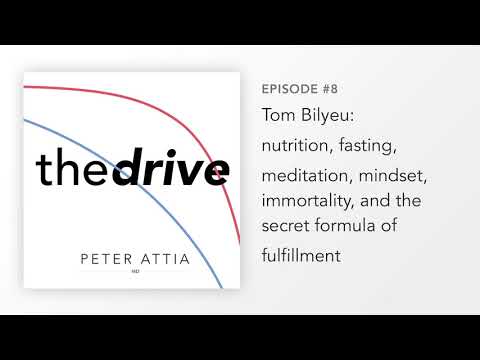
Tom Bilyeu spent two years on a 1,200–1,500-calorie rabbit-starvation diet (>80% protein) before one five-day ketogenic trial resolved 15 years of chronic wrist pain and converted him permanently to high-fat low-carb eating.
2
His current daily protocol cycles one week high-protein / one week ketogenic, with 18:6 intermittent fasting only during keto weeks and a mandatory 5-day water-only fast once per year — a regimen he frames as cognitive and longevity optimization rather than weight management.
3
Meditation transformed Bilyeu from chronically anxious to functionally stress-free: diaphragmatic breath work adopted from Navy SEAL Mark Divine shifts him from sympathetic overdrive to parasympathetic baseline, and he now treats it as performance infrastructure rather than spiritual practice.
4
Bilyeu's fulfillment formula is concrete: do the hard thing others avoid, build a skill set that serves others, and accept that fulfillment is a neurochemical state that ebbs and flows — not a stable destination money or fame can purchase.
Protocols
Concrete recipes — what, when, how much, and why
8 items
Weekly cyclical keto / high-protein rotation
WhatAlternate approximately one week in strict ketosis (blood ketones measurable, fat-dominant macros) with one week of higher protein intake (~+40g above keto baseline). IF (18:6) only during the keto week. On protein weeks, eat minimum 12-hour fasting window; fat intake drops naturally as protein replaces calories.
WhenOngoing, year-round, as the baseline dietary architecture.
Dose~1-week keto / ~1-week high-protein alternation; keto baseline ~100g protein, protein-week target ~140g; IF only during keto weeks (16+ hour fast).
For whomIntermediate-to-advanced athletes who have already fat-adapted and want long-term sustainable cycling rather than permanent strict keto.
WhyExtended consecutive ketogenic weeks cause perceptible muscle softening without necessarily improving outcomes. The rotation preserves the anti-inflammatory and cognitive benefits of keto while maintaining muscle firmness and anabolic signaling.
CaveatsBilyeu navigates by feel and blood monitoring rather than by fixed macro counts. He explicitly stopped numerical tracking after years of data. Beginners would benefit from more structured guidance.
The protocol emerged from lived experience rather than a pre-designed plan. Bilyeu discovered the muscle-softening signal after extended keto blocks and self-corrected. On the question of IF, he distinguishes: 12-hour gap (not IF in his view), 14-hour typical day (borderline), 16+ hours (true IF). He intermittent fasts easily in keto because ketosis suppresses appetite; he finds it 'a little more distracting' in protein weeks so he defaults to the shorter window.
Mechanism
Ketosis reduces insulin, shifts fuel to fat oxidation, and may suppress inflammation; cyclical carbohydrate/protein reintroduction restores mTOR signaling and muscle protein synthesis after the keto-phase attenuation.
If I'm in a ketogenic cycle I do IF the entire time. Let's say I do one week protein, one week keto — that's pretty typical for me. So I just bounce back and forth because I find if I do too many consecutive weeks where I'm actually posting ketones in my blood, I do start to notice the softening of my muscles.
Annual 5-day water-only fast preceded by ketogenic priming
WhatOnce per year, conduct a strict 5-day water-only fast. In the weeks prior, run a ketogenic cycle to pre-adapt fat-oxidation machinery. Expect ketones to reach 3+ mmol/L during the fast. Accept that day 3 is primarily boredom (not hunger); budget for ~20% energy reduction on day 4.
WhenOnce per year; timing flexible but should follow at least several days of ketogenic eating.
Dose5 days, water only. No calories whatsoever.
For whomKeto-adapted individuals with existing fasting experience. Not appropriate for beginners, anyone with metabolic disorders, or those on medications requiring food. Medical supervision recommended.
WhyBilyeu's stated motivations include autophagy induction, the mindset challenge of doing something hard as hell, and the discipline of proving commitment to oneself.
CaveatsDay 4 energy drop is real even in fully keto-adapted individuals — Bilyeu notes ~20% performance reduction. He does not weigh himself to avoid fixating on scale fluctuations.
Bilyeu and Attia compare protocols: Attia's FMD results in more scale weight loss (10 lbs if entering carb-fed vs. Bilyeu's 3–4 lbs) because glycogen depletion carries 4g of water per gram of glycogen. Bilyeu's lower scale loss reflects his already-depleted glycogen baseline. Both agree the fat-oxidation machinery being pre-primed is the critical variable for tolerating the fast without keto flu.
Mechanism
Extended fasting elevates ketones, activates autophagy, reduces insulin and IGF-1 signaling, and shifts cellular metabolism toward repair pathways.
Personal experience
What I love about fasting is that it's hard as hell and I know that I'm gonna stick with it. So there's like so much just like juice that comes from that.
At least once a year I'll do a five-day fast and that's water only — it's not like a Ramadan style, water only fast for five days.
Also said
“I usually do a cycle of keto leading up to a fast so I'm already primed to burn fat. I'll get into the threes when I'm doing a five day fast so it's like my machinery's there.”— Specifies the priming protocol and the resulting ketone level, confirming full fat-adaptation before the fast begins.
18:6 intermittent fasting during ketogenic weeks only
WhatDuring ketogenic weeks, extend the daily fast to 16+ hours (18:6 target). On protein weeks and by default, maintain a minimum 12-hour gap; typical baseline is 14 hours (last meal ~6pm, first meal ~8am).
WhenLinked to dietary state: automatically engaged during keto weeks, relaxed during protein weeks.
Dose16+ hours fast / 8 hours eating window during keto weeks. 12–14 hours fast during protein weeks.
For whomAnyone already keto-adapted who wants to layer IF without forcing willpower over appetite signals.
WhyKetosis suppresses hunger naturally, making 16+ hour fasts effortless during keto weeks. During protein weeks, appetite returns and forcing IF adds friction without clear benefit.
CaveatsBilyeu distinguishes strictly: 12 hours = not IF, 14 hours = borderline, 16+ hours = true IF. He never eats in less than a 12-hour window regardless of dietary phase.
This protocol emerged organically rather than as a designed plan: Bilyeu discovered that IF felt natural during keto and felt like friction during protein weeks, and he simply followed the signal. The 6pm last meal / 8am first meal cadence is his default — the 14-hour gap is not deliberate IF but the natural rhythm of his day.
I find it so easy to intermittent fast when I'm ketogenic. I always do — I never eat in less than a 12-hour window. But I don't consider that intermittent fasting. I only consider intermittent fasting if I go all the way to 16 hours without food.
Whole-food high-fat low-carb baseline diet
WhatWhole foods only whenever possible. Wide variety of vegetables with diverse color array. High fat from olives, olive oil, red meat; substantial egg intake. Cycle protein sources: beef, chicken, lamb, some pork. Approximately twice per year, a single off-protocol meal — not a full cheat day.
WhenDaily baseline.
DoseOngoing. During keto weeks: fat-dominant macros (~100g protein). During protein weeks: ~140g protein, fat intake naturally decreases.
For whomAnyone seeking cognitive optimization and longevity who is willing to remove ultra-processed foods.
WhyAfter the keto conversion experience (wrist pain resolution), Bilyeu concluded that dietary fat quality directly modulates systemic inflammation. Whole-food sourcing and macro diversity are the structural guardrails.
CaveatsBilyeu notes he does not count macros after years of experience. He also acknowledges genuinely loving carbohydrates — his restriction is values-driven, not taste-driven.
I'm on just whole foods whenever humanly possible. I'll have a wide variety of vegetables constituting a very diverse color array. I eat a lot of eggs. I have a lot of fat in my diet primarily from olives and olive oil. High fat, low carb. I never cheat — not never, but it's rare: twice a year maybe, and then it's not like some debaucherous day, it's like a meal.
Diaphragmatic breath meditation — daily and pre-performance
WhatBreath-focused (not mantra-based) meditation using deep diaphragmatic breathing to mechanistically shift from sympathetic to parasympathetic nervous system state. Practiced daily and deployed pre-stage, pre-high-stakes conversation, and for pain management.
WhenDaily practice; also used acutely as a performance primer before any high-stakes event.
DoseFrequency and session length not specified. Long enough to reliably eliminate background anxiety.
For whomHigh-anxiety founders, executives, and performers who have resisted meditation as soft. The mechanistic framing removes the identity barrier.
WhyDiaphragmatic breathing triggers the vagal brake mechanistically — parasympathetic activation suppresses the HPA stress axis in real time.
CaveatsBilyeu is evangelical about this but acknowledges it took years of anxiety accumulation before he adopted it. Benefit is most pronounced for people carrying chronic background-radiation stress.
Bilyeu describes the practice's impact on pain perception: during body-work sessions (serratus/subscapularis), he applied breath-focus to stay in the present-moment sensation rather than anticipating the next two minutes of pain. The pain became significantly more tolerable, consistent with research showing that anticipatory processing amplifies pain experience beyond the moment.
Mechanism
Diaphragmatic breathing stimulates the vagus nerve, shifting autonomic balance toward parasympathetic dominance. This reduces cortisol, adrenaline, and sympathetic arousal, allowing the prefrontal cortex to regain access.
Personal experience
If I'm like about to go on stage or something, guaranteed if they're like doing the announcement I am meditating — diaphragm breathing, getting into a nice calm state. It is crazy to me how well it works.
Once I understood its taking me out of the sympathetic nervous system into the parasympathetic and that diaphragm breathing actually causes that trigger to happen — that it's mechanistic — I was like, okay, all of a sudden I get this. This isn't woo woo, this is like some hard biology.
Also said
“It gets rid of what I call the background radiation — like all that just sort of residual stress. Even on my worst day I can get to absolute zero where I am totally stress and anxiety free just from breathing.”— Defines the specific target state and confirms it is reliably achievable regardless of external circumstances.
9pm bedtime, no alarm — strict sleep discipline
WhatBe in bed by 9pm Monday–Friday without exception. No alarm. Sleep as much as needed. Saturday is slightly looser.
WhenEvery weeknight.
Dose16-year practice; duration is individual — Bilyeu wakes naturally without an alarm.
For whomAnyone whose primary productivity constraint is cognitive output quality rather than raw time quantity.
WhyCognitive output efficiency: being tired degrades performance enough that staying up for extra hours produces net-negative output. The opportunity cost of sleep deprivation exceeds the benefit of extra waking hours.
CaveatsRequires significant lifestyle design: 9pm bedtime constrains social calendars and evening events.
Attia anchors the recommendation with the University of Chicago euglycemic clamp study: 14 consecutive nights of 4-hour sleep → 50% drop in glucose disposal (2x insulin resistance), with diet controlled. The implication is that sleep deprivation sabotages metabolic health independent of dietary choices.
I'm in bed by 9:00 pm every night like it's a religion, Monday through Friday. I get to bed, I don't use an alarm, I sleep as much as I need, I wake up when I wake up. Being tired is a unique form of misery — you're worse at everything you do.
5x/week resistance training with proprioception-based abort protocol
WhatTrain 5 days per week with resistance/strength focus. On compound lifts (deadlift, squat), run a structured warmup progression. If glutes are not firing cleanly and weight is loading into lumbar spine or sacroiliac joint at any warmup rung, abort the session entirely.
WhenFive days per week, ongoing.
DoseApproximately 1 in 5 deadlift sessions aborted based on proprioceptive feedback.
For whomAnyone with history of lower-back injury or sacroiliac dysfunction training for the long term.
WhyRule number one for longevity: don't get hurt. A single injury-missed-week costs more than the marginal benefit of a compromised session.
CaveatsBilyeu hates training intrinsically but does it for strength, longevity, and cognitive optimization. The abort protocol requires genuine proprioceptive awareness.
Personal experience
About one out of every five times I go to deadlift I abort. I'll go: bar, 135, 185, 225, 275, 315 is always the warmup — and if on the way up that ladder I don't feel perfect, like all glute basically doing the work, nothing loading into my lower back, if I don't feel that, we're done.
I have this thing where part of my schtick in longevity is rule number one is don't get hurt. One of the things I've been fortunate to develop over the years is a really good sense of the cues that tell you something's not right that day.
WhatActively choose to believe in your capacity to improve, especially under conditions of failure. Treat every skill as learnable through reading, repetition, and myelination. When failing, diagnose the knowledge gap rather than the talent gap. Practice asking 'how am I wrong?' rather than defending current beliefs.
WhenOngoing as a meta-cognitive stance; especially critical after failure events.
DoseLifelong practice. Initial adoption required deliberate reading campaigns on neuroplasticity.
For whomAnyone who has concluded a skill is innate and they don't have it, especially after a high-visibility failure.
WhyBeliefs are upstream of effort; effort is upstream of skill; skill drives results. Bilyeu observed across 1,500+ Quest interviews that people's dream ceilings were defined by the largest thing they'd ever seen — a belief-mediated limit, not a capacity limit.
Bilyeu's 1,500-interview observation: in the magic-genie question (ask for anything self-focused), every single interviewee asked for money and capped their request at one million dollars. He eventually concluded this wasn't a failure of imagination but a failure of reference points. Impact Theory's entire mission is to expand those reference points through storytelling.
I'm gonna make a decision — I choose to believe that the camp that's saying that it can change is right. And so I started reading and reading and reading about the brain voraciously. I wanted to understand how it could change, what the neurological process of getting better at something was, what are synaptic connections, how does the myelination process work.
What's new
Personal practice updates, fresh positions, predictions
7 items
Rabbit starvation → keto conversion: 15-year wrist pain resolved in 5 days
~15 min
Bilyeu ran an ultra-high-protein, ultra-low-fat diet for two years (1,200–1,500 cal/day, ~80%+ protein, steamed chicken breast with salt), losing 60 lbs from 230 to 170. One five-day therapeutic ketogenic trial — taken reluctantly for potential anti-cancer properties — resolved chronic wrist pain he had been icing twice daily for 15 years. He attributed the change to fat's anti-inflammatory and cell-membrane roles and never cut fat from his diet again.
Why this matters: Reframes a long-standing 'nutrition company founder on rabbit starvation' contradiction as a first-person data point: the very mechanism (fat quality, inflammation) that keto advocates cited was confirmed by resolution of a clinical symptom within days.
Background
Bilyeu founded Quest Nutrition while fat-phobic and in the middle of a two-year rabbit-starvation phase. He met Peter Attia and Dom D'Agostino in ~2013, who made the case for fat via anti-cancer evidence.
The shift was psychologically significant: Bilyeu describes himself as having had a 'fixed mindset' about nutrition — he thought he had it dialed in after losing 60 lbs. The encounter with disconfirming evidence, and the willingness to act on it quickly, is the same epistemological posture he later tried to codify in his Impact Theory work. He went from therapeutic ketosis (ketones >3 mmol/L, glucose ~60s mg/dL) through the keto flu without knowing how to supplement, experienced 'drug-like' wrist relief mid-misery, and immediately concluded the fat mechanism was real.
I went from chronic wrist pain — I'd been icing my wrists up to two times a day every day for 15 years — and that was like to just get to the day. But in the middle of all that I realized my wrists don't feel better they feel perfect.
Also said
“It is like a drug like effect on my wrist. This is crazy and it's just eating. So I said I'm never taking fat out of my diet again. I was like there clearly was something to cell membranes, anti-inflammatory, like there were all kinds of things about the importance of fat that I just wasn't appreciating.”— States the mechanistic conclusion Bilyeu drew in real time — cell membranes and anti-inflammation — and the resulting permanent dietary commitment.
Cyclical keto / high-protein weekly rotation to prevent muscle softening
~1 h 25 min
Rather than staying continuously ketogenic, Bilyeu cycles approximately one week of ketosis followed by one week of higher protein intake (~+40g protein over keto baseline). He discovered that extended consecutive weeks of blood-measurable ketones softened his muscles perceptibly, so the weekly rotation preserves the cognitive and anti-inflammatory benefits of keto while maintaining muscle hardness.
Why this matters: An n=1 protocol from a founder-athlete who experienced the muscle-softening phenomenon first-hand, with a concrete weekly toggle that sidesteps it. The observation about muscle texture as a real-time feedback signal is practically actionable.
Background
Most public keto protocols focus on weeks-to-months adaptation. Bilyeu's experience suggests an earlier aesthetic and functional feedback signal that may precede measurable muscle-loss markers.
On protein weeks, Bilyeu does not intermittent fast (or fasts minimally — never less than 12 hours). On ketogenic weeks, he naturally extends to 16+ hours (18:6). Fat intake drops unintentionally on protein weeks as protein calories replace fat. He tracks his state by how his blood ketones feel and by muscle firmness rather than by macro counting, having moved past numerical tracking after years of experience.
If I do too many consecutive weeks where I'm actually posting ketones in my blood, I do start to notice the softening of my muscles and so I just don't feel as hard. So I tend not to stay ketogenic for long but I'll bounce back and forth.
Annual 5-day water-only fast: ketone >3 mmol/L, day 4 is the wall
~1 h 28 min
Once per year Bilyeu does a strict 5-day water-only fast, deliberately preceded by a ketogenic priming cycle to ensure fat-oxidation machinery is ready. Ketones reach 3+ mmol/L. Days 1–2 are easy; day 3 the dominant obstacle is boredom — food provides dopamine anticipation markers throughout the day, and those disappear entirely; day 4 he estimates ~20% energy reduction even with full ketone adaptation.
Why this matters: The subjective 'boredom on day 3' framing is a novel, specific calibration tool for anyone planning an extended fast: the psychological difficulty is not hunger or cravings but the collapse of daily dopamine structure.
Background
Bilyeu entered the multi-day fasting practice initially attracted to the anti-cancer hypothesis Attia had cited. The protocol remained partly for the mindset challenge — doing something 'hard as hell' that he knew he would complete.
Attia cross-references with his fasting-mimicking diet (FMD) practice (~750 cal/day, 5 days), noting he loses more scale weight than Bilyeu's 3–4 lbs, attributing the difference partly to Bilyeu's very low baseline glycogen (never carb-loads). Bilyeu does not weigh himself during or after the fast; the 3–4 lb estimate is a guess. He attributes the day-4 energy dip not to inadequate fat oxidation ('my machinery is there, I'm posting awesome numbers') but possibly to incomplete ketone utilization efficiency.
The first two days are easy. By day three the problem is mostly boredom, and what I've realized is I get a lot of dopamine hits from knowing oh I'm gonna eat — like here comes this meal, I love this meal, it's gonna be awesome — and there's none of that. So your day doesn't have those like excitement markers in it.
Also said
“I usually do a cycle of keto leading up to a fast so I'm already primed to burn fat. I'll get into the threes when I'm doing a five day fast so it's like my machinery's there.”— Specifies the priming protocol and the resulting ketone level, confirming full fat-adaptation before the fast begins.
Meditation as mechanistic sympathetic-to-parasympathetic switch, not spiritual practice
~1 h 45 min
Bilyeu resisted meditation for years — found it 'feminine,' incompatible with his 'need to toughen up' identity. Navy SEAL Mark Divine reframed it as hard-wiring: diaphragmatic breathing mechanistically triggers the parasympathetic nervous system, shifting cortisol-driven sympathetic overdrive into recovery mode. Once Bilyeu understood the biology he adopted it immediately and now describes it as 'inhumanly helpful' for eliminating what he calls 'background radiation' — the chronic low-level anxiety that accumulated during high-pressure business years.
Why this matters: The reframing from spiritual to mechanistic practice is a direct behavioral unlock: the same men who resist meditation for identity reasons will adopt it when told it is controlled physiology, not woo.
Background
Bilyeu developed massive anxiety during the early Quest years — constantly out of his element, always behind — and describes himself as 'incredibly anxious by nature.' Meditation was the first tool that addressed the baseline, not just acute episodes.
His current practice is breath-focused, not mantra-based. He used it pre-stage, pre-high-stakes conversation, and for pain management — in the latter case, a body worker (Josh) working on his serratus and subscapularis produced unbearable pain until Bilyeu applied breath-focus: stay in the moment of pain without anticipating the next two minutes. He found this halved the subjective pain experience, consistent with the thesis that most physical pain is anticipatory, not momentary. He credits the insight partly to Sam Harris.
Once I understood its taking me out of the sympathetic nervous system into the parasympathetic and that diaphragm breathing actually causes that trigger to happen — that it's mechanistic — I was like, okay, all of a sudden I get this. This isn't woo woo, this is like some hard biology.
Also said
“Even on my worst day I can get to absolute zero where I am totally stress and anxiety free just from breathing. It's crazy.”— States the ceiling outcome of the practice in Bilyeu's own experience — complete acute stress elimination regardless of context.
Bilyeu's wife underwent approximately 12+ antibiotic courses (chronic chest infections) plus a restrictive diet parallel to Tom's own rabbit-starvation phase, plus over-sanitizing. Microbiome testing showed her microbiome was essentially absent. She couldn't hold food down, came close to clinical depression, and lost the ability to maintain body composition. The rebuilding process — and the understanding of the gut-brain axis (95% of serotonin stored in gut) — became Tom's microbiome obsession.
Why this matters: A visceral first-person example of how dietary restriction + antibiotic overuse + over-sanitizing compounds to eliminate the microbiome, with psychiatric consequences (near-depression) that appeared inseparable from the GI collapse.
Background
The episode occurred ~3 years before the interview. Bilyeu connects it to broader suicide and depression epidemics, hypothesizing microbiome dysbiosis as an underappreciated driver of current mental health deterioration.
Bilyeu lists the compounding errors: chronic antibiotic courses for chest infections, massively restricted eating (same rabbit-starvation protocol he was on), excessive hand-washing and sanitizing, and general over-restriction of environmental microbial exposure. The recovery was slow and complicated; the experience made him start running microbiome diversity testing at Quest across employees, finding widespread diversity collapse. He frames the microbiome-depression link as one of the most underappreciated health threats of contemporary life.
She basically doesn't have a microbiome — they're like it's been so decimated by overuse of antibiotics. She just absolutely murdered it. And of course it sends her into — if she wasn't clinically depressed she was getting real close.
Growth mindset as a deliberate decision made in the face of scientific uncertainty
~1 h 10 min
Around 1999, Bilyeu encountered the active scientific debate about brain plasticity — one camp saying the brain caps learning in early teens, the other saying it remains plastic indefinitely. He made an explicit decision to bet on the plasticity camp: 'I choose to believe that the camp that's saying it can change is right.' This decision preceded the popular growth mindset literature and was driven by personal necessity after his film school failure and fixed-mindset collapse.
Why this matters: Frames the growth mindset not as a passive belief adoption but as a deliberate high-stakes wager made under uncertainty — the same epistemological posture he later used for the keto decision and microbiome work.
Background
Bilyeu had a catastrophic senior thesis film failure at USC film school, concluded he had no natural talent (fixed mindset), became the 'king of remedial jobs,' and nearly slid into depression before the plasticity reframe.
He then read voraciously about neuroplasticity, myelination, and synaptic connections. The belief that he could rewire became the foundation for every subsequent transformation — learning entrepreneurship from scratch, learning marketing, building Quest, and later building Impact Theory. He uses this story to explain his interviewing practice at Quest: over 1,500 interviews, always asking a magic-genie question, discovering that people dream only as big as what they've seen, and concluding that belief is the upstream variable that determines effort which determines outcome.
I'm gonna make a decision — I choose to believe that the camp that's saying that it can change is right. And so I started reading and reading and reading about the brain voraciously to try to understand how it could change, what I needed to do, what the process of getting better at something was.
Sleep hygiene: bed by 9pm, no alarm, 16-year streak — framed as cognitive ROI
~1 h 32 min
Bilyeu goes to bed by 9pm Monday through Friday 'like a religion' for 16 years. No alarm; wakes when he wakes. The justification is cognitive efficiency: being tired degrades performance enough that the hours gained from sleep deprivation are net-negative versus the output quality lost. He calls being tired 'a unique form of misery.'
Why this matters: Attia reinforces with the University of Chicago study: 14 consecutive days of 4-hour sleep → 50% drop in glucose disposal (2x insulin resistance), controlled for diet. Both hosts converge on sleep as the highest-ROI health behavior.
Background
Bilyeu started the sleep discipline during the Quest build years, specifically framing it around cognitive output rather than health rhetoric.
The conversation surfaces the memory consolidation angle: Attia notes the hippocampus is particularly sensitive to sleep deprivation and that he has notable memory gaps from his residency years of 28 hours of sleep per week. Bilyeu correlates this with his own film school intensity periods. The 9pm rule is strict during weekdays; Saturdays he allows flexibility. He does not specify a target hours count — 'I sleep as much as I need.'
I'm in bed by 9:00 pm every night like it's a religion Monday through Friday. I get to bed, I don't use an alarm, I sleep as much as I need, I wake up when I wake up. Being tired is a unique form of misery — you're worse at everything you do.
Recommendations
Products, supplements, and tools mentioned in the episode
3 items
Einstein's Dreams by Alan Lightman
Book
Bilyeu read this as a 12-year-old and credits it with forming his foundational attitude toward immortality — identifying himself as the type who would do everything given infinite time.
The book contains a chapter on a world where everyone lives forever, splitting into perpetual procrastinators and people who pursue everything sequentially with total commitment. Bilyeu immediately identified with the second camp. The self-knowledge informed his clarity about wanting to live forever and his productive orientation toward time, which runs through his nutrition and performance protocols: every hour is irreplaceable, so cognitive output must be protected.
vs alternatives
Contrasted with the 'buy an island and retire' response most people have when financially freed — Bilyeu used his Quest liquidity event to accelerate rather than stop.
There's a book I read — it's called Einstein's Dreams — and in that book there's a story about a planet where everyone lives forever. It splits into two camps: people that do nothing because there is always time to do it tomorrow, and people that do everything because they know they can stack all these passions sequentially.
Mark Divine breath meditation videos (Navy SEAL reframe)
Practice
Former Navy SEAL Mark Divine's framing of meditation as mechanistic sympathetic/parasympathetic control was the specific belief-unlock that enabled Bilyeu to adopt the practice after years of resistance.
Bilyeu had resisted meditation because it felt incompatible with his identity of needing to toughen up. A Navy SEAL endorser removed the identity barrier. The content of Divine's videos is breath mechanics and autonomic physiology, not mindfulness or spirituality. Bilyeu watched the videos, understood the biology, and adopted immediately.
I met a Navy SEAL named Mark Divine — and he was like, stop being a jackass, meditate. So I went and watched his videos and I thought: alright, if it's a Navy SEAL, a tough guy, let me give this a shot.
Bilyeu references these books in the context of how dominant narratives shape human behavior — directly relevant to his Impact Theory mission of replacing failing religious narratives with empowering secular stories.
Bilyeu's thesis: Harari shows that narrative is the primary driver of human cooperation and behavior. As religious narratives lose credibility for large populations, people are left without metaphors bigger than their lived experience. Bilyeu believes this is the root cause of the dream-ceiling problem he observed in 1,500 Quest interviews.
When you read Homo Deus and Sapiens it's just really understanding how narrative is so massively influential and that the dominant narratives that we use are all religious — and then you look at how I think the bottom is falling out in terms of belief in a lot of the religions for a lot of people.
After his wife's microbiome collapse, Bilyeu ran company-wide microbiome diversity testing at Quest and found widespread diversity collapse across the workforce.
DisclosureBilyeu co-founded Quest Nutrition — this is an internal company initiative, not a consumer product recommendation.
The practice arose not as a health benefit per se but as a research impulse: after seeing what happened to his wife and linking it to widespread patterns in their employee base, Bilyeu wanted to understand how representative the problem was. Results he describes as alarming — 'people's microbiomes, the diversity is just absolutely atrocious.' This anchors his broader belief that microbiome health is a severely underappreciated driver of mood, cognition, and metabolic function.
We started doing a lot of microbiome testing at Quest and it was just like, man, people's microbiomes — the diversity is just absolutely atrocious.
Lines worth pulling out — contrarian, specific, or perfectly phrased
6 items
I went from chronic wrist pain — I'd been icing my wrists up to two times a day every day for 15 years — and I realized my wrists don't feel better, they feel perfect. This is crazy and it's just eating.
Bilyeu's pivot-moment quote: a 15-year chronic symptom resolving within one 5-day dietary trial. The most compressed argument for dietary fat's anti-inflammatory role in the episode.
Once I understood its taking me out of the sympathetic nervous system into the parasympathetic — and that diaphragm breathing actually causes that trigger to happen, that it's mechanistic — I was like, okay, all of a sudden I get this. This isn't woo woo, this is like some hard biology.
The belief-unlock that converted a self-described tough guy into an evangelical meditator. The reframe from spiritual to mechanistic is the most transferable moment for skeptical audiences.
You only dream as big as you think, and you only think as big as what you see. So if what you see around you is that everyone's wishing and thinking about a million dollars because that seems like an impossibly large amount of money, you never think big enough.
Bilyeu's most-cited insight from 1,500+ job interviews — the consistent $1M genie-wish ceiling as evidence that reference-point expansion, not raw intelligence, is the growth lever.
My diet is like thing number one. I don't mess around with my diet. My diet is on point. And I work out five days a week and that is hugely importantly for strength, longevity, and cognitive optimization.
Bilyeu's own ranked priority statement — diet first, exercise second, both non-negotiable — from someone who openly dislikes training.
Fulfillment comes from becoming someone that you're proud of, building a skillset that was incredibly hard to build, that serves not only yourself but other people. When I think about the times where I feel just awesome, it is because I did something really hard while other people were playing.
Bilyeu's working definition of fulfillment — the alternative to the money-buys-happiness trap. Specific, neurochemical framing with the 'hard thing while others play' element as the distinguishing variable.
I find it so easy to intermittent fast when I'm ketogenic. I always do — I never eat in less than a 12-hour window. But I don't consider that intermittent fasting. I only consider intermittent fasting if I go all the way to 16 hours without food.
A precise personal definition of IF with state-dependency (only easy during keto) made explicit — useful calibration for anyone planning to layer IF onto their dietary practice.
Sign in to share feedback
Tell us if this brief hit the mark or missed it — feedback feeds back into the next iteration of the prompt.
Reading is free for everyone. A free account adds the personal layer: save protocols, follow experts, and see how the other experts weigh in on this same topic.
Educational summary of the cited expert source — not medical advice. Open the source recording linked above and consult a qualified physician before acting on any protocol.