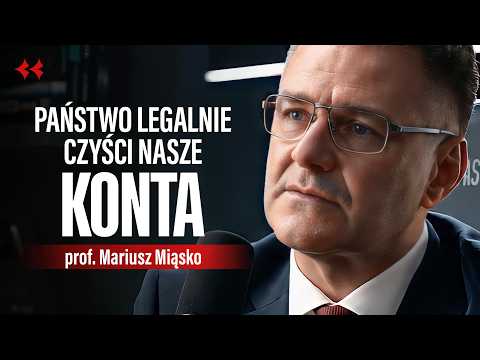
Prof. Mariusz Miąsko argues that Polish elites have traded freedom for comfort, exemplified by compliance with illegal pandemic mask mandates that lacked any legal basis, as he discovered while teaching law to security forces.
2
He founded the associations 'My Ludzie' and 'My Przedsiębiorcy' to empower citizens with legislative rights, and champions meritocracy (merytokracja) over democracy, citing China’s historical exam system and the absurdity of electing politicians like pilots based on popularity.
3
Poland’s transport sector collapsed – over 2,200 firms shut down in one year and a quarter – because the government imposed social security obligations on driver wages 1/3 above EU requirements; the KSeF system is a national security threat, sending all fiscal data to foreign-controlled servers.
4
Poland is not prepared for a full-scale war; Miąsko proposed building 1,000 shooting ranges for mass voluntary training, but the government ignored the plan. He leads a protection team (Zenit 9) and advocates firearm ownership and patriotic spirit.
Protocols
Concrete recipes — what, when, how much, and why
6 items
Join the associations 'My Ludzie' or 'My Przedsiębiorcy'
WhatBecome a member of the civic or entrepreneurs' association to contribute expertise, influence legislation, and scale resistance against systemic overreach.
WhenNow; continuous participation.
DoseOngoing membership.
For whomAll Polish citizens, especially entrepreneurs and those willing to contribute intellectual/patriotic capital.
WhyThese associations exploit legally guaranteed rights to sit in parliamentary subcommittees and table amendments, building a parallel merit-based authority.
CaveatsRequires genuine commitment; success depends on mass mobilization and sustained effort over years.
The strategy is to move from ad-hoc interventions (like the ViaToll victory) to a systemic operation: 200 lawyers drafting legislation full-time, hundreds of trained experts sitting in every subcommittee, and eventually fielding candidates for higher office. Miąsko calls it a 'government of entrepreneurs' built on meritocracy. He urges people to join not based on political affiliation but on a shared commitment to dignity and freedom, emphasizing that the associations are 'politically ecumenical.' The immediate goal is to aggregate the collective wisdom of members and convert it into legal and political action.
Mechanism
Associations under Polish law have the right to participate in the legislative process as a 'social factor' (czynnik społeczny). By training experts and lawyers, the associations can systematically submit amendments, petitions, and complaints, effectively disciplining the state from within.
Personal experience
He founded these after years of leading smaller interventions and realizing the need for a permanent infrastructure. He personally invests time and resources, traveling to media appearances without compensation, motivated by the mission.
There must, there must be millions of us in these associations. We will arrange millions. ... I will not ask you, ladies and gentlemen, whether you are left-wing, centrist or right-wing, be whatever you want. It is indifferent to me. Just be people who will put their wisdom into the defense of the Polish state and Polish entrepreneurship.
Also said
“We will create a new quality no longer for ourselves, because maybe we will not live to see the benefits, but we will create it for ours, for generations.”— Emphasizes the long-term, selfless nature of the protocol.
Undertake firearms training and ownership
WhatAcquire a firearm license, purchase weapons, and regularly train at shooting ranges to cultivate defensive skills and a patriotic mindset.
WhenAs soon as possible; integrate into lifestyle.
DoseContinuous practice; join a community of approximately 400,000 Polish sport shooters.
For whomAny law-abiding citizen willing to learn.
WhyWidespread civilian firearm competency acts as a deterrent, enables local defense in initial invasion phases, and fosters pro-state, patriotic values through community interaction.
CaveatsRequires dedication and compliance with Polish gun laws; not a substitute for large-scale military training but a complementary civilian layer.
He advocates that Poland should not only allow but encourage firearm ownership. He explains that Ukraine’s inability to stop lightly armed Russian units in the first days stemmed partly from a disarmed populace. In Poland, the current sport shooting community (~400,000) already holds a deeply patriotic identity and is eager to teach new generations. By expanding this base, the country builds a decentralized defense network and a citizenry mentally immune to defeatism. He ties this to the concept of being a 'pastoral dog' rather than a sheep or wolf.
Mechanism
On the tactical level, armed civilians can delay or disrupt initial enemy advances, as demonstrated by the lack of such capability in Ukraine’s early days. Sociologically, shooting ranges are spaces where strong patriotic ethos and a sense of duty are transmitted, strengthening national resilience.
Personal experience
He owns 12 firearms, is an active personal protection agent, and trains with the elite civilian team Zenit 9, whose members have guarded several presidents. He describes the 'bullet catcher' ethos: entering the line of fire to protect another, a mentality that requires inner work and dedication. He often analyzes protection failures (like the Fico assassination attempt) to show what real commitment means.
Owning a weapon is associated with creating a certain, just a certain sense of pro-defense state community. ... we meet at shooting ranges with people who are characterized mainly by very strongly patriotic attitudes.
Also said
“If there had been any mobilization and defense capability even at the social level ... the Russian troops would have been stopped drastically earlier.”— Provides the strategic rationale from the Ukraine war.
Engage in the legislative process as a citizen via associations
WhatForm or join an association, then exercise the statutory right to attend Sejm subcommittee meetings, submit legislative amendments, and monitor parliamentary work.
WhenImmediately, as legislative sessions occur regularly.
DoseContinuous engagement; each subcommittee meeting is an opportunity.
For whomAny citizen or group of citizens; associations need at least a few dedicated members.
WhyPoliticians have hidden this right; systematic participation can override partisan blockades and directly inject citizen-proposed law.
CaveatsRequires learning parliamentary procedure and dedicating time; may face informal pushback from established parties.
He repeatedly emphasizes that this is not theoretical. His own experience with the 'Najlepsza Droga' association proved that sustained legal and media pressure can force systemic change (cancelling illegal viaTOLL fines). He now scales this by building a permanent army of lawyers and experts who will dominate these processes, effectively creating a shadow legislative corps. He urges regular citizens not to underestimate their power and to learn these mechanisms.
Mechanism
Polish law grants associations the status of 'czynnik społeczny' (social factor) in the legislative process—they can attend meetings, speak, and submit amendments that must be voted on. This bypasses the monopoly of political parties.
Personal experience
He personally led a year-long media and legal war that forced the government to stop illegal fines, saving 200,000 drivers from bankruptcy. That success made him realize the power of association-based action.
You can enter ... from the street into the Sejm for a session, for the first reading for a subcommittee session on a given topic and everyone who represents this association can submit their own draft of their amendment and it will be voted on.
Adopt a deterministic legal mindset when drafting or interpreting regulations
WhatAdvocate for and apply a principle that every legal provision must have exactly one unambiguous meaning, denying officials the power to insert their own interpretations.
WhenIn all legal design and auditing; during legislative proposals.
DoseConceptual shift; ongoing application.
For whomLegislators, lawyers, judges, and citizens engaged in law reform.
WhyThe root cause of arbitrary fines, overturned investments, and systemic injustice is the abstract, multi-interpretable nature of current legal norms.
CaveatsRequires a fundamental overhaul of legal drafting and a new semantic engine (still in development); may be resisted by those who benefit from ambiguity.
He and his team are building this system as a 'gift to the nation.' He acknowledges the complexity and cost (100 million zł) and notes politicians' lack of enthusiasm because it would curb their ability to exploit loopholes. However, the societal pain caused by unpredictable law—entrepreneurs losing fortunes, drivers being unfairly fined—is so immense that he is determined to complete it regardless of political support.
Mechanism
By creating a semantic representation of law that maps words to fixed meanings and using computer-aided verification, statutes can be made deterministically interpretable. This eliminates the gap where an official says 'this glass is a bottle.'
Personal experience
In 26 years and thousands of cases, he witnessed countless people who were legally right but lost because of hostile interpretations. This drove him to start the project 16 years ago.
We are creating this system and we will create it based on the principles of social justice and predictability. Above all, predictability.
Also said
“Forbidden by the jurisprudence of the Supreme Court ... forbidden for contra legem jurisprudence, that is, one in which it says that this is a glass. As we see, the provision says this is a glass, and the official says this is a bottle.”— Illustrates the illegal practice that the deterministic system aims to make impossible.
Conduct mass voluntary military training via shooting ranges
WhatImplement a national program of 1,000+ shooting ranges where citizens train voluntarily after work, covering basic military skills.
WhenWeekends and after work; as soon as infrastructure is built.
DoseRegular, recurring sessions; frequency flexible.
For whomAll able-bodied citizens, without mandatory conscription.
WhyPoland lacks trained manpower for a protracted war; voluntary decentralized training is cheap, non-oppressive, and keeps families together.
CaveatsRequires state investment and political will; currently blocked by government inaction.
He formalized the proposal and sent it to the Prime Minister and Minister of Defense over 1.5 years ago but received no substantive reply. He calculates that to hold a long front like Poland’s, at least 10% of the population (~4 million) must be trained; current trained personnel are around 200,000. The proposed system would be far cheaper and more socially acceptable than a draft. He ties the failure to the fact that the defense minister is a pediatrician, lacking military understanding.
Mechanism
Training a large reserve force reduces dependency on small professional units and creates a societal deterrent. Proximity of ranges ensures high participation without disrupting daily life.
Personal experience
As someone with a background in national security education and as a practitioner, he drafted the concept himself and tried to push it through official channels.
I proposed to the Polish government in an official letter ... the organization of a program to build 1,000 shooting ranges and conduct universal training in free time ... for a year and a half there has been no response whatsoever.
Also said
“Poland is not prepared for a full-scale war. ... training of at least 10% of the population is required ... We currently have trained ... 200,000 people.”— Defines the scale of the training gap.
Treat leadership as a moral and spiritual vocation
WhatPoliticians and elites must undergo an inner transformation, placing national interest and human dignity above party branding and personal gain, guided by principles akin to the Decalogue.
WhenImmediately, as a baseline for any reform to be effective.
DoseContinuous self-examination.
For whomCurrent and aspiring politicians, officials, judges.
WhyWithout a restored sense of duty, love of country, and shame, structural changes will be circumvented by the same corrupt mentality.
CaveatsIntangible; cannot be legislated directly but must be cultivated through culture, example, and accountability.
He repeatedly returns to this as the deepest layer. The mileage affair shows that even when laws are clear, without an internal prohibition ('thou shalt not steal'), politicians rationalize theft. He contrasts the Warsaw Uprising generation’s sacrifice with today’s leaders who fear losing a few polling points. He calls for elites to stop trading freedom for comfort and to see their education and position as a mandate to serve, not to exploit. The concept of a 'truly educated person' (człowiek wykształcony) is one who feels obligations to others, unlike a mere 'wykształciuch.'
Mechanism
The 'pastoral dog' ethos—self-sacrifice, protection of the community—counteracts the wolf-like behaviour driven by a lack of inner moral code.
Personal experience
He teaches his son to be a pastoral dog, not a wolf or sheep. He regularly asks his lawyers to consider the servant role of their profession, and he judges his own actions—such as creating a new liberal employment form for farmers pro bono—by how many lives they improve.
An educated person is one who additionally knows that once they have acquired, once they have acquired these hard competencies, these skills, they now have only duties. ... Now they must set an example.
Also said
“When I close my eyes and think, what is most important to me? ... family ... the Polish state is most important to me after family. Not a political party, not my private ambitions.”— Illustrates the value hierarchy he believes leaders must adopt.
What's new
Personal practice updates, fresh positions, predictions
5 items
Meritocracy (merytokracja) as a systemic alternative
Miąsko proposes replacing electoral democracy with merit-based governance, drawing from ancient China's imperial exams, where officials must prove hard competencies or documented management success rather than popular appeal.
Why this matters: It challenges the fundamental political assumption in Poland and the West, advocating a technocratic parallel government by citizen experts.
Background
In the current Polish political system, ministers are often appointed based on party loyalty rather than relevant education or experience. Miąsko notes that 50% of politicians since 2000 have no matching qualifications for their portfolios, with some like a pediatrician leading the defense ministry.
Miąsko defines meritocracy by contrasting it with democracy, which he describes as a popularity contest. He recounts the story of an ancient Chinese emperor who introduced rigorous state exams to prevent incompetent nobles from holding office, a system China still follows. He then gives the airplane analogy: no passenger would accept a charismatic but untrained person as captain, yet society allows the same in government. For him, competence means either a directly relevant higher education degree or a 10-year proven track record of successful enterprise management. He and his team are developing a framework of tests and manuals to train their own experts within the 'My Przedsiębiorcy' association, who will sit in legislative subcommittee meetings as a social factor, effectively building a parallel merit-based government. He believes this will gradually replace current politicians. The ultimate goal is to create a 'government of entrepreneurs' that operates on merit, not party lines.
Please now compare this to something very concrete. I often give this example of an airplane. Most of us fly somewhere on an airplane on trips and please imagine that you are sitting in such an airplane that has 200 people and a certain passenger stands up and says: 'I want to be the captain' and says: 'Listen, I am handsome, I am nice, I smile nicely and on top of that I like this or that.' ... 100% of passengers would say: 'No, absolutely not, man, you are cool, nice, but absolutely sit down nicely and the stewardess will bring you two drinks here, but do not even think of such an idea.' So how is it that at the same time in a 37-million-strong country we agree to exactly that?
Also said
“If you possess a relevant education from a good university, a relevant education, for example in economics, then perhaps you possess the competencies to be a minister, um, for example of finance or a minister of labor, but it must be relevant. Secondly, but it may be that one may not have a relevant education, but have proof of effective competence.”— Clarifies the two-path criteria for competence in his meritocratic model.
Citizen legislative empowerment via associations
Miąsko reveals that Polish law allows any registered association to participate directly in parliamentary subcommittee sessions, propose amendments, and have them voted on, a right deliberately obscured by politicians.
Why this matters: This is a concrete, actionable mechanism for bypassing political parties that most citizens are unaware of; his associations are actively building legal expert cadres to occupy these positions.
Background
He initially founded 'Najlepsza Droga' to fight illegal fines for truck drivers, saving 200,000 people from bankruptcy. He later realized that associations have strict statutory rights in the legislative process, but politicians do not inform the public.
Miąsko explains that as a representative of an association, an ordinary citizen can walk into the Sejm, attend a subcommittee meeting, and submit an amendment that will be formally debated and voted on. He says such amendments are almost always accepted because it is politically difficult for the chairman to oppose a social voice. He contrasts this with the current situation: no citizens fill the parliamentary galleries or subcommittee rooms. To exploit this systematically, 'My Przedsiębiorcy' aims to recruit 200 lawyers working full-time drafting bills, petitions, and amendments, and to train hundreds of experts who will permanently monitor and influence the legislative process. This is presented as a peaceful, system-legal transformation from within.
Personal experience
He led the successful ViaToll campaign with 'Najlepsza Droga', forcing the removal of illegal 8,000 zł fines. This experience taught him the power of association-based legal pressure. He also mentions handling over 12,000 administrative proceedings and seeing countless citizens crushed by the system, motivating him to create a structural solution.
I understood that politicians do not provide information ... that you can, as a member of an association, you can enter ... from the street into the Sejm for a session, for the first reading for a subcommittee session on a given topic and everyone who represents this association can submit their own draft of their amendment and it will be voted on and it is almost always voted on.
Also said
“Why political parties would be unnecessary, because the average Kowalski would set up an association and go to amend a bill.”— Highlights that this mechanism could make political parties obsolete.
Deterministic legal interpretation system
Together with a professor from Wrocław University of Science and Technology, Miąsko is building the world's first semantic legal system that forces every statute to be read in only one way, eliminating judicial and bureaucratic interpretive discretion.
Why this matters: A radical technical-legal solution to systemic injustice, claiming to remove the chaos of contradictory rulings that currently bankrupt businesses and citizens.
Background
Polish law uses general and abstract norms, which judges and officials later fill with their own context, leading to unpredictable outcomes. This has caused massive suffering, with businesses investing millions only to be ruined by a single adverse interpretation.
Miąsko argues that the current legal system is fundamentally broken because it allows a glass to be called a bottle by an official, contradicting the social contract. He and his team have been working for 16 years on a deterministic system of legal exegesis and semantic representation. The goal is that a given provision will yield exactly one outcome today, tomorrow, and in 10 years, unless the law is explicitly changed. He admits the project needs 100 million zł and may not be completed in his lifetime. Politicians are said to be unenthusiastic because a clear system would prevent them from exploiting legal ambiguity for personal gain (e.g., the recent MPs' mileage allowances scandal). The system is being built out of a sense of duty to restore human dignity to those crushed by arbitrary rulings.
Personal experience
His motivation comes from witnessing thousands of lives destroyed by unpredictable legal interpretations in his 26 years of practice. He describes seeing people who were right but got crushed by judges and officials, prompting him to say 'it can't go on like this.'
We decided to create the world's first deterministic system of legal interpretation and semantic representation of law. ... so that it would be possible to read the content of a provision in only one single way.
Also said
“The current legal system is based to a huge extent on such a scheme, which you would often call fraud, because you think that when you read a provision, it can be decoded in only one single way, and few of you know that norms have a general and abstract character, and this abstractness is only later filled in by judges and officials with contexts.”— Explains the fundamental flaw of current law that his project aims to fix.
Poland’s defense unpreparedness and the shooting range proposal
Miąsko states Poland is unprepared for a protracted full-scale war because military doctrine requires 10% of the population (about 4 million) to be trained, while currently only about 200,000 are. He sent a formal proposal to build 1,000 shooting ranges for voluntary, low-cost, mass training but received no reply for 1.5 years.
Why this matters: Directly contradicts official assurances and offers a concrete, feasible alternative that the government has ignored, linking the neglect to ministerial incompetence.
Background
Given the geopolitical situation and reports of intense intelligence activity in Poland, civilian and military counterintelligence should be expanded 50-fold, but it is not. The minister of defense is a doctor (pediatrician), which Miąsko cites as emblematic of the leadership gap.
He details the implications: a full-scale war could last years, and without sufficient trained personnel, the front cannot be maintained. The Ukrainian example demonstrates that without massive external support, the country would have collapsed. His proposal involved building over 1,000 shooting ranges so that people could train after work without being conscripted, keeping them near their families and jobs. He repeatedly asked the Prime Minister’s office and the Defense Ministry for a response but received none, which he interprets as a lack of understanding and care. He contrasts this with his own proactive stance: he has three offensive-packed backpacks ready and would head east, criticizing the vice-premier who spoke of having an evacuation backpack.
Personal experience
He is an active personal protection agent (bodyguard) and part of the elite civilian team Zenit 9, trained to take a bullet for the protectee. He describes the mindset of a 'bullet catcher' and how such people can instill patriotic duty in others. He has 12 firearms at home and believes widespread gun ownership and training naturally build a pro-defence community.
Poland is prepared for a non-full-scale war. Poland is not prepared for a full-scale war. ... military doctrine states that ... training of at least 10% of the population is required, that is around almost 4 million people. We currently have trained ... 200,000 people.
Also said
“I made such a proposal ... the organization of a program to build 1,000 shooting ranges and conduct universal training in free time ... for a year and a half there has been no response whatsoever.”— Shows the specific policy initiative and the government's lack of response.
Spiritual and moral deficit as the root cause of political dysfunction
Throughout the conversation, Miąsko repeatedly diagnoses a deeper spiritual emptiness and lack of a 'Decalogue-level' moral compass among politicians, leading them to treat citizens as resources, steal public money, and abandon empathy.
Why this matters: This framing elevates systemic critique from a technical to a civilizational level, arguing that without inner transformation, structural reforms will fail.
He points to the mileage allowance scandal, where MPs from all sides helped themselves to public money despite already receiving free cars and transport. He contrasts this with the sacrifices of the Warsaw Uprising and says politicians have stolen their own human dignity. The problem, he says, is not specific policies but a void where conscience and compassion should be: they do not think about the hungry children in Gaza, the bankrupt entrepreneur's employees, or the country's future. He frames it as 'pastoral dogs, sheep, and wolves' – many politicians start as sheep but become wolves, breaking the commandment 'thou shalt not steal' in spirit if not always in letter. This spiritual decay, he argues, is exacerbated by erasing religion from public life, which removes culturally embedded ethical guardrails. The solution is not just legal reform but a revival of a sense of duty, love for one’s children, and a willingness to sacrifice for the common good.
Personal experience
He teaches his son to be a 'pastoral dog' who leads and protects, not a wolf or a sheep. He often tells his students and lawyers the difference between a truly educated person (who feels obligations) and a 'wykształciuch' (a mere title-holder with no social conscience).
What is wrong with you, that you are decent people when you are not politicians? But when you become politicians, you become wolves. ... Problems at the level of the Decalogue. Thou shalt not steal, thou shalt not steal, thou shalt not steal.
Also said
“We are no longer people worthy and entitled to dignity. We are not free people. We have become a resource in the hands of politicians.”— Captures the dehumanisation at the core of his critique.
Recommendations
Products, supplements, and tools mentioned in the episode
1 item
Great Poland
Book
Miąsko highly recommends this book by publicysta Rafał Ziemkiewicz as essential for understanding how to build a ‘Great Poland’ mentality and counter the small-mindedness of current elites.
He spontaneously praises the book during the discussion about a nation’s self-image, saying it explains why Poland should think of itself as a great country, not in territorial terms but in terms of mental and moral stature. He uses it to illustrate that Polish politicians often have the mentality of a hen (the henhouse is the whole world), while a world citizen treats the whole world as home. The book is meant to inspire a shift from a defensive, provincial mindset to an ambitious, self-confident one.
There is a brilliant, insanely good book by editor Ziemkiewicz. I think that's exactly what it's called. Great Poland. I recommend everyone read it.
Also said
“The book is insanely good, because it talks exactly about how to build the mentality of a great Poland, of the people of a great Poland.”— Confirms the core message he values in the book.
Lines worth pulling out — contrarian, specific, or perfectly phrased
5 items
We are no longer people worthy and entitled to dignity. We are not free people. We have become a resource in the hands of politicians.
Succinctly captures his core thesis about the dehumanisation of citizens into mere fiscal and labor resources.
Shame on you. We gave you money, we gave you even company cars, we gave you free travel, and you still reached for more of our money, which we gave you, because you did not take it from some budget. You took it from me, from the editor and from everyone who listens to us.
A raw, emotional indictment of politicians’ moral failure during the mileage scandal, reframing it as direct theft from citizens.
Did you see during the pandemic that well-off and educated people, that they were the core that offered any resistance to these orders, for example to some order to wear masks, which was never legalized?
Points out the abdication of the educated class during an illegal mandate, making the case that comfort led to mass compliance.
This is nothing other than disciplining us citizens so that we learn that we are to be submissive, because next time when we are submissive on the roads, ... when we discipline people on the roads, they will also be disciplined in other areas.
Frames the speed-camera system not as safety measure but as psychological conditioning for submission to state power.
Do not go to Germany, do not go to France, do not go to Great Britain, to see what countries neglected by their citizens look like. ... It starts with fines, and ends with losing the entire country.
Warns that the erosion of freedom begins with small overreach and ends with losing the entire country, using Western European decay as a cautionary tale.
Sign in to share feedback
Tell us if this brief hit the mark or missed it — feedback feeds back into the next iteration of the prompt.
Reading is free for everyone. A free account adds the personal layer: save protocols, follow experts, and see how the other experts weigh in on this same topic.
Educational summary of the cited expert source — not medical advice. Open the source recording linked above and consult a qualified physician before acting on any protocol.