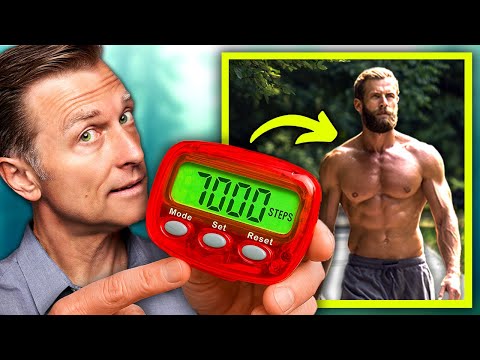
Walking 7,000+ steps daily adds cardiovascular and longevity benefits; even 4,500 steps starts protecting the heart, while under 2,000 steps raises disease risk.
2
The 2017 Japanese interval-walking protocol — alternating 3 minutes fast and 3 minutes slow five times — yields 3× the blood‑pressure reduction and 10× the leg strength of 1.5–2 hours of steady walking.
3
Walking after meals or in a fasted morning state directly burns excess glucose and visceral fat; measuring waist circumference gives a truer picture of progress than the scale.
4
Sensory‑rich walks without a phone or music, combined with nasal breathing and occasional breath holds, can reset stress, boost oxygen efficiency, and trigger anti‑inflammatory genes.
Protocols
Concrete recipes — what, when, how much, and why
10 items
Post‑Meal Walk for Blood Sugar Control
WhatTake a walk shortly after eating to help muscles use the extra glucose that enters the bloodstream.
WhenAfter a meal.
DoseNo fixed duration given; the emphasis is on the timing rather than the length.
For whomAnyone, but especially useful for people concerned about blood sugar spikes or fat gain.
WhyWalking activates muscle uptake of glucose, blunting the post‑meal blood‑sugar spike and reducing the amount of glucose that could be stored as fat.
CaveatsThis is not a license to overeat sugar assuming walking will cancel it out. ‘I know some people are going to go, “Wow, I can just eat more sugar and walk.” Well, I'm not trying to put out that message.’
Berg positions post‑meal walking as a practical, immediate tool to counter dietary glucose. He explicitly separates it from the idea that you can eat poorly and walk it off — it’s damage control for occasional excess, not a substitute for a healthy diet. He doesn’t prescribe a distance or time, making it accessible even for a quick 5–10 minute walk around the block. The focus is on the biochemical timing: glucose enters the blood after a meal, and moving muscles acts as a vacuum for that glucose, preventing it from lingering and causing glycation or fat storage.
Mechanism
Physical activity increases insulin‑independent glucose transport into muscle cells via GLUT4 translocation, removing sugar from the blood without requiring a large insulin release.
Walking after a meal really will help any extra sugar that you ate.
Morning Fasted Walk for High Morning Blood Glucose
WhatWalk in the morning before eating to use up the elevated glucose that often appears upon waking in pre‑diabetics and diabetics.
WhenMorning, before consuming any food (during the fasting window).
DoseNot specified; even a short walk aimed at burning off the excess glucose.
For whomPre‑diabetics and diabetics who experience high morning blood glucose; also beneficial for anyone practicing intermittent fasting.
WhyBurning off the morning glucose spike prevents it from converting into fat and lowers overall glycemic load for the day.
CaveatsIf blood sugar is extremely high or you feel unwell, consult a doctor before exercising fasted. Not intended to replace medication without medical supervision.
Berg builds on the same glucose‑burning principle as post‑meal walking but targets the dawn phenomenon — the natural rise in blood glucose that occurs in the early morning due to hormonal shifts. He advises walking during the fasted period (before noon for those fasting until lunch), which combines the glucose‑clearing effect of movement with the already low insulin environment, theoretically accelerating fat burning and glucose disposal. He frames this as a dual‑benefit practice: it protects against the long‑term damage of high glucose while simultaneously enhancing the metabolic benefits of fasting.
Mechanism
Skeletal muscle contraction pulls glucose from the blood independently of insulin, lowering glucose concentrations during the fasted state when insulin levels are low.
when you wake up in the morning and you don't eat, you fast until noon, you should walk in the morning. You'll get better benefits.
Brisk Walking for Enhanced Benefits
WhatWalk at a faster pace during your regular walks, covering the same number of steps but at a higher intensity.
WhenDuring any walk.
DoseSame step count or time, but with elevated speed.
For whomAnyone capable of speeding up their walking pace without injury.
WhyFor the same number of steps, a brisker pace yields better results; the metabolic and cardiovascular demand is higher.
CaveatsStart gradually to avoid joint strain or overexertion; if you have joint issues, consult a professional before significantly increasing pace.
Berg makes the comparison simple: even if the number of steps is identical, walking faster is superior. He doesn’t specify a target heart rate or speed, leaving it as a universal piece of advice — push the pace. This pairs naturally with his interval walking recommendation but stands alone as a fundamental rule of walking efficiency.
Mechanism
Higher walking speed increases heart rate and muscle activation, driving greater caloric expenditure and stronger cardiovascular adaptation per unit of time or distance.
if you walk briskly, you will have much better benefits. Even if we compare the same steps, if you're walking faster, your results are going to be better.
30‑Minute Interval Walking Protocol
WhatAlternate 3 minutes of fast walking with 3 minutes of normal‑pace walking, repeating five times, for a total of 30 minutes.
WhenAny time of day; can be done daily or a few times per week.
Dose30 minutes total: 5 cycles of (3 min fast + 3 min normal).
For whomAnyone who can walk briskly; particularly beneficial for those wanting cardiovascular and leg‑strength improvements in minimal time.
WhyProven in a 2017 Japanese study to produce three times the blood‑pressure reduction and ten times the leg strength gain of 1.5–2 hours of steady walking.
CaveatsIf you are new to exercise or have cardiovascular concerns, start with shorter fast intervals and build up. The ‘fast’ pace should be relative to your own fitness.
Berg presents this protocol as a direct alternative to long walks, which many people struggle to fit into their day. By citing the specific study outcomes, he gives it scientific weight. The structure is simple enough to perform anywhere, no equipment. He emphasizes that the 30‑minute investment replaces 90–120 minutes of regular walking for those outcomes — a time‑efficiency argument likely to appeal to busy listeners. He doesn’t specify how many days per week, leaving it to the listener to experiment.
Mechanism
High‑intensity intervals during walking create greater shear stress on blood vessels (improving endothelial function) and maximal muscle fiber recruitment in the legs, triggering stronger adaptation signals than continuous moderate‑intensity walking.
that specific type of walking for 30 minutes gives you more benefits than an hour and a half to two hours of just regular walking.
Also said
“In 2017, there was a Japanese study which actually has amazing benefits. It can actually produce three times the results of lowering blood pressure, 10 times the results with leg strength.”— Provides the numerical basis for the claim.
Backward Walking for Joint, Balance, and Cognitive Health
WhatWalk backwards in a safe, obstacle‑free environment.
WhenDuring a walk, for short periods.
DoseNo set duration; incorporate brief intervals of backward walking into your walk.
For whomAnyone without severe balance disorders; start cautiously if you have a history of falls.
WhyStrengthens knees, ankles, and hips; improves balance; and enhances cognitive function through increased coordination demands.
CaveatsDo not walk backwards on streets, uneven sidewalks, or crowded areas. Ensure a clear, flat surface.
Berg offers this as a quick to add to any walk, emphasizing the structural and neurological return on a few minutes of inversion. The cognitive benefit, he says, comes from the brain having to process movement in a novel way, which may contribute to improved function beyond just leg strength. He doesn’t assign a specific program, leaving it open as an on‑the‑spot enhancement.
Mechanism
Backward walking places a greater load on the quadriceps and anterior shin muscles, which are under‑used in forward walking. The unfamiliar motor pattern challenges the vestibular and proprioceptive systems, theoretically boosting neuroplasticity and balance.
Another tip that I would recommend is to walk backwards. It strengthens your knees and ankles and hips and it apparently it improves more cognitive function when you do that. It also helps your balance.
Nasal Breathing During Walks
WhatBreathe exclusively through the nose (not the mouth) while walking.
WhenThroughout the walk.
DoseFor the entire walk, as much as possible.
For whomAnyone; particularly beneficial for those who mouth‑breathe habitually or get winded easily.
WhyIncreases carbon dioxide (CO2) tolerance, which makes oxygen more efficient in the blood due to the Bohr effect.
CaveatsIf you have nasal obstruction, address that first. Stop if you feel lightheaded.
Berg presents nasal breathing as a simple, universally available technique to improve gas exchange physiology. He ties it to CO2 efficiency, a concept popularized in breathwork communities (like Buteyko). By practicing it during a walk — a moderate aerobic activity — you gently build CO2 tolerance, which can translate into better endurance and oxygen utilization at rest and during exercise. He doesn’t dictate a specific breathing rate, only the nasal route.
Mechanism
Nasal breathing increases the resistance to airflow, slightly elevating arterial CO2. Higher CO2 facilitates oxygen release from hemoglobin to tissues (Bohr effect) and up‑regulates nitric oxide production in the nasal passages, improving airway dilation and blood flow.
nasal breathing when you're walking as much as possible because you can increase more CO2 which then makes your oxygen more efficient in your blood.
Sensory‑Engaged Walking for Stress Relief
WhatWalk without your phone, music, or videos; instead, deliberately cycle through looking, listening, and smelling in the environment to anchor yourself in the present moment.
WhenDuring a walk, ideally 30–60 minutes.
DoseContinue until you feel fully present; Berg notes it sometimes takes him 30 minutes to an hour to achieve this state.
For whomAnyone feeling overwhelmed, distracted, or chronically stressed; those seeking to deepen the mental health benefits of walking.
WhyUsing your senses sequentially draws your attention away from ruminative thought and counteracts the stress of daily life, improving mental calm and presence.
CaveatsYou should still be aware of your surroundings for safety; if walking in a busy area, you may need to keep some external attention for traffic.
Berg describes this as his personal practice for using walking to counter stress. He leaves the phone at home and avoids all audio input. He doesn’t just ‘notice’ things passively; he purposefully cycles through modalities — first visual (trees, colors, brightness, ground details), then auditory (as many distinct sounds as possible for as long as he can), then olfactory. He treats it as a mental exercise, not just relaxation, stating that sometimes it takes 30 to 60 minutes to really sink into that state. This protocol is less about step count and more about mental conditioning.
Mechanism
Directed attention to sensory input (sights, sounds, smells) shifts the brain from default‑mode rumination to present‑moment processing, which can reduce cortisol and increase parasympathetic tone. The sequential focus on different senses mimics elements of mindfulness training, building attentional control.
Personal experience
Berg explicitly states: 'When I go for a walk, I do not bring my cell phone. I don't listen to music. I'm not watching videos when I'm walking. What I'll do is I'll use as many sense organs as possible. I'll be looking at trees. I'll be looking at different colors. I'll look at how bright it is or how cloudy it is. I'll look at the details of things on the ground. I try to really uh focus in on listening to all these different sounds as long as I can. Then I'll shift to smelling different things.' He adds that reaching the deeply present state can require up to an hour.
These are all things that help you get into the present. Sometimes it might take up to 30 minutes to an hour before I can achieve that.
Hypoxia‑Style Breath‑Sync Walking
WhatWhile walking, inhale for 3 steps and exhale for 4 steps to restrict oxygen flow slightly; then, after a warm‑up, every few minutes hold your breath for 5–10 seconds.
WhenDuring a walk, after you have established nasal breathing and a steady pace.
DoseStart with the 3‑in/4‑out pattern for several minutes; then intermittently add 5–10 second breath holds every few minutes. Build up over sessions.
For whomExperienced walkers looking to add a metabolic/epigenetic stimulus; not for those with severe lung or cardiovascular conditions unless cleared.
WhyLight oxygen restriction (form of hypoxia) triggers gene expression that strengthens the body, reduces inflammation, and improves recovery.
CaveatsDo not push breath holds to the point of dizziness or distress. This is a graded practice, not a competitive one. ‘This is not an exact hypoxy method. It's a form of it.’
Berg introduces this as a way to mimic altitude training without specialized equipment. He calls it a ‘form of hypoxia,’ acknowledging it’s not as precise as laboratory protocols. He suggests starting with the breath‑to‑step ratio to create a mild, sustained restriction, then layering on short breath holds as your comfort grows. The benefits he lists — stronger body, less inflammation, better recovery — are adapted from high‑altitude training research. He frames it as a progressive challenge that can evolve with your walking routine.
Mechanism
Intermittent mild hypoxia up‑regulates hypoxia‑inducible factors (HIFs) and other genetic pathways that enhance mitochondrial efficiency, angiogenesis, and anti‑inflammatory cytokines. Over time, this can improve tissue resilience and recovery.
sync your breath with inhalation for three steps and exhalation for four steps. ... Then you can work up to every few minutes you're going to hold your breath for 5 to 10 seconds.
Also said
“you're triggering certain genes in the body that compensate and make your body stronger, decreasing inflammation and even help improve your recovery.”— Specifies the downstream genetic activation that makes the effort worthwhile.
Measure Waist, Not Weight
WhatInstead of tracking body weight on a scale, measure your waist circumference at the level of the navel to monitor fat loss.
WhenPeriodically, such as weekly.
DoseSingle measurement each time.
For whomAnyone using walking for fat loss who may be frustrated by a stagnant scale weight.
WhyWalking can increase muscle mass, which weighs more than fat, potentially masking fat loss on the scale. Waist circumference directly tracks visceral fat reduction.
CaveatsEnsure consistent placement of the tape measure and measure at the same time of day (e.g., morning after using the bathroom).
Berg acknowledges that walking can lead to weight loss, particularly visceral belly fat, but warns that the scale may deceive because muscle is denser than fat. He therefore strongly recommends a simple tape measure at the belly button as the primary metric. This shifts the focus from weight to body composition change, which aligns better with health outcomes.
Mechanism
Visceral fat loss reduces abdominal girth, whereas muscle gain — which occurs with walking, especially in the legs — can offset total body weight. Waist measurement isolates the metabolically dangerous fat depot.
Instead of focusing on weight loss, what I recommend you do is just measure your waist at the level of the belly button. You should see a significant decrease in belly fat.
Allow Recovery and Avoid Walking Every Day Over Soreness
WhatDo not walk long distances every single day if you are still sore; build in rest days so the body can recover.
WhenAfter a particularly long or intense walking session.
DoseLet soreness resolve before the next session; avoid creating a habit of daily long walks that leave you sore.
For whomEnthusiastic new walkers who may jump into long daily walks too quickly.
WhyOvertraining without recovery can lead to persistent soreness, fatigue, and diminished benefits.
CaveatsSoreness is a signal; listen to your body. Walking short, easy distances on recovery days is probably fine.
Berg warns against the mistake of overtraining — the person who gets excited and walks a really long distance every day, ignoring soreness. He frames it as a beginner’s error rooted in enthusiasm and highlights the need for patience. The advice is simple: let your body recover so each walk can be productive rather than grinding down into chronic fatigue or injury.
Mechanism
Muscle repair and adaptation occur during rest when micro‑tears heal and inflammation resolves. Repeated intense activity without recovery impairs tissue remodeling and increases injury risk.
some people get very enthusiastic and they overtrain. They go out for a a really long walk and they make this a habit of walking every single day over soreness. So, they're overtraining and I don't recommend that.
What's new
Personal practice updates, fresh positions, predictions
6 items
Sitting nullifies the benefits of walking
Eric Berg warns that prolonged sitting cannot simply be counteracted by a short walk or bike ride later; the damage of sitting persists.
Why this matters: Contradicts the common belief that any exercise easily offsets prolonged sedentariness — the nullification effect means timing and breaking up sitting matters.
Background
Many people believe that a daily workout or walk can erase the harms of sitting all day. Berg calls out this misconception as ‘not quite true,’ shifting focus toward integrating movement throughout the day rather than relying on a single exercise bout.
Berg frames this as a critical reality check for anyone who exercises but still sits for long stretches. He explicitly says that thinking ‘I can go ride my bike around the block’ after sitting too long won’t fully counter the negative effects. The underlying implication is that the metabolic and vascular insults from sitting — reduced blood flow, lower muscle activity, poor glucose handling — build up and need to be interrupted much more frequently than one exercise session provides. This insight shifts the conversation from total daily steps toward patterns of constant low-grade movement.
One of the things that will nullify the benefits of walking is sitting too long and then thinking that I can go ride my bike around the block and that will be enough to counter that. Unfortunately, it's not quite true.
Interval walking gives disproportionate returns
A 2017 Japanese study found that 30 minutes of alternating 3‑minute fast/3‑minute normal walking produced three times the blood‑pressure drop and ten times the leg strength of an hour‑and‑a‑half to two hours of steady walking.
Why this matters: This effectively triples the efficiency of walking for cardiovascular and strength goals, making it a powerful, time‑saving strategy.
Background
Endurance walking — logging longer steady distances — has been the default recommendation. Berg introduces this specific interval protocol as a game‑changer based on a single high‑quality study, shifting the emphasis from volume to intensity variation.
Berg describes the protocol in precise, actionable detail: walk fast for 3 minutes, then normal pace for 3 minutes, repeating the cycle five times — a total of 30 minutes. He contrasts this sharply with the standard advice, which often pushes people toward longer and longer walks to get benefits. The claim is striking: in 30 minutes you get more cardiovascular and strength benefit than in 90–120 minutes of regular walking. He does not cite the study’s design or population, but he stresses the magnitude of the outcomes (3× blood‑pressure reduction, 10× leg strength), positioning it as a practical tool for anyone who wants outsized results without doubling walking time.
In 2017, there was a Japanese study which actually has amazing benefits. It can actually produce three times the results of lowering blood pressure, 10 times the results with leg strength. All you do is for three minutes you're walking fast and then for three minutes you're walking normal. And you simply go back and forth, back and forth five times. that specific type of walking for 30 minutes gives you more benefits than an hour and a half to two hours of just regular walking.
Breath‑restricted walking mimics high‑altitude training
Berg advocates a naturally achieved hypoxia‑like stimulus during a walk by first syncing breath to steps (in 3, out 4) and later adding intermittent 5–10‑second breath holds every few minutes, which he says triggers beneficial genetic adaptations.
Why this matters: This reframes a simple walk as an epigenetic trigger — no altitude chamber needed — claiming tangible benefits like reduced inflammation and faster recovery.
Background
Hypoxia training is typically associated with elite athletes using altitude tents or high‑elevation training camps. Berg brings the concept to the everyday walker, arguing that controlled breath restriction on a walk can generate similar adaptive stress signals without gear or travel.
Berg starts with a basic breath‑step synchronization: inhale for three steps, exhale for four steps, which he calls a ‘form of’ hypoxia method that lightly restricts oxygen. He then advises progressing to intermittent breath holds — holding for 5 to 10 seconds every few minutes. He insists this is not a rigorous, prescriptive hypoxia protocol but a ‘way’ to get hypoxia‑like effects. Over time, he claims this triggers genes that strengthen the body, decrease inflammation, and improve recovery. The recommendation is for walkers to layer it on top of their usual routine, progressively increasing the duration and frequency of breath holds as tolerated. No safety warnings are given beyond the graded progression.
sync your breath with inhalation for three steps and exhalation for four steps. This is not an exact hypoxy method. It's a form of it. ... Then you can work up to every few minutes you're going to hold your breath for 5 to 10 seconds.
Also said
“you're triggering certain genes in the body that compensate and make your body stronger, decreasing inflammation and even help improve your recovery.”— Describes the expected physiological payoff from the practice.
Sensory‑engaged walking reprograms stress
Berg personally walks without a phone – no music, no videos – and deliberately uses all his senses to drop into the present moment, sometimes taking up to an hour to achieve that state.
Why this matters: Distinct from the popular ‘phone‑down’ mindfulness advice, he frames sensory immersion as a deliberate training of attention — a tool to counter stress and strengthen focus.
Background
Most people walk while listening to music, podcasts, or scrolling, effectively muting the environment. Berg reverses this by advocating a full‑sensory engagement approach that he says neutralizes the stress of life and pulls you into present‑moment awareness.
Berg describes his method in detail: he leaves his phone behind, actively looks at trees, colors, brightness, cloud cover, and details on the ground. He listens to as many different sounds as he can for as long as possible, then shifts to smelling. This sequential, intentional use of the senses is a practice of attention training, not just a casual stroll. He notes that it can take 30 to 60 minutes before he achieves the fully present state he’s after, suggesting it’s a skill that requires time and repetition. The primary outcome he names is stress reduction — a cognitive and emotional reset rather than a physical training goal.
Personal experience
Berg describes his own walks in the first person: 'When I go for a walk, I do not bring my cell phone. I don't listen to music. I'm not watching videos when I'm walking. What I'll do is I'll use as many sense organs as possible.' He shares that it sometimes takes up to 30 minutes to an hour to reach the desired state of deep presence.
I'll be looking at trees. I'll be looking at different colors. I'll look at how bright it is or how cloudy it is. I'll look at the details of things on the ground. I try to really uh focus in on listening to all these different sounds as long as I can. Then I'll shift to smelling different things. These are all things that help you get into the present.
Also said
“Another really important purpose of walking to counter the stress of life. When I go for a walk, I do not bring my cell phone. I don't listen to music. I'm not watching videos when I'm walking.”— Establishes the no‑device rule and the overarching goal of stress counter‑action.
Walking backwards strengthens joints and cognition
Berg recommends walking backwards (in a safe place) because it strengthens the knees, ankles, and hips, improves cognitive function, and enhances balance.
Why this matters: It is a low‑cost, zero‑equipment addition to a walk that targets stability and brain function in a single movement pattern change.
Background
Backward walking appears occasionally in physical therapy and agility training but is rarely prescribed as a general health tool. Berg brings it forward as an accessible health booster that adds cognitive load and joint resilience.
Berg mentions this tip briefly but with enthusiastic endorsement. He explains that reversing the walking direction loads the lower‑body joints differently, building strength in the knees, ankles, and hips in a way that forward walking does not. The cognitive benefit, he says, comes from the added coordination and attention required — which he frames as improving cognitive function and balance. He adds a clear safety caveat: do this only in a safe environment, not on a city street. No specific dose (e.g., minutes per session) is given, leaving it as an occasional spice to a walking routine.
Another tip that I would recommend is to walk backwards. It strengthens your knees and ankles and hips and it apparently it improves more cognitive function when you do that. It also helps your balance. Of course, do this in a safe place.
Fasted walking targets morning glucose spikes
For those who wake up with high blood glucose (pre‑diabetics, diabetics), a morning walk before eating can directly burn off the excess glucose, preventing it from converting to fat.
Why this matters: It positions walking as a first‑line, drug‑free intervention specifically for the morning glucose spike — a known metabolic risk factor — and connects it to fasting for amplified results.
Background
Elevated morning blood sugar (the dawn phenomenon) is a common problem in insulin resistance. Rather than reaching for medication or simply waiting it out, Berg proposes a targeted walk during the fasting window to clear glucose immediately.
Berg ties this advice to his broader view of fasting and glucose management. He reasons that walking activates muscle uptake of glucose independently of insulin, so a fasted morning walk can blunt the glucose surge without food. He explicitly warns that this doesn’t give permission to eat more sugar and then walk, but rather it’s a tool for managing inevitable rises. He also connects it to his earlier point about walking after meals, creating a complete strategy: walk after meals and walk during the fasting morning to keep glucose low throughout the day. No specific duration is given; the emphasis is on the timing.
another thing in the morning when you wake up with high blood glucose, especially if they're a pre-diabetic or a diabetic, walking can handle that too because you can go for a walk in the morning and burn off that excess glucose, which should be a very, very good thing because we don't want the glucose converting into fat.
Recommendations
Products, supplements, and tools mentioned in the episode
1 item
Apple cider vinegar diluted in water
Supplement
Berg mentions it as a tool to enhance walking‑induced weight loss by improving blood sugar control.
Berg advises drinking a little apple cider vinegar in water — presumably before or during a walking routine — to improve the ability to lose weight. He links this to the effect of vinegar on blood sugar, known to lower post‑meal glycemic responses. The recommendation is positioned as a complement to walking, not a standalone solution.
drinking a little apple cider vinegar and some water, that can improve your ability to lose weight because what it does to your blood sugar.
Lines worth pulling out — contrarian, specific, or perfectly phrased
6 items
Walking is one of the most powerful medicines. It lengthens your life, decreasing anxiety and depression, reducing cortisol.
Sets the tone that walking is a broad‑spectrum health intervention, not just a calorie burner.
One of the things that will nullify the benefits of walking is sitting too long and then thinking that I can go ride my bike around the block and that will be enough to counter that. Unfortunately, it's not quite true.
Challenges the ‘I exercised today so I’m covered’ mindset and highlights the insidious nature of prolonged sitting.
In 2017, there was a Japanese study which actually has amazing benefits. It can actually produce three times the results of lowering blood pressure, 10 times the results with leg strength. All you do is for three minutes you're walking fast and then for three minutes you're walking normal. And you simply go back and forth, back and forth five times.
Boils a specific, high‑return protocol down to a memorable, actionable formula with impressive numbers.
When I go for a walk, I do not bring my cell phone. I don't listen to music. I'm not watching videos when I'm walking. What I'll do is I'll use as many sense organs as possible.
A rare, counter‑cultural personal admission — opting out of constant digital input — that makes the sensory‑walking practice tangible.
I'm doing sprinting up hills right now and it's amazing how my feet are responding and they're like putting back in that elastic band ... bypassing the actual loss of the arch.
A striking testimony from a 70‑year‑old sprinter about hill sprints rebuilding foot arches — a claim rarely heard in walking advice.
some people get very enthusiastic and they overtrain. ... you want to let your body recover so it's not so sore.
Grounds the enthusiasm with a necessary warning, underscoring that more isn’t always better.
Sign in to share feedback
Tell us if this brief hit the mark or missed it — feedback feeds back into the next iteration of the prompt.
Reading is free for everyone. A free account adds the personal layer: save protocols, follow experts, and see how the other experts weigh in on this same topic.
Educational summary of the cited expert source — not medical advice. Open the source recording linked above and consult a qualified physician before acting on any protocol.