UNFUCG
DashboardSearchChatBookmarksNotificationsActivityPremiumProfile
?
Home
Search
Chat
Saved
Profile
Episode
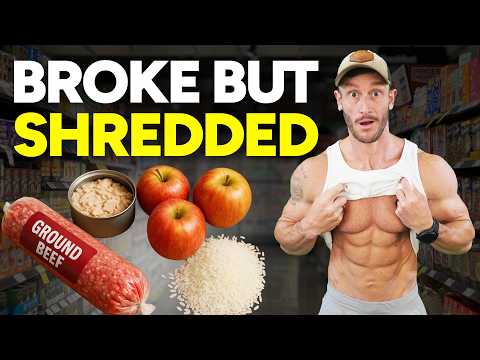
Get Shredded for Less than $10/Day by Eating This (full food list)
~51 min
Episode Brief·YouTube

Get Shredded for Less than $10/Day by Eating This (full food list)

Thomas DeLauer
Watch on YouTube Add to chat My bookmarks← All sources

TL;DR

The four things you'd lose by not watching

4 items

TL;DR

The four things you'd lose by not watching

4 items
1

$50/week shredding requires swapping expensive beef and eggs for skinless chicken thigh, ground turkey, canned tuna, and sardines—straining fatty ground meats to cut calories.

2

A temporary shift to lower-fat, moderate-carb eating (with carbs back-loaded to dinner via potatoes) makes budget shredding possible, though Thomas doesn't recommend it long-term.

3

Fat-free Greek yogurt, low-fat cottage cheese before bed, and frozen broccoli/berries deliver high protein and nutrients without blowing the budget.

4

Mustard and simple hot sauce like Tabasco act as appetite-suppressing thermogenic condiments that cost pennies per serving and last for weeks.

Protocols

Concrete recipes — what, when, how much, and why

10 items

Choose Skinless Chicken Thighs Over Breasts for Budget Protein

WhatBuy chicken thighs without skin, bake or barbecue to render out as much fat as possible, and use as your dinner staple protein.
WhenDinner, as main protein source.
DoseNo specific amount; let budget and calorie needs dictate portions.
For whomAnyone on a $50/week shredding budget who can't afford chicken breast.
WhyChicken thigh delivers more protein per dollar than increasingly expensive chicken breast; removing the skin makes it lean enough while darker meat may offer better nutrition.
CaveatsConventional feedlot chicken might contain glyphosate—this is a short-term solution, not forever. Cooking method matters to minimize remaining fat.

Thomas starts by noting that chicken breast prices have gone 'out of control,' making the protein-per-dollar math favor thighs. Even with skin, thighs are caloric, so he emphasizes buying them already skinned or removing the skin yourself. He then recommends dry-heat cooking (baking or grilling) to allow additional fat to drip away, making the final meat even leaner. He acknowledges feedlot chicken quality concerns but frames this as a temporary necessity. The overall message is: on a severe budget, you trade some nutritional perfection for economic viability, but thigh without skin is a strong middle ground.

Mechanism

The darker meat of the thigh contains slightly more myoglobin and potentially more micronutrients like iron and zinc, which he alludes to when saying 'you're potentially getting more nutrition out of a darker cut of meat.' Removing the skin eliminates the concentrated subcutaneous fat, and baking/grilling further renders intramuscular fat, lowering the calorie density per gram of protein.

Personal experience

Thomas says, 'I would actually next go with chicken thigh that does not have the skin,' indicating this is his personal tier-2 choice after budget constraints force out beef/eggs.

I would actually next go with chicken thigh that does not have the skin. Reason is is yes, there's some fat content, but protein per dollar, you're getting more.

Also said
“Chicken breast has just gotten out of control. And the protein for dollar doesn't add up to like the same that you would get protein per dollar for chicken thigh.”— Direct economic comparison between thigh and breast.
“Just get it without the skin because the skin is just so caloric. At least when they strip the skin off, you're left with a relatively leaner cut of meat.”— Clarifies why skin removal is non-negotiable for leanness.
“When you cook the chicken, I would recommend that you bake it in this case or barbecue it, right? So that you're able to get as much of the fat off as you possibly can.”— Specifies the cooking technique to further reduce fat.

Strain Cooked Ground Meats to Reduce Fat

WhatCook fatty ground beef or turkey, then pour boiling water over it in a colander to rinse away rendered fat, making the final product much leaner.
WhenWhenever using bargain ground meats (75–85% lean) as a protein source.
DoseNo set dose; rinse until most visible fat is removed.
For whomBudget-conscious shredders who can only afford cheap ground beef or turkey.
WhyMassive price differences between lean and extra-lean ground meat make fattier options the only budget-friendly choice; fat-straining turns them into a high-protein, moderate-fat meal.
CaveatsRinsing with hot water may also remove some water-soluble nutrients, but the trade-off is worth it for calorie control on a tight budget.

He points out that 90% lean ground beef and 96% lean are 'astronomically different in price' despite only a small fat difference, so even if you can stretch to 90%, straining still helps. With the cheapest chubs (75–80% lean), straining is essential to keep fat calories from overwhelming the diet. For ground turkey, even the 99% lean version is cheap, but the more common 85–90% lean is significantly cheaper, and straining tames the fat. The hot-water rinse is a old bodybuilding trick he endorses.

Mechanism

The fat melts during cooking; hot water emulsifies and carries away the liquid fat. This mechanical separation drastically lowers the fat-to-protein ratio without altering the protein matrix.

Personal experience

He says, 'I would typically go for like a 93 or 96% lean, but that gets so crazy expensive. … I go for like a 90 or a 93% and I'll still strain it if I want it a little bit leaner.'

I would cook it and then I would run it under really hot water or even a metal colander, boil some water, and then run it over the beef after you've cooked it and drain some of that fat.

Also said
“You can get those chubs of like 80% or maybe even 75% lean beef usually pretty cheap.”— Defines the starting point for the straining method.
“A 90% lean beef and a 96% lean beef are astronomically different in price and it's not even that different in fat content.”— Explains the economic absurdity that makes the method useful even at 90%.

Use Canned Tuna and Sardines as Lean Protein Staples

WhatRely on chunk light tuna (lower mercury) and sardines packed in water (not oil) as inexpensive, shelf-stable protein sources.
WhenAnytime—lunch, snack, or emergency protein.
DoseNo strict limit; the selenium in tuna helps mitigate mercury, so moderate daily intake is reasonable.
For whomAnyone on a bare-bones budget who needs convenient, non-perishable protein.
WhyCanned fish is extremely cheap per gram of protein and requires no cooking; sardines add omega-3s without the questionable oils in oil-packed versions.
CaveatsAvoid oil-packed sardines (likely low-quality oil). Albacore tuna has higher mercury, so prefer chunk light. Long-term, rotate fish sources.

He acknowledges the mercury concern but argues that tuna naturally contains selenium, which binds mercury and aids excretion—'selenium has been demonstrated to help actually remove some of the mercury from the tuna in the first place as you consume it.' So he's not overly worried about occasional daily consumption. Sardines in oil are cheap, but he warns the oil is usually 'cruddy' and recommends water-packed instead. He admits sardines and tuna aren't the most exciting food, but they get the job done.

Mechanism

Selenium forms inert complexes with mercury (mercury selenide), reducing its bioavailability and promoting its elimination. Sardines in water avoid the pro-inflammatory oxidized oils often found in cheap oil-packed versions.

Canned tuna. Now, here's the thing. Albaore is a higher mercury content than the chunk light. Either way, you have enough selenium that is coming along with the mercury that selenium has been demonstrated to help actually remove some of the mercury from the tuna in the first place as you consume it.

Also said
“The problem with the sardines is if you get them in oil, it's usually going to be cruddy oil. So, get sardines in water.”— Critical pack type specification.
“Now, this is budget food. I know that's not the most exciting thing, sardines and tuna, but I'm just being real. It's relatively inexpensive and it works pretty dang well.”— Acknowledges the palatability trade-off while standing by the recommendation.

Ground Turkey Breakfast with Hot Sauce

WhatCook ground turkey (85–90% lean is cheapest) with hot sauce and optionally oregano for a breakfast-sausage-like meal; strain fat if needed.
WhenBreakfast.
DoseAs much as needed to hit morning protein target.
For whomBudget shredders who want a savory, high-protein breakfast.
WhyGround turkey is typically cheaper than lean beef or eggs, and hot sauce adds flavor plus mild thermogenesis.
CaveatsIf using 85–90% lean, strain to lower fat as with beef. Hot sauce should be clean (vinegar, salt, peppers) without sodium benzoate.

Thomas positions this as a direct replacement for expensive breakfast sausage or eggs. He suggests that with a bit of oregano, it mimics the taste profile of breakfast sausage, making it psychologically satisfying. The hot sauce provides capsaicin-based thermogenesis and more intense flavor, which helps with satiety on fewer calories. Since ground turkey is leaner than its label suggests relative to cost, it becomes a top protein-per-dollar pick.

Mechanism

Capsaicin in hot sauce triggers TRPV1 receptors, increasing energy expenditure and reducing appetite via catecholamine release. Oregano provides flavor without calories.

Personal experience

He says, 'I recommend ground turkey with some hot sauce as a breakfast food,' indicating he personally suggests this combination.

I recommend ground turkey with some hot sauce as a breakfast food. If you have a little bit of oregano or something laying around, you can give it like a breakfast sausage type taste that feels like a good breakfast food.

Also said
“You can get 99% lean ground turkey, pretty cheap, but you're going to find that traditional ground turkey that's more like 85 to 90% lean is going to be a lot cheaper.”— Explains why the 85–90% version is the budget choice.

Fat-Free Greek Yogurt as a High-Protein Meal Base

WhatBuy a large tub of fat-free Greek yogurt and sweeten it with stevia or mix in frozen berries for a dessert-like breakfast or snack.
WhenBreakfast or any time you need a sweet protein hit.
DoseNo specific serving; fill a bowl as a meal base.
For whomBudget shredders who enjoy sweet, creamy meals.
WhyFat-free yogurt provides maximal protein per dollar; stevia keeps calories negligible, and frozen berries add antioxidants without fresh-fruit cost.
CaveatsAvoid pre-flavored yogurts to dodge added sugars; honey is too expensive for the $50 budget. Check for carrageenan if you plan to eat daily long-term.

He suggests this as a cheap way to get a dessert-like experience while still hitting protein goals. Because fat-free costs the same as low-fat versions, it maximizes protein per dollar. He advises against using honey due to cost—$7-$8 for halfway decent honey would take a big bite out of the $50 budget—so stevia packets are the economical sweetener. Frozen strawberries can be stirred in for texture and phytonutrients. He frames it as a psychologically helpful meal that feels indulgent.

Mechanism

Greek yogurt's straining process concentrates casein and whey proteins, providing a slow-digesting protein matrix that is highly satiating. Steviol glycosides from stevia offer sweetness without insulin impact.

I would get a large tub of fat-free Greek yogurt. This would be a tremendous breakfast food. … if you put a couple packets of stevia or something like that … you're going to have a perfectly tasting dessert and or breakfast.

Also said
“A lot of times the fat free costs the same as the 5% or the 2%. So, let's go maximize that protein per dollar and go low fat on those ones.”— Economic justification for choosing fat-free.
“You're probably looking at like seven or eight bucks for halfway decent honey. So, it's probably just not going to really work.”— Explains why honey is ruled out, pushing stevia as the sweetener.

Low-Fat Cottage Cheese Before Bed

WhatEat low-fat cottage cheese as a pre-sleep snack to meet daily protein targets without impairing fat loss.
WhenBefore bed.
DoseOne serving (e.g., 1 cup) to fill remaining protein needs.
For whomBudget shredders who struggle to hit daily protein and want a nighttime option.
WhyCottage cheese is a cheap, slow-digesting casein source; research cited by Dr. Mike Ormsby indicates it doesn't impede overnight fat loss and may support muscle protein synthesis.
CaveatsMany cheap brands contain carrageenan, which is best avoided long-term, though occasional use is fine pending more research.

He references his guest Dr. Mike Ormsby's finding that cottage cheese before bed does not impair fat loss in the morning, making it a viable tool for those low on protein. He acknowledges that carrageenan is a concern in cheaper versions but tells listeners not to be 'freaked out'—it's more of a caution for long-term habitual intake. The main goal is getting the protein in without overspending.

Mechanism

Casein forms a gel in the stomach, releasing amino acids slowly over several hours, sustaining muscle repair and satiety without spiking insulin high enough to block overnight lipolysis.

Cottage cheese before bed is still pretty legit. Dr. Mike Ormsby, the protein researcher I had on my channel, he was talking about like even cottage cheese before bed doesn't impede fat loss in the morning.

Also said
“Try to avoid one that has carrageen in it. The only problem is most of the cheaper ones do have carrageenan. I don't want you to be freaked out by carrageen. It's just something maybe you don't want to have long term while we're still waiting for more research to come out on it.”— Adds the carrageenan caution while keeping it in perspective.

Backload Carbohydrates to Evening with Potatoes

WhatConsume the majority of your daily carbohydrates in the evening, using cheap potatoes (russet, red) to create a voluminous, satisfying dinner while keeping daytime intake low.
WhenEvening/dinner.
DoseEnough to meet budget and calorie targets; the rest of the day stays low-carb.
For whomBudget shredders following his temporary lower-fat, moderate-carb approach.
WhyCentralizing carbs at night allows a filling meal without becoming a 'high carb' person all day; supports low-fat shredding while potatoes are a cheap per-calorie carbohydrate.
CaveatsDon't overdo carbs; this is for a shredding cycle, not a permanent high-carb diet. It replaces expensive fats as a satiety tool.

He concedes that good fats are too costly for a $50/week plan, so going moderate-carb becomes the budget-friendly route. To prevent insulin spikes all day, he recommends keeping carbs low during the day and concentrating them at dinner with potatoes. This provides volume and satiety without making the person a 'high carb person' because total daily carb intake remains moderate. He calls it a temporary fix that works for shredding but not ideal for long-term metabolic health.

Mechanism

Allocating carbs around the evening meal may improve compliance by using carbohydrates' serotonin-boosting effect to enhance sleep and satiety, while limiting daytime insulin excursions can maintain lipolysis during active hours. However, Thomas does not elaborate on this biology; he frames it purely as a volume and budget strategy.

If you were to say allocate your carbohydrates to the evening time, you could get a good portion of volume in your food just by having say potatoes or something with dinner.

Also said
“I don't want you to become someone that's just overdoing the carbs for the sake of it. But if you had your carbs in the evening, you're getting to have something more voluuptuous like to eat, but you're not actually like really changing your diet to becoming a high carb person.”— Clarifies that this tactic doesn't mean embracing a high-carb lifestyle.
“As much as I don't like it, it might be a temporary fix that could work.”— Reiterates the short-term, pragmatic nature.

Incorporate Mustard and Clean Hot Sauce for Thermogenesis

WhatUse stone-ground or Dijon mustard and a simple hot sauce like Tabasco (vinegar, salt, peppers) as condiments to boost thermogenesis and suppress appetite.
WhenWith meals—drizzled on meats, eggs, or vegetables.
DoseA small dollop of mustard and a few dashes of hot sauce per meal.
For whomAnyone on a shredding diet looking for cheap, non-supplement metabolic enhancers.
WhyMustard seeds contain an active compound that induces dietary thermogenesis and curbs appetite; the capsaicin in hot sauce provides an additional thermic effect, and both add flavor without meaningful calories or budget impact.
CaveatsAvoid mustard with added sugars or fillers; choose stone-ground or Dijon. For hot sauce, avoid brands with sodium benzoate or other preservatives—Tabasco's simple ingredient list makes it a safe pick.

Thomas gives mustard unusually strong praise, calling its thermogenic effect 'profound.' He explains that the active compound in mustard seeds (likely allyl isothiocyanate) can significantly increase energy expenditure and also alter taste perception to reduce appetite. Because a jar of mustard lasts a month or more, it's a very low-cost tool. He pairs it with hot sauce—specifically Tabasco—which adds additional capsaicin-driven thermogenesis and flavor complexity. Together, they transform bland budget meals and provide a metabolic edge.

Mechanism

Allyl isothiocyanate (from mustard) activates TRPA1 channels and may stimulate sympathetic nervous system activity, increasing thermogenesis and reducing hunger signaling. Capsaicin activates TRPV1, raising catecholamines and energy expenditure. Both enhance the thermic effect of food.

Mustard has tremendous effects when it comes down to thermogenesis. It has a dietary induced thermogenic effect that is profound.

Also said
“It can curve the appetite, have a significant effect on taste profile to make it so that you don't have as much of an appetite.”— Highlights the appetite suppression beyond calorie burn.
“A little bit goes a long way. So, even if you go over budget for like one week, it's going to carry over because your mustard is going to last you for a month or two.”— Reinforces the extreme cost-effectiveness.
“Try to just get straight up Tabasco or something. It's just vinegar, salt, and red pepper. Pretty darn simple.”— Specifies the hot sauce brand/type to buy.

Frozen Broccoli and Cauliflower as Primary Vegetables

WhatBuy frozen broccoli and cauliflower instead of fresh to get sulforaphane, NRF2 activation, and liver-supporting compounds (DIM, I3C) at a fraction of the price.
WhenWith lunch and dinner.
DoseA few servings per day; frozen bags work for weeks.
For whomBudget shredders who need nutrient-dense greens without the cost of fresh organic produce.
WhyBroccoli retains its bioactive compounds even when frozen; it's anti-inflammatory, supports detoxification and gut motility, and is consistently cheap.
CaveatsNon-organic frozen broccoli is acceptable for short-term use; long-term, consider organic to avoid pesticide residues.

He says fresh vegetables are 'pretty much out of the equation right now' due to price, but broccoli is the one vegetable he still stands behind because of its unique benefits—sulforaphane and NRF2 activation provide potent antioxidant and anti-inflammatory effects, while dandolmethane (DIM) and indole-3-carbinol support liver detox. Frozen broccoli retains these compounds well, and it doesn't need to be organic for a short shredding cycle. He also mentions cauliflower as a secondary option.

Mechanism

Sulforaphane, formed when glucoraphanin in broccoli is enzymatically converted, activates the NRF2 pathway, upregulating antioxidant genes. DIM and I3C support phase I and phase II liver detoxification. The fiber also improves gastric emptying and motility.

Broccoli is one vegetable that I will still stand behind. the sulfurophane, the overall other components that you get from NRF2 activation, but you can get broccoli frozen and it still retains a lot of its benefits as well as cauliflower.

Also said
“Not to mention a hormonal benefit with dandolmethane, indol 3 carbinol. So really is a tremendous liver food.”— Adds liver detox benefits.
“It helps with gastric emptying. It helps with motility. You have the NRF2 effect, the anti-inflammatory, antioxidant, sulfurophane effect.”— Lists multiple physiological benefits.

Frozen Berries Instead of Fresh Fruit

WhatUse frozen strawberries, blueberries, and other in-season frozen berries as your fruit intake; they are flash-frozen, preserving antioxidants, and are far cheaper than fresh.
WhenMixed into Greek yogurt, as a snack, or eaten alone.
DoseA handful per serving; adjust to budget.
For whomAnyone on a tight budget who still wants fruit variety and antioxidants.
WhyFresh fruit is prohibitively expensive; frozen berries retain polyphenols and are available cheaply in bulk, making them a cost-effective source of phytonutrients.
CaveatsIf absolutely necessary, you can skip fruit altogether and rely on a small honey splurge for antioxidants, but that's a last resort.

He acknowledges that fresh fruit is unrealistic on a $50/week budget. Frozen berries are the solution because the flash-freezing process preserves the antioxidant capacity. He suggests buying whatever is in season and cheapest, and notes that if you truly can't fit them in, you'll be fine—the diet still works without fruit. The earlier suggestion to sweeten yogurt with stevia and berries creates a dual-purpose purchase.

Mechanism

Flash-freezing rapidly locks in cell structure and minimizes oxidation of anthocyanins and other heat-sensitive antioxidants found in berries.

The frozen fruits are still okay. Go for the frozen berries … They're flash frozen, so you usually preserve the antioxidants within them, even if they're frozen.

Also said
“Fresh fruit is kind of out of the equation right now. It's just not realistic right now.”— Sets the economic premise for using frozen.

What's new

Personal practice updates, fresh positions, predictions

4 items

budget-shredding-requires-lower-fat-higher-carb-shift

Thomas admits that cheap good-quality fats (avocados, macadamia nuts, olive oil) make keto-on-a-budget impractical; he recommends a temporary lower-fat, moderate-carb approach to get shredded, calling it a pragmatic fix he normally wouldn't endorse.

Why this matters: He typically advocates higher-fat diets, so this pragmatic pivot highlights a real-world constraint that overrides his usual metabolic health preferences.

Background

A standard Thomas DeLauer shredding protocol often includes quality fats like macadamia nuts and avocados for satiety and metabolic flexibility. Those items have become prohibitively expensive for a $50/week budget.

He walks through the trade-off: good fats are costly, so if you try keto on a tight budget, you'll blow your money on olive oil, nuts, and avocados. A lower-fat, higher-carb plan is simply cheaper and can still work for a short shredding phase. He acknowledges this goes against his preference for metabolic health—he doesn't want people becoming 'high carb'—so he suggests allocating carbs only to the evening with potatoes to get volume without spiking insulin all day. The message is clear: this is a temporary, budget-driven tactic, not a permanent lifestyle change.

As much as I don't like it, it might be a temporary fix that could work.

Also said
“The bottom line is that dieting on a lower fat or moderate fat, higher carbohydrate diet might be harder, but it's probably easier to do on a budget.”— Reinforces the practical economics over his usual low-carb stance.
“But if you're getting shredded, I'm not going to lie, like low fat gets you shredded if you're trying to go for that.”— Acknowledges the aesthetic outcome while cautioning against doing it forever.

beef-and-eggs-now-too-expensive-for-budget-shredding

Eggs and beef are effectively off the budget-friendly list; the only workaround is buying cheap 80% lean beef chubs and rinsing cooked meat with hot water to drain fat.

Why this matters: Eggs and beef have been staples of his previous high-protein recommendations; acknowledging their price as prohibitive is a significant shift driven by current food costs.

Background

Prior advice often included whole eggs and lean cuts of beef as go-to protein sources. Recent price spikes have made those unsuitable for a $50/week plan.

He leads with 'We can't even eat the eggs anymore' and 'beef is probably out.' The alternative he offers is buying the cheapest ground beef (75–80% lean) in large chubs, cooking it, then pouring boiling water over it in a colander to remove a substantial portion of the fat. He notes that even a 90% lean versus a 96% lean beef has an astronomical price difference that doesn't match the fat differential, so he often buys 90–93% and strains it as well. This fat-straining technique extends to ground turkey. The stance is that you can still use beef if you must, but eggs are simply too expensive to recommend.

We can't even eat the eggs anymore. They're just so dang expensive. And then the beef is just getting astronomical, too.

Also said
“You can get those chubs of like 80% or maybe even 75% lean beef usually pretty cheap. So if you're on a serious budget, you could get one of those.”— Shows the exact cheap-beef hack he's offering.
“A 90% lean beef and a 96% lean beef are astronomically different in price and it's not even that different in fat content.”— Illustrates the irrational pricing that forces budget-conscious shoppers toward fattier cuts.

mustard-as-thermogenic-appetite-suppressant

Thomas spotlights mustard—especially stone-ground or Dijon—as a potent dietary thermogenic that can significantly curb appetite, making it a cheap tool for shredding.

Why this matters: Mustard is rarely discussed as a weight-loss aid; he frames it as an active compound-driven thermogenic, not just a condiment.

Background

Discussions of thermogenic foods typically focus on capsaicin (peppers) or caffeine; mustard is an underappreciated player that he now elevates.

He explains that mustard has a profound dietary induced thermogenic effect, largely due to an active compound in mustard seeds. He says this compound can curve appetite and alter taste profiles so you eat less. He advises getting stone-ground or Dijon-style mustard rather than bright yellow varieties that may have additives, noting that even cheap versions work and a little lasts a long time—so the cost amortizes over weeks. Combined with a simple hot sauce like Tabasco (vinegar, salt, red pepper), you get both heat-driven thermogenesis and mustard's unique effect.

Mustard has tremendous effects when it comes down to thermogenesis. It has a dietary induced thermogenic effect that is profound.

Also said
“It can curve the appetite, have a significant effect on taste profile to make it so that you don't have as much of an appetite.”— Adds appetite suppression as a second mechanism, not just calorie burn.

grocery-haul-videos-avoided-despite-tradition

Thomas stopped doing grocery haul videos because they became trendy on TikTok, but he's open to returning if audience demand is there.

Why this matters: It's a personal content strategy shift—even though he pioneered the format a decade ago, he now avoids it to distance himself from the viral trend.

Background

He previously did grocery haul content but pulled back when the format exploded on TikTok.

He mentions this almost offhand, saying 'I don't really do grocery haul videos anymore because every one of their brothers started doing them on TikTok and I just didn't want to be one of those people. Even though I've been doing them for a decade, I just didn't want to be part of that crowd anymore.' He then invites viewers to comment if they want him to bring the format back.

Personal experience

He personally chose to stop doing them to avoid being associated with the TikTok trend.

I don't really do grocery haul videos anymore because every one of their brothers started doing them on TikTok and I just didn't want to be one of those people.

Recommendations

Products, supplements, and tools mentioned in the episode

1 item

Tabasco hot sauce

Product

He recommends Tabasco as the go-to hot sauce because it has a simple ingredient list: vinegar, salt, and red pepper, avoiding sodium benzoate or other additives.

While discussing condiments for thermogenesis, he warns against cheap hot sauces with preservatives and suggests sticking to 'straight up Tabasco or something.' He doesn't mention any partnership; it's a straightforward product endorsement based on ingredient quality. He frames it as a hack to add flavor and metabolic boost without hurting the budget.

vs alternatives

He contrasts Tabasco with other hot sauces that contain sodium benzoate or complex additive profiles, implying Tabasco's minimalism makes it superior.

Try to just get straight up Tabasco or something. It's just vinegar, salt, and red pepper. Pretty darn simple.

Find Tabasco
Disclosed sponsorships1speaker disclosed

Subco supplement management app

Tool Sponsored · disclosed

He describes Subco as an app that helps manage supplements, shops for supplements with a trust score, and includes his personal protocols for preworkout, fat loss, muscle building, and nighttime supplementation. A premium version with founding member discount is available.

DisclosureThomas DeLauer is an advisor for Subco and helped produce supplement protocols used within the app.

In the introduction, he highlights that Subco utilizes algorithms and his personal feedback on things like rancidity and clinical trials to recommend supplements. As an advisor, he has provided his essential fitness protocols, making them accessible within the app. The premium version offers a customized supplement protocol that adjusts over time. He directs viewers to a specific link (sub.co/thomas) for a founding member discount. This endorsement is prominent and directly tied to his role in the app's development.

Personal experience

He states, 'This is a brand that I stand behind so much I actually became an advisor for them. So, I've helped produce some different protocols.'

Subco is a supplement management app. So, it helps you not only manage your own supplements, but it helps you shop for supplements. It has a trust score. … I also have my protocols within the app.

Also said
“Subco is also proud to announce that now their premium version is live. And this means that if you're watching this video, you get legit founding member access to the premium version at a serious discount.”— Adds the specific call-to-action for viewers.
Find Subco

Notable quotes

Lines worth pulling out — contrarian, specific, or perfectly phrased

5 items
We can't even eat the eggs anymore. They're just so dang expensive. And then the beef is just getting astronomical, too.
Sharply captures the economic reality forcing this budget shredding plan.
Mustard has tremendous effects when it comes down to thermogenesis. It has a dietary induced thermogenic effect that is profound.
An unusually strong endorsement of mustard as a weight-loss tool, rarely heard in nutrition circles.
As much as I don't like it, it might be a temporary fix that could work.
Candid admission that he's compromising his usual dietary philosophy for practical budget reasons.
Low fat gets you shredded if you're trying to go for that.
Blunt statement that cuts through nuance, acknowledging the raw outcome of low-fat dieting for aesthetics.
I don't really do grocery haul videos anymore because every one of their brothers started doing them on TikTok and I just didn't want to be one of those people.
Reveals his personal content strategy pivot and his awareness of social media trends, with a touch of humor.

Sign in to share feedback

Tell us if this brief hit the mark or missed it — feedback feeds back into the next iteration of the prompt.

Topics covered

budget-shreddingprotein-per-dollarchicken-thigh-vs-breastground-turkeycanned-tuna-mercurysardines-in-watermeat-fat-strainingfat-free-greek-yogurtlow-fat-cottage-cheese-before-bedmustard-thermogenesishot-sauce-thermogenesisfrozen-broccolisulforaphane-nrf2frozen-berriescarb-backloadingpotatoes-as-carb-sourcelower-fat-diet-budgetsubco-appgrocery-haul-videos
Free account

Make this library yours

Reading is free for everyone. A free account adds the personal layer: save protocols, follow experts, and see how the other experts weigh in on this same topic.

Create a free accountSign in

Where the experts disagree — weekly

One email a week: the sharpest new disagreements and protocols from the library. No spam, unsubscribe anytime.

Educational summary of the cited expert source — not medical advice. Open the source recording linked above and consult a qualified physician before acting on any protocol.