UNFUCG
DashboardSearchChatBookmarksNotificationsActivityPremiumProfile
?
Home
Search
Chat
Saved
Profile
Episode
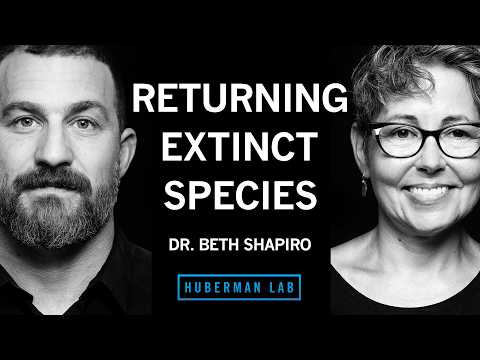
Bringing Extinct Species Back to Life | Dr. Beth Shapiro
~180 min
Episode Brief·YouTube

Bringing Extinct Species Back to Life | Dr. Beth Shapiro

Andrew Huberman
Watch on YouTube Add to chat My bookmarks← All sources

TL;DR

The four things you'd lose by not watching

4 items

TL;DR

The four things you'd lose by not watching

4 items
1

Species is a human concept, not a biological reality; de-extinction is about engineering traits, not recreating exact genomes.

2

Same synthetic biology tools used for conservation (e.g., plague-resistant black-footed ferrets, red wolf cloning).

3

Direwolves created with 20 edits from fossil genomes; three live pups (Romulus, Remus, Khaleesi).

4

Neanderthal DNA in humans: 2-5% per person, different per person, 95% of Neanderthal genome still present in living humans.

What's new

Personal practice updates, fresh positions, predictions

7 items

Species concept as human construct

early in episode, after introduction

Shapiro explains that species is a human concept; biology doesn't care about species boundaries. Different species concepts (biological, genetic, geographic) are tools for conversation.

Why this matters: Challenges common assumption that species are fixed categories; shows taxonomy arbitrary (e.g., bison bison bison).

Background

Historically, Linnaeus named animals based on appearance; DNA reveals relationships often different.

Shapiro spends several minutes explaining that species concepts are human inventions to facilitate communication. She uses examples: American bison called buffalo but not related to African/Asian buffalo; biological species concept (interbreeding) vs genetic species concept (sequence similarity). She emphasizes that the same animal can be different species depending on the concept used. This is foundational to understanding de-extinction: the goal is not to recreate a genetically identical individual but to engineer traits that make an animal capable of filling an extinct ecological niche.

Personal experience

She mentions working on bison for years, noting the taxonomic confusion.

Species is a human concept. We have this incredible proclivity to want to put things into boxes so that we can talk about them.

Also said
“Biology doesn't care what species you are.”— Reinforces that species boundaries are not biological reality.
“Your species concept is something that you have adopted to have a conversation with another person about a particular topic.”— Explains why different concepts are valid.

Neanderthal interbreeding and human evolution

after species concept discussion

Humans have 2-5% Neanderthal DNA, but it's a different 2-5% per person; 95% of Neanderthal genome exists in living humans.

Why this matters: Shows that most Neanderthal DNA is not maladaptive; the 5% missing may hold key to what makes us human.

Background

Neanderthal genome shortened the branch from 3-5 million years to 300-500k years, narrowing list of human-specific mutations.

Shapiro explains that before Neanderthal genome, we compared humans vs chimps; now we can compare to Neanderthal. The 5% of Neanderthal genome not found in any living human is where the human version was essential for survival. This is where we look for what made us human. She also discusses admixture events: Neanderthal and Denisovan interbred with humans; polar bear/brown bear hybridization example shows that hybrid bears only survive as brown bears, not polar bears due to adaptation.

Personal experience

Her husband Ed Green worked on Neanderthal genome assembly.

If they were a different species, they were violating the biological species concept at this point.

Also said
“We now know that 95% say of the Neanderl genome exists in people today.”— Quantifies how much Neanderthal DNA is still present.
“That is where the stuff that the baby had to have the human version in order for that baby to survive.”— Identifies the critical 5%.

De-extinction species selection criteria

mid-episode, after Neanderthal

Technical, ethical, ecological, and social reasons guide selection; need well-preserved DNA, understand cause of extinction, and ecological niche still available.

Why this matters: Clarifies that dinosaurs impossible due to no DNA; mammoth possible because of cold preservation; dodo genome from museum specimen.

Background

DNA degrades via UV, freeze-thaw, microbial decay; oldest DNA ~1-2 million years from mammoth.

Shapiro explains the four criteria: technical (DNA availability), ethical (should we?), ecological (niche still open?), social (public support). She gives example of mammoth: cold Arctic preservation; dodo from museum; dodo genome from bird that went to Europe. She also discusses that de-extinction is not about recreating exact genome but engineering traits that make animal capable of living in today's habitats. She uses direwolf example: 20 edits from fossil genomes, engineered into greywolf genome to recreate direwolf traits.

Personal experience

She tried hundreds of dodo bones from Mauritius; no DNA from Mauritius.

We are not trying to make something that is identical to a particular individual that used to be alive.

Also said
“If it looks like a direwolf and it's able to fill the niche of a direwolf, I'm happy to call it a direwolf.”— Shows pragmatic approach to species identity.
“We have to take an Asian elephant and turn it into a woolly animal. That trait requires changing not just the structure of the hair, but of the skin itself.”— Illustrates complexity of engineering.

Direwolf creation and safety engineering

after de-extinction process

Three direwolves created: Romulus, Remus, Khaleesi; 20 edits from fossil genomes; used safe coat color edits from living dogs to avoid blindness/deafness.

Why this matters: Demonstrates deliberate safety: they avoided edits that could cause oculocutaneous albinism in greywolf background.

Background

Fossil direwolf genomes showed variants for light coat; but same variants in living dogs cause problems; they used different safe edits from living dogs.

Shapiro explains that they sequenced genomes from fossil direwolves, learned genetic changes for size, robustness, light coat. They engineered those into greywolf genome. For coat color, they had to ensure safety: they didn't use exact direwolf variants because they could cause blindness/deafness in greywolf background. Instead, they used edits known safe from light-colored domestic dogs and greywolves. This is the approach for all projects: careful, staged, with animal welfare.

Personal experience

She describes the wolves: Romulus and Remus are boys, Khaleesi is girl; they are hand-reared, wild, not domestic. Remus is less skittish.

We decided that because we're not changing the whole genome, they have to be safe on a greywolf genetic background, we wouldn't make the trait that way. It just wasn't passing the bar of animal welfare safety.

Also said
“If it looks like a direwolf and it's able to fill the niche of a direwolf, I'm happy to call it a direwolf.”— Reiterates pragmatic species identity.
“They're also huge, right? They were at least like 120 lbs, which is big for a grey wolf.”— Physical size difference.

Black-footed ferret genetic rescue using cloning and synthetic biology

later in episode, after direwolf

Nearly extinct due to plague; cloning from frozen zoo tissues to introduce genetic diversity; also engineering plague resistance.

Why this matters: Example of using same tools for conservation: cloning red wolves, plague resistance editing.

Background

Prairie dog control killed ferrets; last wild died; then a dog killed one in Wyoming; captive breeding from few individuals; inbreeding depression; frozen zoo samples from unrelated lineage.

Shapiro explains the story: black-footed ferrets nearly extinct due to plague from prairie dogs. Captive breeding from Matiti Wyoming population. Low genetic diversity. They cloned Elizabeth Anne from 40-year-old frozen tissue, but she was infertile. Another clone reproduced. Also, they are working on editing ferrets to be resistant to plague, using synthetic biology. This is a direct application of de-extinction tools to save living species.

Personal experience

She was not personally involved but on board of Revive & Restore.

We can use the tools of synthetic biology, genetic engineering to edit the genome of these blackfooted ferrets and make them resistant to plague.

Also said
“Elizabeth Anne was the first clone of 40-year-old tissues from an animal that had lived decades earlier.”— Shows cloning from old tissue.
“We have cloned red wolves... using the same toolkit that we used to be able to clone and generate our direwolves.”— Links de-extinction to conservation.

Gene drives for ecosystem management

after ferret story

Gene drives can be used to reduce invasive species or pests, but need safety measures; they can be designed to last fixed generations.

Why this matters: Controversial but powerful tool; Shapiro argues for careful deployment.

Background

Cheatgrass in California is highly flammable, outcompetes native grasses; gene drive could tamp it down.

Shapiro discusses gene drives: they can be made to last only a fixed number of generations, and natural selection works against them. She gives example of cheatgrass in California, which is invasive and causes fires. She suggests that using a gene drive to reduce cheatgrass for a few generations could allow native grasses to recover. She emphasizes that doing nothing is also a decision, and we must consider risks vs benefits.

Personal experience

She mentions spending time in Arctic with mosquitoes.

If we say these technologies... are too risky we are accepting the outcome of doing nothing which is also a decision.

Also said
“You can make a gene drive so it only lasts for a fixed number of generations.”— Shows controllability.
“There is incredibly strong natural selection against them.”— Natural brakes.

Human genetic selection and ethics

near end

Humans already select mates based on traits; embryo selection for height/IQ is happening; Shapiro argues that the real ethical issue is removing future freedom of choice.

Why this matters: Connects de-extinction ethics to human genetic editing; discusses the Chinese CRISPR babies.

Background

IVF and embryo screening exist; companies offer IQ/tall selection; Chinese scientist edited HIV receptor.

Shapiro discusses that we already do genetic selection by choosing mates. Height is heritable and has been selected in Northern Europe via migration. She argues that what offends us about embryo selection is that it removes the child's freedom to choose their own path. She also mentions that a pandemic could push us over the edge to accept gene editing for survival. She uses the example of baby KJ cured of urea cycle deficiency using CRISPR base editing, which was celebrated, not condemned.

Personal experience

She is 5' tall, didn't get tall genes.

What offends us about it... is that while we don't care that a Chihuahua and a boxer we pick, we engineer to have different traits... we like to think of people as not having niches to fill, as having some freedom of choice.

Also said
“We would be naive to imagine that it doesn't happen, that it hasn't happened throughout our evolutionary history.”— Normalizes selection.
“The most morally reprehensible thing that we could imagine doing becomes the actual only ethical solution.”— Pandemic scenario.
Disclosed sponsorships2speaker disclosed

How to Clone a Mammoth

Book Sponsored · disclosed

Book about de-extinction science and ethics.

DisclosureAuthor is Dr. Beth Shapiro

I wrote a book a long time ago now called How to Clone a Mammoth.

Find How

Life as We Made It

Book Sponsored · disclosed

Book about how humans have been modifying species and turning editing on ourselves.

DisclosureAuthor is Dr. Beth Shapiro

My last book is called Life as We Made It.

Find Life

Notable quotes

Lines worth pulling out — contrarian, specific, or perfectly phrased

5 items
Biology doesn't care what species you are.
Core message that species is human construct.
If it looks like a direwolf and it's able to fill the niche of a direwolf, I'm happy to call it a direwolf.
Pragmatic approach to de-extinction identity.
Doing nothing is not not deciding; doing nothing is saying we accept the fact that we are going to have a future that is less biodiverse than the present.
Powerful ethical argument for intervention.
We are doing both. It is the same tools. It's the same technology. It's the same needs.
Refutes criticism that de-extinction distracts from conservation.
The most morally reprehensible thing that we could imagine doing becomes the actual only ethical solution.
Thought-provoking on pandemic scenario for human gene editing.

Sign in to share feedback

Tell us if this brief hit the mark or missed it — feedback feeds back into the next iteration of the prompt.

Topics covered

species conceptde-extinctiondirewolfneanderthalhuman evolutionancient DNAsynthetic biologyconservation geneticsgene drivescloningblack-footed ferretpolar bear hybridizationdodomammothgene editing ethicshuman genetic selectionartificial wombecosystem restorationcheatgrasscrispr
Free account

Make this library yours

Reading is free for everyone. A free account adds the personal layer: save protocols, follow experts, and see how the other experts weigh in on this same topic.

Create a free accountSign in

Where the experts disagree — weekly

One email a week: the sharpest new disagreements and protocols from the library. No spam, unsubscribe anytime.

Educational summary of the cited expert source — not medical advice. Open the source recording linked above and consult a qualified physician before acting on any protocol.