UNFUCG
DashboardSearchChatBookmarksNotificationsActivityPremiumProfile
?
Home
Search
Chat
Saved
Profile
Episode
Why You Should Eat Blueberries Every Day As You Age
~70 min
Episode Brief·YouTube

Why You Should Eat Blueberries Every Day As You Age

Rhonda Patrick
Watch on YouTube Add to chat My bookmarks← All sources

TL;DR

The four things you'd lose by not watching

4 items

TL;DR

The four things you'd lose by not watching

4 items
1

Blueberries improve vascular function by enhancing flow-mediated dilation (FMD) by ~1–1.5 percentage points, which translates to ~12% lower cardiovascular event risk per point.

2

In older adults, daily blueberry consumption improves episodic memory and cognitive flexibility; long-term intake is associated with slower cognitive aging (equivalent to 1.5–2.5 years younger).

3

Metabolic benefits are most evident in insulin-resistant individuals: one study showed 22% improvement in insulin sensitivity with 2 cups/day, though a replication attempt failed.

4

Blueberry polyphenols are transformed by the gut microbiome into signaling metabolites that influence nitric oxide, inflammation, gene expression, and more; the effective dose appears to be about 1 cup per day.

Protocols

Concrete recipes — what, when, how much, and why

3 items

Daily blueberry consumption

WhatConsume approximately one cup of whole, fresh, or frozen blueberries per day.
WhenDaily, ideally with a meal or as a replacement for refined carbohydrate dessert.
Dose1 cup (approx 160–385 mg anthocyanins depending on type)
For whomGeneral population, especially older adults, those with metabolic syndrome or insulin resistance.
WhyImproves vascular function (FMD), supports brain health, metabolic resilience, gut health, exercise recovery.
CaveatsHalf cup may not be sufficient for vascular benefits; two cups may be needed for insulin sensitivity (based on one study). Individual variation.

She summarizes the evidence across domains. The strongest evidence is vascular: multiple meta-analyses show 1–1.5 percentage point improvement in FMD, which correlates with lower cardiovascular risk. Brain: RCTs show improved episodic memory and cognitive flexibility. Metabolic: effects most evident under challenge (post-meal, insulin resistance). Gut: polyphenols transformed by microbiome. Exercise: shifts oxylipins toward resolution. The dose of 1 cup is practical and supported by most trials.

Mechanism

Polyphenols are metabolized into signaling molecules that enhance nitric oxide production, reduce oxidative stress, modulate inflammation, and influence gene expression. Specifically, anthocyanins improve endothelial function via nitric oxide preservation.

Personal experience

She mentions her own smoothie practice (avocado instead of banana) but not specifically about daily consumption.

About one cup per day.

Also said
“The equivalent of about one cup of blueberries per day seems to be the sweet spot.”— Reinforces dose
“It's a dose that's practical, affordable, it's easy to sustain.”— Practicality

Smoothie optimization to preserve polyphenols

WhatWhen making a blueberry smoothie, avoid high-polyphenol oxidase foods like bananas; use low-PO alternatives like avocado.
WhenWhen preparing smoothies.
For whomIndividuals aiming to maximize polyphenol intake from blueberries.
WhyBanana PO can degrade blueberry polyphenols, potentially reducing health benefits.
CaveatsNot proven to reduce blueberry-specific benefits; based on mechanistic plausibility and one human study on epicatechin. Bananas are still healthy; this is an optimization.

She details the chemistry: banana PO activity is 270x higher than blueberry. Direct targets include chlorogenic acid, catechin, epicatechin. Quinones from those reactions then degrade anthocyanins. Human study showed 84% reduction in epicatechin metabolites. She swaps banana for avocado for creaminess and monounsaturated fat which increases bioavailability of lutein from kale.

Mechanism

Polyphenol oxidase enzyme in bananas oxidizes chlorogenic acid and other polyphenols, generating quinones that degrade anthocyanins.

Personal experience

When I make my blueberry smoothie, I am trying to maximize the polyphenols and therefore I leave out the banana. I swap it with an avocado.

I'm choosing not to blend them with my blueberry smoothie.

Also said
“Avocado has low PO activity... I like the monounsaturated fat which increases the bioavailability of some of the other components.”— Alternative choice

Blueberries for exercise recovery

WhatConsume approximately one cup of blueberries per day for 2–3 weeks before and after strenuous exercise.
WhenBefore and after damaging exercise (eccentric, downhill running).
Dose1 cup/day for 2–3 weeks leading up to and after exercise.
For whomAthletes or individuals engaging in strenuous eccentric exercise.
WhyShifts oxylipin profile toward resolution of inflammation, potentially speeding recovery of muscle strength.
CaveatsDoes not prevent initial muscle damage or soreness; does not replace carbohydrates or protein. Evidence is preliminary.

She describes crossover study in women: blueberries did not prevent strength loss but strength returned faster. Two trials showed shift in oxylipin response. She emphasizes that inflammation is needed for adaptation; blueberries help resolve it efficiently.

Mechanism

Blueberries influence oxylipins – short-lived lipid signals that coordinate inflammation and its resolution. Pro-inflammatory signals lower, omega-3 derived resolution signals higher.

Blueberries appear to help the body move more efficiently from inflammation into repair and recovery.

Also said
“Several pro-inflammatory signals were lower while some omega-3 derived signals involved in inflammation resolution were actually higher after blueberry consumption.”— Mechanistic detail

What's new

Personal practice updates, fresh positions, predictions

4 items

Blueberry polyphenols as signaling molecules

Blueberry anthocyanins and their metabolites act as biological signaling molecules, not just direct antioxidants.

Why this matters: Shifts understanding from simple antioxidant to complex signaling network.

Background

Traditional view was that polyphenols directly neutralize free radicals.

She explains that most polyphenols are transformed by gut and liver into metabolites that circulate at low concentrations and influence enzyme activity, nitric oxide production, gene expression, etc. She compares to lactate and ketones as signaling molecules. This reframes the mechanism.

Blueberry anthocyanins are transformed into metabolites that act like biological signaling molecules.

Also said
“They can influence processes in the body like nitric oxide production, endogenous antioxidant defenses, inflammatory pathways, enzyme activity, gene expression, and on and on.”— Lists the broad effects

Dose threshold for vascular benefits

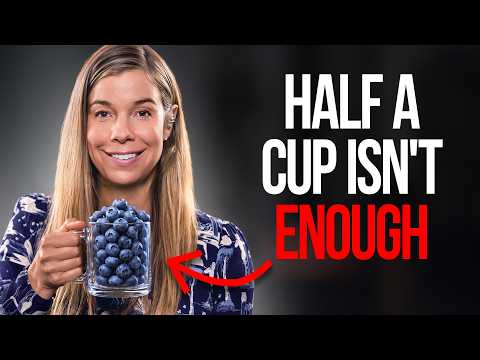
In a 6-month trial in metabolic syndrome, 1 cup/day improved FMD and arterial stiffness, but 1/2 cup did not.

Why this matters: Establishes a minimum effective dose.

Background

Previous studies used varying doses; this trial directly compared two doses.

Details of the study: participants with metabolic syndrome, 1 cup vs 1/2 cup vs placebo. Only full cup showed 1.5 percentage point improvement in FMD and 2.24 point decrease in augmentation index. This suggests a threshold.

It was the full cup that was required.

Also said
“The half a cup equivalent dose of blueberries did not have the same vascular benefits as the full cup.”— Confirms lack of effect at lower dose

Banana-blueberry smoothie interaction

Banana polyphenol oxidase (PO) can degrade blueberry polyphenols, especially chlorogenic acid and indirectly anthocyanins, potentially reducing health benefits.

Why this matters: Mechanistic evidence and human study show 84% reduction in epicatechin metabolites; personal practice change.

Background

Bananas have high PO activity; blending can cause enzymatic oxidation.

She explains PO enzyme, direct targets (epicatechin, catechin, chlorogenic acid), and indirect degradation of anthocyanins via quinones. Human study with cocoa extract showed 84% lower epicatechin metabolites. Even separate sips reduced by 37%. She concludes that while not tested directly on blueberries, the mechanism is plausible.

Personal experience

When I make my blueberry smoothie, I am trying to maximize the polyphenols and therefore I leave out the banana. I swap it with an avocado.

I am not avoiding bananas. I'm choosing not to blend them with my blueberry smoothie.

Also said
“The mechanistic evidence is sufficient to justify a cautious approach when the goal for me is to maximize blueberry polyphenol exposure.”— Her rationale

Failed replication of insulin sensitivity improvement

Her postdoc trial using 2 cups/day freeze-dried blueberry powder did not replicate the 22% improvement in insulin sensitivity seen in an earlier study.

Why this matters: Highlights complexity and need for more research.

Background

Earlier study used hyperinsulinemic-euglycemic clamp; her trial used HOMA-IR and OGTT, not gold standard.

She describes her involvement in Dr. Bruce Ames lab, 8-week double-blind trial in overweight insulin-resistant adults. They measured many markers but found no improvement in insulin resistance. However, HDL increased 7%, adiponectin and SAM increased. She notes limitations: did not use clamp.

Personal experience

I have a very personal connection to this study because during my post-doctoral work in Dr. Bruce Ames lab, I was involved in a clinical trial using blueberries.

We were unable to reproduce the improvement in insulin resistance.

Also said
“Neither HOMA-IR nor the response to an oral glucose tolerance test improved.”— Specific negative result
“HDL cholesterol was increased by about 7%. We saw adiponectin move up in a favorable direction.”— Other positive changes

Recommendations

Products, supplements, and tools mentioned in the episode

1 item

Whole blueberries (fresh or frozen)

Product

Daily consumption of approximately one cup of blueberries for vascular, brain, metabolic, gut, and exercise recovery benefits.

She emphasizes that the evidence supports whole blueberries over supplements due to the complex chemical network and food matrix. The dose is practical and affordable.

vs alternatives

Compared to other fruits, blueberries have the strongest evidence for vascular function due to anthocyanin content. Bananas are healthy but high PO activity may reduce polyphenol bioavailability when blended.

About one cup per day.

Also said
“It's a dose that's practical, affordable, it's easy to sustain.”— Practicality
Find Whole

Notable quotes

Lines worth pulling out — contrarian, specific, or perfectly phrased

6 items
Blueberry anthocyanins are transformed into metabolites that act like biological signaling molecules.
Core mechanistic insight that reframes how blueberries work.
The equivalent of about one cup of blueberries per day seems to be the sweet spot.
Key practical takeaway for dosing.
I am not avoiding bananas. I'm choosing not to blend them with my blueberry smoothie.
Nuanced personal practice that avoids demonizing a healthy food.
We were unable to reproduce the improvement in insulin resistance.
Honest reporting of a failed replication, showing scientific integrity.
Blueberries appear to help the body move more efficiently from inflammation into repair and recovery.
Summarizes the exercise recovery mechanism.
The strongest benefit is vascular.
Clear hierarchy of evidence from the episode.

Sign in to share feedback

Tell us if this brief hit the mark or missed it — feedback feeds back into the next iteration of the prompt.

Topics covered

brain agingcognitive declineepisodic memorycognitive flexibilityvascular functionendothelial functionflow-mediated dilationarterial stiffnessmetabolic healthinsulin sensitivityglucose regulationgut microbiomepolyphenol metabolismanthocyaninschlorogenic acidproanthocyaninsexercise recoveryoxylipinsinflammation resolutionbanana polyphenol oxidase
Free account

Make this library yours

Reading is free for everyone. A free account adds the personal layer: save protocols, follow experts, and see how the other experts weigh in on this same topic.

Create a free accountSign in

Where the experts disagree — weekly

One email a week: the sharpest new disagreements and protocols from the library. No spam, unsubscribe anytime.

Educational summary of the cited expert source — not medical advice. Open the source recording linked above and consult a qualified physician before acting on any protocol.