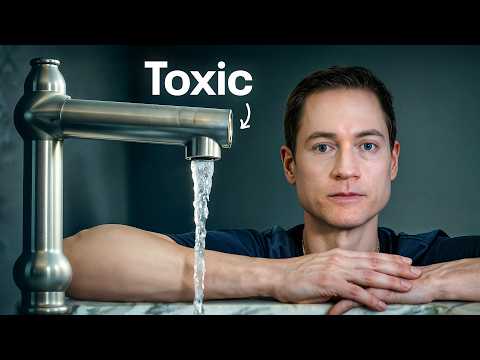
Episode
Your House Is Making You Sick (15 Solutions)
~19 min
Episode Brief·YouTube

Your House Is Making You Sick (15 Solutions)

Bryan Johnson

TL;DR

The four things you'd lose by not watching

4 items
1

Remove shoes at the door to prevent 85% of outdoor contaminants like lead and pesticides from entering your home.

2

Install a reverse osmosis water filtration system to remove heavy metals, PFAS, and microplastics, reducing dissolved substances from over 300mg to almost nothing.

3

Replace gas stoves with induction cooktops to eliminate nitrogen dioxide and fine particle emissions linked to childhood asthma.

4

Use red LED lighting in the evenings and black out your bedroom completely to improve sleep quality by preserving melatonin production.

Protocols

Concrete recipes — what, when, how much, and why

9 items

Remove shoes at the door

WhatTake off shoes immediately upon entering the house.
WhenEvery time you enter the house.
For whomEveryone living in or visiting a home.
WhyPrevents 85% of outdoor contaminants, including lead and pesticides, from being tracked inside, reducing internal exposure.

The first four steps inside a house are responsible for tracking in 85% of outdoor contaminants, such as lead and pesticides. Once these substances are inside the home, they are much more likely to enter the bodies of the occupants. Therefore, the simple act of removing shoes at the door is a highly effective first line of defense against indoor pollution.

Mechanism

Contaminants from the outside world (e.g., lead, pesticides) adhere to shoe soles. By removing shoes at the door, these substances are contained to the entryway, preventing their spread throughout the living space where they are more likely to be inhaled or ingested by residents.

The thing to be aware of is the first four steps inside the house tracks 85% of the outside world's contaminants includes leads and pesticides. So the big one here is remove your shoes at the door.

Monitor indoor air quality

WhatUse specialized sensors to measure indoor air quality.
WhenContinuously, or regularly.
For whomAnyone concerned about indoor air quality.
WhyIdentifies specific toxins (PM2.5, VOCs, CO2) and assesses the effectiveness of air purification systems.

Indoor air quality can be significantly compromised by toxins and carcinogens entering through windows, vents, and even from gas stoves. To understand the extent of this problem, specialized air quality monitors are essential. Bryan uses two types: one that provides detailed readings for specific toxins like PM2.5, PM1, PM10, and VOCs, and another that gives a more general Air Quality Index (AQI) and CO2 levels. These monitors offer constant recording, enabling users to track air quality trends and confirm that their air purifiers and HVAC systems are functioning optimally.

Mechanism

Sensors detect various airborne pollutants like PM2.5 (fine particulate matter), VOCs (volatile organic compounds), and CO2. Continuous monitoring provides real-time data, allowing individuals to understand their exposure levels and verify if air purifiers or HVAC filters are effectively reducing these contaminants.

Personal experience

Now, I have two monitors. For example, this guy gives you something called PM2.5. That's a particular kind of toxin, and I want to know what it is. There's also PM1, PM10. I see VOCC's on this one. This guy gives me a much more general number of AQI.

To see how bad the problem is, you'll need to measure your indoor air quality with specialized sensors.

Also said
These are really nice in that they give me a constant recording of the air quality inside the home. That allows me to know if my air purifiers are working and as we'll get to later, the filter in my HVAC system.Highlights the practical benefit of continuous monitoring.

Check smoke alarms, carbon monoxide detectors, and radon levels

WhatEnsure smoke alarms and carbon monoxide detectors are functional and test for radon.
WhenSmoke alarms/CO detectors: test monthly. Radon: test if not done previously.
For whomAll homeowners/residents.
WhyAddresses critical, life-threatening indoor hazards; radon is the second leading cause of lung cancer.

Beyond general air quality, there are specific, critical hazards that require attention. Smoke alarms, while common, are often neglected, contributing to a high percentage of fire-related deaths. Carbon monoxide detectors are also essential for detecting this dangerous gas. Furthermore, radon, an invisible and odorless gas originating from the earth, is the second most prominent cause of lung cancer after smoking. It's crucial to have a radon test done if you haven't already, and to regularly check smoke and CO detectors by pressing their test buttons monthly.

Mechanism

Smoke alarms detect fire, CO detectors sense carbon monoxide (an odorless, colorless gas), and radon tests measure the concentration of radioactive gas emanating from the earth. Ensuring these are functional or measured mitigates immediate and long-term health risks by providing early warning or identifying a significant carcinogen.

This is a carbon monoxide detector, which again is a good one to have. And then also radon. So radon is an invisible odorless gas that comes from the earth.

Also said
It's actually the second most prominent cause of lung cancer behind smoking. So it really is a meaningful risk and you want to make sure you know where your radon levels are.Emphasizes the severity of radon risk.

Replace plastic items with safer materials

WhatSubstitute plastic products, especially in the kitchen, with wood, ceramic, or food-grade stainless steel.
WhenGradually, as plastics are identified.
For whomEveryone.
WhyReduces exposure to unknown chemicals and microplastics that are pervasive in plastic products.
CaveatsIt's challenging to eliminate all plastic, as it's ubiquitous, even in medical devices.

Despite efforts to remove plastic from his environment, Bryan Johnson notes its pervasive presence, even in new medical devices. He advises mindfulness in daily routines to identify and replace plastic items with safer alternatives such as wood, ceramic, or food-grade stainless steel. He acknowledges that this is a difficult task due to plastic's ubiquity but stresses the importance of reducing exposure to its unknown chemical components.

Mechanism

Plastics can leach chemicals and shed microplastic particles into food, water, and the environment. By replacing plastic items with inert materials like stainless steel, ceramic, or wood, the potential for chemical migration and microplastic exposure is significantly reduced.

Personal experience

Even after several months of trying to remove all plastics from my house, I still occasionally find things like how did this get in here? So, just be mindful as you go about your daily routines. Find plastic and replace it with wood, ceramic, uh stainless steel, a food grade stainless steel.

Just be mindful as you go about your daily routines. Find plastic and replace it with wood, ceramic, uh stainless steel, a food grade stainless steel.

Avoid non-stick pans

WhatDo not use non-stick pans for cooking.
WhenAlways.
For whomEveryone who cooks.
WhyNon-stick coatings often contain PFAS ('forever chemicals') which are harmful.

When it comes to cooking materials, Bryan specifically advises against using non-stick pans. These pans often contain PFAS, or 'forever chemicals,' which are known to be harmful and persistent in the body. He recommends using materials like food-grade stainless steel or cast iron as safe alternatives that do not contain these dangerous chemicals.

Mechanism

Non-stick pans typically use per- and polyfluoroalkyl substances (PFAS), also known as 'forever chemicals,' which can leach into food, especially when heated. These chemicals are persistent in the environment and human body and are linked to various health issues. Using alternatives like stainless steel or cast iron eliminates this source of exposure.

You want to specifically avoid non-stick pans. They can have PAS. These are forever chemicals. They're really bad chemicals. You don't want them in your body.

Replace gas stoves with induction stoves

WhatSwitch from gas-burning stoves to induction cooktops.
WhenAs soon as feasible.
For whomAnyone with a gas stove.
WhyGas stoves release nitrogen dioxide and fine particles, linked to childhood asthma.

Bryan highlights gas stoves as a significant source of indoor pollution. Even using just one gas burner can rapidly increase levels of nitrogen dioxide and fine particles, which are linked to approximately 13% of childhood asthma cases in the US. He plans to replace his own gas stove with an induction stove to eliminate these harmful emissions. For a period, his chef even cooked off-site to avoid using the gas stove in his home.

Mechanism

Gas stoves emit nitrogen dioxide (NO2) and fine particulate matter (PM2.5) during combustion. These pollutants can quickly spike indoor air levels and are associated with respiratory problems, particularly childhood asthma. Induction stoves, which use electromagnetic fields to heat cookware directly, do not produce these combustion byproducts, thereby improving indoor air quality.

Personal experience

For years, I have a gas burning stove, which is not a good idea. Here's why. Using just one gas burner quickly spikes nitrogen dioxide and fine particles. These are linked to around 13% of childhood asthma cases in the US. And you breathe them in every time you cook. for a while. My chef made the food at their house and they delivered it. My current chef comes here and makes the food here. So, I'm going to replace this gas stove with an induction stove.

So, for years, I have a gas burning stove, which is not a good idea. Here's why. Using just one gas burner quickly spikes nitrogen dioxide and fine particles.

Use red LED lighting before bed

WhatSwitch to dim red LED lights in living areas.
When2 hours before bedtime.
Dose2 hours
For whomAnyone looking to improve sleep quality.
WhyRed light helps the body wind down and prepares for sleep by not suppressing melatonin.

Modern environments, including homes, are often filled with white and blue light, which can significantly delay sleep onset by decreasing melatonin production. Bryan uses a low-cost red lamp in the evenings. He turns it on as it gets dark, finding it provides enough light to navigate while creating a soothing and calming atmosphere that signals readiness for bed. He suggests using a dim red LED in the living room for two hours before sleep to help the body wind down.

Mechanism

Blue and white light, common in modern environments, can suppress melatonin production, delaying sleep onset. Red light, with its longer wavelength, has minimal impact on melatonin, allowing the body to naturally prepare for sleep. Using dim red LEDs creates a calming atmosphere that signals to the body it's time to wind down.

Personal experience

So, one thing I have is a lowcost red lamp. This guy is maybe $30. I have nice natural light in the home. So, I rarely turn on lights in the house at all. But at night, when it's getting dark, I'll turn this guy on. It's enough light to navigate the house. It's a really cool vibe. It's soothing. It's calming. I know we're getting ready for bed.

Try using a dim red LED in your living room and do so 2 hours before bed. It will help your body wind down and prepare for sleep.

Black out bedroom for sleep

WhatEnsure the bedroom is completely dark.
WhenDuring sleep.
For whomAnyone seeking optimal sleep.
WhyEven minimal light (10 lux) can halve melatonin production and fragment sleep, significantly improving sleep quality.
CaveatsIf a full blackout is not possible, use an eye mask.

Bryan emphasizes that a completely blacked-out bedroom substantially improves sleep quality. He notes that the body is extremely sensitive to light, with even 10 lux capable of halving melatonin production and fragmenting sleep. He ensures his own bedroom sees no light ever. For those who cannot achieve a full blackout due to their living situation, he suggests using an eye mask as an alternative.

Mechanism

The human body is highly sensitive to light, even low levels (10 lux) can disrupt the circadian rhythm by suppressing melatonin, a hormone crucial for sleep. A completely blacked-out room ensures maximum melatonin production and prevents light from fragmenting sleep, leading to deeper, more restorative rest.

Personal experience

The first thing you're going to notice is it is completely blacked out. I've noticed in my own testing of the various places I've slept, either hotel rooms or bedrooms, a blacked out bedroom substantially improves sleep quality.

Even 10 lux of light can half your melatonin production and fragment your sleep. Your body is hyper sensitive to light.

Use pink noise for sleep

WhatPlay pink noise in the bedroom.
WhenDuring sleep.
For whomAnyone with inconsistent sleep due to noise.
WhySmooths out environmental noise spikes, reducing the likelihood of waking up.
CaveatsIndividual results may vary; measure sleep to confirm effectiveness.

Bryan uses a noise machine in his bedroom, a practice he started when living next to a noisy road. He found it improved his sleep by smoothing out noise spikes. He continues this practice even in a quieter home, noting it provides incremental improvement by making environmental noises more steady and reducing awakenings. He specifically recommends pink noise, describing it as less high-pitched than white noise and having an audio signature similar to natural sounds like rustling leaves, rain, and wind.

Mechanism

Pink noise, characterized by a lower frequency and less high-pitched sound than white noise, has a sound signature similar to natural phenomena like rustling leaves or rain. It helps to mask sudden environmental noises, creating a more consistent auditory background that prevents sleep disruptions caused by noise spikes, thereby promoting more stable sleep.

Personal experience

I started doing this because I lived in an apartment next to a road and there would be loud cars all night long, motorcycles. I started using this to see if I could smooth out the the noise so I wouldn't have these spikes. It did in fact improve my sleep. So, I carried it over to this house.

Pink noise is best. It's less high-pitched than white noise and has a similar audio signature to rustling leaves, rain, and wind.

What's new

Personal practice updates, fresh positions, predictions

3 items

Personal approach to EMFs

10:00

Bryan Johnson and his team are studying the effects of EMFs and currently take precautions like keeping routers out of the bedroom and disabling phone Wi-Fi/Bluetooth at night, but are awaiting more data.

Why this matters: He admits uncertainty on the topic, highlighting a scientific, data-driven approach rather than immediate adoption of popular concerns.

Bryan Johnson acknowledges the common concern around electromagnetic fields (EMFs) but states that he and his team are still in the process of studying its impact. He doesn't have a definitive stance on whether it's a 'big deal, a medium deal, or not a big deal.' In the interim, he takes precautionary measures such as keeping his Wi-Fi router outside his bedroom and turning off Wi-Fi, mobile data, and Bluetooth on his phone while sleeping to minimize emissions. He emphasizes that this is a topic they are actively investigating and promises updates once they have more conclusive data.

Personal experience

I keep my router outside the bedroom. So, I have my phone inside the room. I turn off Wi-Fi and mobile and Bluetooth. So, the phone is emitting as little as it can. But, we're going to do a study as a team. We're going to figure out what we think about it. I'm not quite sure if it's a big deal, a medium deal, or not a big deal.

My team and I are about to study this. We don't know what we think about this.

Skepticism about 'organic' labels and cleaning product apps

5:50

Bryan expresses distrust in 'organic' food labels based on his own testing and is cautious about endorsing apps for identifying toxic cleaning products, advocating for third-party lab testing instead.

Why this matters: He challenges common assumptions about product labeling and consumer tools, emphasizing a need for rigorous, independent verification.

Bryan Johnson voices significant skepticism regarding the efficacy and trustworthiness of 'organic' labels on food products, stating that his personal testing has shown them to be 'worthless.' This distrust extends to apps designed to identify potentially toxic cleaning supplies. While he uses such apps as a starting point, he is not confident in their accuracy or ability to fully disclose all harmful ingredients. He advocates for a more rigorous approach, similar to his food testing protocols, where third-party lab analysis is used to genuinely understand the chemical composition of products, as ingredient labels often don't tell the full story.

Personal experience

I know from testing foods for example organic is worthless. I've tested enough organic foods I don't trust it at all as a label. So I don't want to go on to say I want to endorse any products or even the apps other than I'm trying just like you and perhaps we will get into here's my general collection of things but I do want to say that what we have done for food and testing with third party labs and being legit in the testing I do think we want to do for this because you of course can look at an ingredient label uh that includes supplies or food that tells you one set of things but testing in a lab reveals an entirely other set of things.

I know from testing foods for example organic is worthless. I've tested enough organic foods I don't trust it at all as a label.

Also said
So, I can look at this guy and say, "What's on the label?" But if I want to send it to lab, I may discover there's a lot more things in there than I thought.Illustrates his point about labels not being comprehensive.

Autonomous self and system building for health

10:30

He advocates for building 'systems and habits' that automate health-promoting behaviors, likening it to putting his house on autopilot to avoid repeated decision-making and anxiety.

Why this matters: This reflects his broader 'Project Blueprint' philosophy of optimizing life through systematic approaches, extending it to the home environment.

Bryan Johnson emphasizes the importance of creating automated systems and habits for health, rather than relying on constant conscious decision-making. He refers to this as putting his 'house on autopilot' and part of his 'autonomous self' philosophy. The goal is to implement solutions that, once set up (like a high MERV filter in an HVAC system), continue to provide benefits without requiring ongoing effort or causing 'anxiety loops.' He acknowledges that achieving this level of optimization takes time, noting his own home took five years to build to its current state, encouraging patience and a step-by-step approach.

Personal experience

You see throughout the house I've tried to put this house on autopilot. I think about this as my autonomous self. All things I do for health, I try to never make a decision twice. Once system solved.

Build systems. So, that's why, for example, putting a high MER filter in your HVAC system is really good. You put it in and you forget about it.

Also said
So most of these things you're trying to say systems and habits solve for health. That way it avoids you going through anxiety loops of having to do the same thing again and again.Explains the core benefit of system building.

Recommendations

Products, supplements, and tools mentioned in the episode

9 items

Air Quality Monitors (PM2.5, VOCs, AQI, CO2)

Tool

Used to measure indoor air quality, including specific toxins like PM2.5, VOCs, and general AQI/CO2 levels.

Bryan uses two types of air quality monitors: one that provides detailed readings for specific particulate matter (PM2.5, PM1, PM10) and volatile organic compounds (VOCs), and another that offers a more general Air Quality Index (AQI) and CO2 levels. These devices are crucial for continuously recording indoor air quality, allowing users to understand their exposure to pollutants and verify the effectiveness of their air purifiers and HVAC filtration systems.

Personal experience

Now, I have two monitors. For example, this guy gives you something called PM2.5. That's a particular kind of toxin, and I want to know what it is. There's also PM1, PM10. I see VOCC's on this one. This guy gives me a much more general number of AQI.

To see how bad the problem is, you'll need to measure your indoor air quality with specialized sensors.

MERV 13 HVAC filter

Tool

A high-efficiency filter for HVAC systems to capture toxins.

Bryan uses a MERV 13 filter in his HVAC system, which is a rating indicating its ability to capture a high percentage of toxins. He notes that while MERV 13 is highly effective, not all HVAC systems can handle this level of filtration without issues. He advises checking your system's rating, as a MERV 8 filter only captures about 30% of PM2.5. The HVAC system, with an appropriate MERV filter, should be the primary defense for air quality in a home, with portable air purifiers as an add-on.

vs alternatives

MERV 8 filters only capture about 30% of PM2.5, making MERV 13 significantly more effective if the system can support it.

Personal experience

This is a MV 13 filter. So, MV is a rating of how many toxins your filter is going to capture. For this particular HVAC system, it can handle a Merv 13, but not all HVAC systems can handle that much.

This is a MV 13 filter. So, MV is a rating of how many toxins your filter is going to capture.

Also said
A Merv 8 is only going to capture about 30% of PM 2.5. So, the higher you can go, the better, but don't go higher than your system is rated, otherwise it will cause problems.Provides specific comparison and caveat for MERV ratings.

Reverse Osmosis (RO) Water Filtration System

Tool

A system for filtering tap water to remove contaminants like heavy metals, PFAS, and microplastics.

Bryan emphasizes that tap water can be a significant source of contaminants, including heavy metals, PFAS, and microplastics. He uses a reverse osmosis system, which he states does an excellent job of filtering these out. His monthly testing shows that while tap water can have over 300 mg of dissolved substances, his RO system reduces this to almost nothing. These systems range from a few hundred to over a thousand dollars and require regular filter replacement every few months.

Personal experience

I have a reverse osmosis water system that does a great job filtering for these contaminants. If you get a good water filtration system, these reverse osmosis systems cost between a few hundred to over a thousand, but the water's clean. We test it every month.

I have a reverse osmosis water system that does a great job filtering for these contaminants.

Also said
Straight from the tap, you get over 300 mg of dissolved substances. With reverse osmosis, that drops to almost nothing.Quantifies the effectiveness of RO filtration.

Food-grade stainless steel / Cast iron pans

Tool

Recommended materials for cooking pans to avoid PFAS found in non-stick coatings.

To avoid the harmful PFAS ('forever chemicals') found in non-stick pans, Bryan recommends using cooking materials that do not contain these substances. His preferred alternatives are food-grade stainless steel and cast iron. These materials offer a safe cooking surface without the risk of chemical leaching associated with non-stick coatings.

vs alternatives

Non-stick pans contain PFAS, which are 'forever chemicals' and harmful. Stainless steel and cast iron do not.

This, for example, is food grade stainless steel. You could also use cast iron. None of these have PAS.

Induction stove

Tool

An electric cooking appliance that uses electromagnetic fields to heat cookware directly.

Bryan plans to replace his gas stove with an induction stove due to the harmful pollutants emitted by gas cooking. Gas stoves release nitrogen dioxide and fine particles, which are linked to childhood asthma. Induction stoves, by contrast, do not produce these combustion byproducts, offering a cleaner indoor air environment.

vs alternatives

Gas stoves release harmful pollutants like nitrogen dioxide and fine particles; induction stoves do not.

Personal experience

My current chef comes here and makes the food here. So, I'm going to replace this gas stove with an induction stove.

So, I'm going to replace this gas stove with an induction stove.

Window film (99% UVA/UVB filter)

Tool

Film applied to windows to filter out 99% of UVA and UVB radiation.

As someone sensitive to the sun, Bryan uses window film to control his light exposure, filtering out 99% of UVA and UVB. He explains that non-tinted glass still allows 37% of UVA to pass through, which contributes to skin aging and melanoma risk. This film allows him to manage his sun exposure intentionally, choosing when and how much sun he gets, rather than passively receiving it through windows all day.

vs alternatives

Non-tinted glass allows 37% of UVA to pass through, whereas the film blocks 99% of both UVA and UVB.

Personal experience

So, I have here film on my windows, which filters out 99% of UVA and UVB because I want controlled light exposure.

So, I have here film on my windows, which filters out 99% of UVA and UVB because I want controlled light exposure.

Also said
Non-tinted glass allows 37% of UVA to come through the window. So, there's a substantial amount of UVA coming through the window.Quantifies the amount of UVA blocked by the film compared to regular glass.

Vacuum with HEPA filter

Tool

A vacuum cleaner equipped with a High-Efficiency Particulate Air (HEPA) filter.

Carpets can harbor ten times more dust, allergens, and microbes than hard floors. While hard floors are preferred, if carpets are present, a vacuum with a HEPA filter is crucial. This type of vacuum removes 99.97% of microplastic particles, significantly reducing chronic irritation and respiratory issues. Regular vacuuming (twice a week) with such a device can offset the negative aspects of carpets.

One thing you can do is have a vacuum with a HEPAR filter. Then, vacuum twice a week. that will be a great offset to the things it will otherwise store.

Also said
A good hepailter on your vacuum removes 99.97% of microplastic particles, which helps you avoid chronic irritation and respiratory issues.Quantifies the effectiveness and benefits of a HEPA filter.

Red LED lamp

Tool

A low-cost red light source for evening use.

To combat the sleep-disrupting effects of white and blue light, Bryan uses an inexpensive red LED lamp in the evenings. He finds it provides sufficient light for navigation while creating a soothing and calming atmosphere that signals the body to prepare for sleep. This practice helps to preserve melatonin production, which is crucial for sleep onset and quality.

vs alternatives

White and blue light from typical household lighting can delay sleep onset by decreasing melatonin production.

Personal experience

So, one thing I have is a lowcost red lamp. This guy is maybe $30. I have nice natural light in the home. So, I rarely turn on lights in the house at all. But at night, when it's getting dark, I'll turn this guy on. It's enough light to navigate the house. It's a really cool vibe. It's soothing. It's calming. I know we're getting ready for bed.

So, one thing I have is a lowcost red lamp. This guy is maybe $30.

Portable HEPA air purifier

Tool

A standalone air purifier with a HEPA filter for individual rooms, especially bedrooms.

While a good MERV filter in the HVAC system is a primary defense, Bryan also uses multiple air purifiers in his bedroom, including a commercial-grade IQR system, to ensure pristine air quality during the 8 hours he spends sleeping. For a quick and effective solution, he recommends a portable HEPA air purifier for the bedroom. Plugging it in and letting it run overnight can significantly improve air quality and contribute to deeper sleep.

vs alternatives

A good MERV filter in the HVAC system can be sufficient, but a portable HEPA purifier offers a quick win for targeted room purification.

Personal experience

This is a commercialgrade IQR system. I did this because, of course, I spend, you know, 8 hours per night in this room breathing this air. I wanted to make sure it was really clean. So, this is uh probably like overkill for what you need in a residential environment.

But if you want a quick win, just grab a portable HEPA air purifier for your bedroom. Plug it in, let it run while you sleep, and enjoy your deep sleep.

Notable quotes

Lines worth pulling out — contrarian, specific, or perfectly phrased

6 items
The thing to be aware of is the first four steps inside the house tracks 85% of the outside world's contaminants includes leads and pesticides.
Highlights the surprising impact of shoes on indoor contamination with a specific, high percentage.
It's actually the second most prominent cause of lung cancer behind smoking.
Emphasizes the severe, often overlooked, risk of radon gas.
Straight from the tap, you get over 300 mg of dissolved substances. With reverse osmosis, that drops to almost nothing.
Provides a stark, quantitative comparison of tap water vs. reverse osmosis filtered water.
Using just one gas burner quickly spikes nitrogen dioxide and fine particles. These are linked to around 13% of childhood asthma cases in the US.
Quantifies the significant health risk associated with gas stoves, particularly for children.
Even 10 lux of light can half your melatonin production and fragment your sleep. Your body is hyper sensitive to light.
Illustrates the extreme sensitivity of the body to light for sleep, with a specific metric.
All things I do for health, I try to never make a decision twice. Once system solved.
Encapsulates his philosophy of automating health behaviors to reduce cognitive load and anxiety.

Sign in to share feedback

Tell us if this brief hit the mark or missed it — feedback feeds back into the next iteration of the prompt.

Topics covered

shoe removaloutdoor contaminantsindoor air qualityair quality monitorspm2.5vocsco2hvac filtersmerv ratingsmoke alarmscarbon monoxide detectorsradonwater contaminationheavy metalspfasmicroplasticsreverse osmosisplastic reductionnon-stick pansgas stoves