
UNFUCG
DashboardSearchChatBookmarksNotificationsActivityPremiumProfile
?
Home
Search
Chat
Saved
Profile
Episode
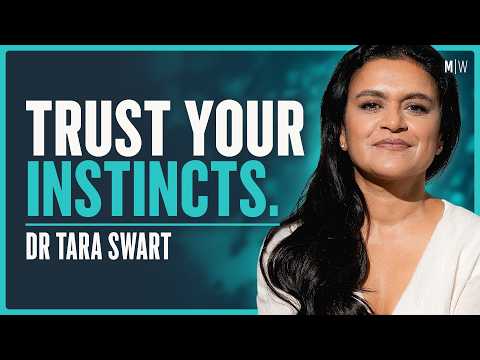
Signs From the Body You Should Never Ignore - Dr Tara Swart
~95 min
Episode Brief·YouTube

Signs From the Body You Should Never Ignore - Dr Tara Swart

Chris Williamson
Watch on YouTube Add to chat My bookmarks← All sources

TL;DR

The four things you'd lose by not watching

4 items

TL;DR

The four things you'd lose by not watching

4 items
1

Intuition is distinct from instinct; intuition is wisdom from life patterns, while instinct is primal survival-driven, sometimes leading to suboptimal decisions in modern life.

2

Serotonin, primarily produced in the gut, plays a significant role in body tone and how trauma and intuition are stored in tissues, not just mood.

3

Chronic stress and inflammation impair intuition by diverting blood flow from higher brain functions and depleting essential nutrients like magnesium.

4

Cultivating intuition involves improving gut health, journaling to identify patterns, and gradually taking low-risk intuitive decisions to build trust.

Protocols

Concrete recipes — what, when, how much, and why

5 items

Intuition vs. Instinct Distinction

WhatDifferentiate between intuition (wisdom from life patterns, stored in limbic system and gut neurons) and instinct (primal, survival-driven, often protective shortcuts).
WhenWhen making decisions, especially those that involve risk or potential loss.
For whomAnyone seeking to improve decision-making and self-trust.
WhyInstinct can sometimes lead to suboptimal decisions in modern contexts due to its loss-avoidance gearing, whereas honed intuition, combined with logic, leads to better outcomes.
CaveatsInstinct, while primal, can sometimes hinder thriving in modern life by prioritizing safety over healthy risk-taking. Always run intuitive insights alongside logic or seek external perspective.

The speaker draws a clear distinction between intuition and instinct. Intuition is described as a form of wisdom and judgment derived from patterns observed and learned throughout life, deeply stored in the limbic system and even in gut neurons. This wisdom, she suggests, can also be held in the body's tissues. Instinct, on the other hand, is a more primal, survival-driven response, often involving shortcuts taken by the brain to protect an individual from perceived loss. While instinct was crucial in Paleolithic times, it can sometimes be detrimental in modern contexts, as the brain's loss-avoidance mechanism might prevent healthy risk-taking that could lead to reward. Therefore, the speaker advises combining intuition with logic and seeking external perspectives to ensure decisions are beneficial.

Mechanism

Intuition is based on accumulated patterns and wisdom stored in the limbic system and gut neurons. Instinct is a more primal, survival-oriented response, often involving brain shortcuts to avoid loss.

Intuition is wisdom and the ability to use your judgment that's based on patterns that you've picked up through life lessons and that these are stored deeply in the the lyic system that I mentioned um all the way down to the gut neurons.

Also said
“Instinct is a good thing too but sometimes your brain will take shortcuts to protect you and it's acting in in such a primal way that that's more related to survival like when we you we lived in paleolithic times than what actually helps us to thrive now.”— Explains why instinct might not always be beneficial in modern life.
“It'll it'll work much harder to keep you safe from losing something than it will to allow you to take a healthy risk to get a reward.”— Highlights the brain's loss-avoidance bias in instinctual responses.

Aligning Logic, Emotion, and Intuition

WhatAn exercise to align logical, emotional, and intuitive responses to a dilemma by focusing on different body parts.
WhenWhen facing a significant decision or dilemma.
DoseInvolves breathing exercises between each step.
For whomAnyone struggling with conflicting internal signals when making decisions.
WhyTo gain clarity and make more holistic decisions by integrating different modes of knowing.
CaveatsIf the three responses are not aligned, it indicates a need for more complex thinking to find the right answer.

The speaker outlines a practical exercise for decision-making that aims to align logical, emotional, and intuitive insights. The process involves: 1) Placing hands on the head and asking the logical mind to answer a question, followed by breathwork. 2) Placing hands on the heart and asking the emotional self to answer the same question, followed by more breathwork. 3) Placing hands on the belly and asking intuition to answer. If all three align, the decision is likely sound. If they conflict, it signals a need for deeper consideration. The speaker notes that with practice, one can learn to trust intuition even when it diverges from logic or emotion, making it work out in the end.

Mechanism

The exercise uses physical touch (hands on head, heart, belly) and breathwork to consciously engage different centers of decision-making: the logical mind, emotional responses, and gut intuition. This physical anchoring helps to separate and then integrate these different forms of intelligence.

Personal experience

The speaker, who has been naturally intuitive since her 20s, has worked on building this skill and now, if there's a dichotomy, she will go with her intuition and trust it will work out.

You start by putting your hands on your head and ask the your the logical part of you to answer the question. Do some breath work. Put your hands on your heart. Ask the emotional part of you to answer the same question. And then some more breathing. Put your hands on your belly and ask your intuition to answer the same question.

Identifying Critical Internal Voices

WhatRecognize critical internal voices as separate from your own intuition, often stemming from childhood experiences or external influences.
WhenWhen a critical voice arises that discourages following intuitive insights.
For whomIndividuals who struggle with self-trust or have a strong inner critic.
WhyTo overcome internal barriers to trusting intuition, especially if one's intuition was ridiculed as a child or if there was an expectation of perfection.
CaveatsThis practice helps separate the critical voice from your true self, allowing for clearer access to intuition.

The speaker addresses the challenge of critical internal voices that can hinder trust in intuition. She suggests that these voices often originate from childhood experiences, such as having one's creativity or intuition ridiculed, or from an upbringing that emphasized perfection and logic over personal feelings. A key strategy is to identify this critical voice as 'not your own,' sometimes even attributing it to a specific past figure (e.g., 'that's actually my mother speaking to me'). By separating oneself from this voice, it becomes easier to ask objective questions, such as 'What would you advise your brother or best friend if they came to you with this?' This externalized perspective can help bypass ingrained self-doubt and access genuine intuitive insights.

Mechanism

By identifying a critical internal voice as distinct from one's own, it creates psychological distance. This allows for a more objective assessment of intuitive feelings, similar to how one might advise a friend, bypassing personal biases and past conditioning that might otherwise suppress intuitive insights.

Personal experience

The speaker mentions that some clients identify the critical voice as their mother's, helping them separate from it.

If you just can separate yourself from that voice, then you can ask yourself a question like, 'Okay, Chris, what would you advise your brother or your best friend if they came to you with this?'

Optimizing Gut Health for Brain Function and Intuition

WhatPrioritize gut health through diet, hydration, and supplements to improve brain function and access to intuition.
WhenContinuously, especially when experiencing brain fog or difficulty accessing intuition.
DoseDietary changes can show effects in days. Probiotics may be taken consistently.
For whomAnyone seeking to enhance cognitive function, emotional well-being, and intuitive abilities.
WhyThe gut-brain axis is crucial; a healthy gut microbiome supports optimal brain function, cognitive flexibility, emotional regulation, and intuition. Stress negatively impacts gut health, creating a vicious cycle.
CaveatsStress can lead to comfort eating and nutrient depletion (e.g., magnesium), making it harder to maintain gut health. Personalized probiotic recommendations are ideal but general approaches are also beneficial.

The speaker emphasizes the critical link between gut health and brain function, particularly for accessing intuition. She explains that brain fog and impaired decision-making often stem from inflammation, which is exacerbated by chronic stress and high cortisol levels. Cortisol not only causes widespread inflammation and dehydration but also diverts blood flow from higher cognitive functions to survival mode. Furthermore, cortisol negatively impacts immunity and the gut microbiome, which is vital for the gut-brain connection. Since the brain cannot be directly accessed, optimizing the gut through a healthy, diverse diet (including fermented foods, pre/probiotics, fiber), adequate hydration, and potentially magnesium supplementation (as stress depletes it) is the best way to support brain health and intuitive abilities. She notes that dietary changes can rapidly impact the gut microbiome.

Mechanism

Chronic stress increases cortisol, causing inflammation and dehydration, which reduces blood flow to higher brain functions. Cortisol also corrodes immunity and impacts the gut microbiome. The gut microbiome, in turn, influences the brain via the gut-brain axis. Optimizing gut health (through diet, pre/probiotics, fiber) directly supports brain function and intuition.

Personal experience

The speaker personally takes a probiotic all the time, including a specific one (Seed) when traveling, and relies on her intuition to feel which probiotic is right for her.

The best way to access, you can't access your brain directly as it were. So a good way to try to optimize your brain is through your gut.

Also said
“Magnesium, a really important mineral that actually helps us to deal with stress, is um ironically actually leeched out of the system by stress to the point that you can't actually eat enough leafy greens and nuts and seeds to replenish that. So then you need to start supplementing.”— Highlights a specific nutrient depletion caused by stress and the need for supplementation.
“You one round of antibiotics will will really negatively impact that. So the best way to access, you can't access your brain directly as it were. So a good way to try to optimize your brain is through your gut.”— Emphasizes the vulnerability of the gut microbiome and the indirect approach to brain optimization.

Building Trust in Intuition Through Journaling and Low-Risk Decisions

WhatUse journaling to record intuitive insights and decisions, then gradually take low-risk actions based on intuition to build trust.
WhenWhen starting to cultivate intuition, or when intuition and logic conflict.
DoseStart with noticing and recording, then move to low-risk decisions, gradually increasing significance.
For whomIndividuals who are 'heady' or struggle to trust their intuition.
WhyJournaling helps identify patterns and past successes/failures related to intuition. Taking small, deliberate intuitive risks provides data to build confidence and trust in one's intuitive guidance.
CaveatsThe key is to read back over journals to identify patterns and learn from past experiences. Start small to avoid significant negative consequences.

For those who are highly logical and struggle to trust intuition, the speaker recommends a structured approach. First, journaling should be used not just to record thoughts but to actively notice and record instances where intuition was present, whether followed or ignored, and the outcomes. The crucial step is to regularly review these entries to identify patterns and build awareness. Once this foundation is established, individuals should begin by making low-risk decisions where intuition and logic diverge, choosing to follow intuition and then recording the results. This process of gathering personal 'data' helps to build trust and confidence in one's intuitive abilities, allowing for a gradual increase in the significance of decisions made based on intuition.

Mechanism

Journaling serves as a data collection tool, allowing individuals to track instances where they followed or ignored intuition and the subsequent outcomes. This empirical evidence, gathered over time, helps to reinforce the reliability of intuition, making it easier to trust in future, higher-stakes decisions. The gradual increase in decision significance allows for a controlled learning process.

At first I would just do like the noticing and the recording and the raising awareness of when you have or haven't used intuition in the past. Then I would encourage people to take a lowrisk decision and where intuition and logic don't align and go with your intuition and see what happens and record that.

Also said
“My biggest like gamechanging tip for journaling is not actually to do with the journaling. It's to do with reading back over it because that's when you see the repeated patterns and you know if it's in your own handwriting and you see I've done this same thing again that it can be really gamechanging in like in like making whatever adjustments you need to to stop repeating patterns of behavior that aren't helping you.”— Emphasizes the importance of reviewing journal entries for pattern recognition and behavioral change.

What's new

Personal practice updates, fresh positions, predictions

5 items

Intuition as a Superpower in the Age of AI

0:01:40

Intuition, emotion, creativity, and vulnerability are becoming superpowers because AI and technology cannot emulate them in the same way humans can.

Why this matters: This is a forward-looking perspective on human capabilities in contrast to technological advancements.

Background

Historically, logic and rationality have been prized above these 'softer' skills, partly due to the lack of scientific tools to understand them until recently.

The speaker posits that as technology and AI advance, the unique human capacities for intuition, emotion, creativity, and vulnerability will gain immense value. These are qualities that machines struggle to replicate, making them increasingly important for human distinction and success. This contrasts with a historical societal emphasis on pure logic and rationality, which was reinforced by the scientific revolution and the initial inability to scientifically measure or understand emotional and intuitive processes. The rise of sophisticated scanning technology has begun to shed light on how emotions and intuition function in the brain, potentially paving the way for a re-evaluation of their importance.

I actually think this is where intuition and emotion and creativity and vulnerability are going to become superpowers.

Re-evaluation of Rigor vs. Effectiveness

0:03:50

There's a growing recognition that not everything valuable needs to be measurable and proven, especially given the rise in mental health issues despite scientific advancements.

Why this matters: This challenges the traditional scientific paradigm that the speaker herself has operated within for her career.

Background

The scientific revolution prioritized rigorous proof, leading to a dismissal of 'wishy-washy mythology.' However, issues like the replication crisis in psychology and persistent mental health challenges suggest a limitation to this purely logical approach.

The speaker observes a societal shift where the relentless pursuit of measurable proof and scientific rigor, while yielding many benefits, has also led to a sense of sterility and disconnection. She notes that despite scientific advancements, rates of mental illness, loneliness, and anxiety are high, prompting a re-evaluation of whether all valuable aspects of human experience must be quantifiable. This perspective suggests a return to valuing things that 'feel right' or are functionally useful, even if they cannot be fully explained or put on a spreadsheet, drawing a parallel to the Harvard longevity study which found social connection, an intuitively known good, to be the most predictive factor for a long life, only to be 'proven' by an 80-year study.

Personal experience

The speaker, as a scientist whose career relied on rigor, is now questioning whether everything of value needs to be measurable and proven.

Do the things that can have value to us that can make us happier and more connected and more at peace, do they actually all have to be measurable and proven? Like I'm I'm starting to even as a scientist whose, you know, career has relied on rigor for so long, I'm starting to question that.

Also said
“It is it is a strange horseshoe to come back around to this. I mean what's the uh the longevity study? Is it the Harvard longevity study? That longitudinal thing uh looking at uh basically the number of friends that you have is the most the single most predictive uh way more predictive than smoking, going to the gym, obesity, body weight, everything.”— The host provides an example of a long-term study validating an intuitively known truth about human well-being.

The Serotonin Hypothesis and Embodied Intuition

0:09:00

New research suggests that intuition and wisdom, like trauma, can be stored in the body's tissues (fascia, muscles) via the serotonin mechanism, which primarily functions in body tone rather than just mood.

Why this matters: This offers a physical, biological explanation for the 'gut feeling' and the concept of embodied wisdom, moving beyond purely mental faculties.

Background

Traditionally, intuition has been viewed as a mental faculty, accessible through practices like journaling or meditation. The 'body keeps the score' concept highlights how trauma is stored physically.

The speaker introduces the serotonin hypothesis to explain how intuition can be physically embodied. She clarifies that up to 95% of serotonin is produced outside the central nervous system, primarily in the gut, and cannot cross the blood-brain barrier. Its name, 'serum and tone,' reflects its primary function in constricting or dilating blood vessels, thereby affecting the tone of tissues throughout the body. This mechanism, she argues, is similar to how trauma is stored in the body's fascia and muscles. Therefore, intuition, or 'hidden wisdom' derived from life experiences, can also be laid down as patterns in these bodily tissues. This perspective expands the understanding of intuition beyond a purely mental process, suggesting that physical sensations like goosebumps or shivers could be visceral reactions indicating intuitive insights.

Personal experience

The speaker notes that in her friendship group, people often say 'that gave me goosebumps' or 'that gave me chills' when something resonates emotionally or feels intuitively right, suggesting a common recognition of this embodied intuition.

The serotonin hypothesis says that when stress causes constriction of your capillaries, it actually has an action on the tissues of the body like the fascia, which is the connective tissue that connects up all the organs and and muscles and things. And that that's how trauma is stored in the tissues of the body. And so it makes sense to me that intuition or hidden wisdom... could also be held in the body by the same way that trauma is held in the body through the serotonin um mechanism.

Also said
“So actually up to 95% of serotonin is produced in the gut or or at least outside of the central nervous system and that serotonin can't cross the blood-brain barrier. So where people feel that serotonin is the mood hormone, mood is actually one of its very very um less significant functions.”— Clarifies the primary function and location of serotonin, challenging common misconceptions about its role as solely a mood hormone.
“So combining the mind and the body um to you know release or access this this wisdom and and and actually how that would show up would be for example in visceral reactions to things. So like have you ever experienced something and had a shiver down your spine or goosebumps on your arms?”— Connects the theoretical mechanism to observable physical manifestations of intuition.

Immune System Sharing in Close Relationships

0:35:00

Individuals in close relationships, particularly those who live and sleep together, can share immune cells, with the stronger immune system donating to the weaker one.

Why this matters: This is a surprising biological interaction that highlights the profound interconnectedness in intimate relationships.

Background

The discussion was initially about the influence of social circles on intuition, but the speaker diverged to discuss a more fundamental biological connection.

The speaker shares a fascinating biological insight from Tim Spector: when people live and sleep together, their immune systems interact, with the person possessing a stronger immune system effectively 'donating' immune cells to their partner with a weaker one. This suggests a deeper biological intertwining in intimate relationships than commonly understood. Additionally, the speaker mentions that the way a partner smells is a non-conscious indicator of their immune system's compatibility (via the major histocompatibility complex), which is beneficial for offspring to develop a 'bilingual immune system' with diverse immunities, although this doesn't predict relationship success.

The person with the stronger immune system is actually going to donate um immune cells to the person that's got a a poorer immune system.

Also said
“And also when you are selecting your partner, the way that they smell is a reflection of their immune system through something called the major hystocompatibility complex.”— Adds another biological aspect of partner selection related to immune systems.

The Art of Noticing Beauty as a Gratitude Practice

0:49:00

The speaker has shifted her gratitude practice to 'the art of noticing beauty,' which involves actively observing and appreciating beautiful things in nature and art, leading to improved mental and physical health.

Why this matters: This is a specific, actionable, and personally transformative practice that connects to neuroesthetics.

Background

The speaker previously had a more traditional gratitude practice focused on external achievements, which she found less emotionally engaging. She also discussed how trauma can shut down speech centers, limiting talk therapy, and highlighting the importance of embodied practices.

The speaker has evolved her gratitude practice from a more conventional focus on external achievements to 'the art of noticing beauty.' This new practice is informed by neuroesthetics, a field that studies how art and beauty, particularly in nature, benefit mental health, physical health, and longevity. By consciously choosing to notice beautiful things throughout her day, she found herself frequently verbalizing appreciation ('oh, that's so pretty,' 'oh, look at that'). This active engagement with beauty, rather than passively walking past it, has profoundly changed her daily experience, making life feel different and more vibrant. This practice also aligns with the idea of embodied therapeutic work, as it engages the senses and the body in a way that traditional journaling or talk therapy might not.

Personal experience

The speaker noticed that after starting this practice, she frequently found herself saying things like 'oh, that's so pretty' or 'oh, look at that,' and pointing out beauty to others, which changed her daily experience.

My gratitude practice has now changed to what I call the art of noticing beauty. So very much informed by this field of research called neuroesthetics which is about how the arts and beauty particularly in nature and creativity benefit our mental health our physical health and our longevity.

Also said
“Life actually feels different when you choose to notice those things.”— Highlights the subjective, transformative impact of the practice.

Recommendations

Products, supplements, and tools mentioned in the episode

3 items

Seed Probiotic

Supplement

A probiotic backed by clinical trials, suitable for generally healthy individuals, especially when traveling.

The speaker mentions Seed as a probiotic that is supported by a significant amount of clinical research. She recommends it as a good option for generally healthy individuals, particularly for travel, as it's a stable form unlike her liquid probiotic used at home. She notes that while personalized stool sample analysis can provide tailored probiotic recommendations, Seed is a reliable broad-spectrum option for many.

vs alternatives

Mentioned as an alternative to personalized stool sample analysis for probiotic selection.

Personal experience

The speaker takes Seed when traveling because her usual liquid probiotic is not travel-friendly. She also states she relies on her intuition to determine which probiotic is right for her.

There are a few probiotics that are backed by a lot of um clinical studies. Um I don't know if I'm allowed to mention names. You can you can mention whatever you'd like. Um so seed um is one that's backed by a lot of clinical trials and so unless you've got a particular um particularly poor immune system or ill health or something that one's probably going to be good for like somebody who's quite healthy.

Find Seed

The Signs: The New Science of How to Trust Your Instincts

Book

The speaker's new book, which delves into receiving signs and trusting intuition, available on Audible with her voice.

This is the speaker's latest book, which she describes as exploring the concept of receiving 'signs from beyond' and the new science behind trusting one's instincts. She mentions that the book will be available on Audible, narrated by herself. The book seems to be a culmination of her evolving understanding of intuition, incorporating both scientific rigor and more esoteric concepts like the collective consciousness and the nature of reality.

Personal experience

The speaker mentions that the book includes a personal story involving her first husband and a prophetic dream.

And the new book, which is also going to be available on Audible with my voice, is called The Signs: The New Science of How to Trust Your Instincts.

Find The

Thrive (US) / Zoe Project (UK)

Service

Companies that offer personalized gut microbiome analysis through stool samples to recommend specific probiotic strains.

For those seeking a highly personalized approach to gut health, the speaker recommends specific services: Thrive in the US and the Zoe Project in the UK. These companies analyze an individual's stool sample to provide a detailed breakdown of their gut microbiome, which then informs recommendations for specific probiotic strains or types of bacteria that would be most beneficial for their unique system. This offers a more targeted approach compared to general broad-spectrum probiotics.

vs alternatives

Presented as a more personalized alternative to broad-spectrum probiotics and general healthy eating.

So in the US there's something called Thrive and in the UK there's the Zoey project and both of them can give you um a breakdown of which strains of bacteria would be beneficial for your gut microbiome.

Find Thrive

Notable quotes

Lines worth pulling out — contrarian, specific, or perfectly phrased

5 items
I think people have got this sense that even if stuff can be literally unproven, it can be functionally useful in the same way as huh well maybe my gut instinct I can't give you on a spreadsheet. I I can't fully dissect why I felt that thing. But I've noticed that when I rely on that sense, the outcomes that I get, my decisions tend to be better, even though they're uh less explainable.
This quote encapsulates the core theme of the discussion: the growing acceptance of functional utility over strict provability, especially regarding intuition.
I think that connects back to what we were saying about um having friends and longevity because your tribe provides you psychological safety. A really good group of friends should absolutely challenge your thinking if they don't think, you know, that it's it's potentially serving you right. But if for example I say you know I can't explain why but intuitively it feel this feels like the right thing to do most most of my experience is that the people around me will validate that will say I trust your intuition when you go with your intuition it usually works out right.
Highlights the crucial role of social support and psychological safety in enabling individuals to trust and act on their intuition, even when it's unexplainable.
You fail in the US for being overconfident. You fail in the UK for being too cringe.
A sharp, culturally insightful observation about the differing societal attitudes towards risk-taking and self-expression in the US versus the UK, relevant to trusting intuition.
Whatever happens I know that I can roll my sleeves up and and deal with it.
This quote represents a powerful mindset of resilience and self-trust, which the speaker actively cultivated through her gratitude practice.
I think in the next decade and decades, a lot of what we're talking about now, which is on the fringe of psychology and spirituality, is going to have further explanation, let's put it that way.
A bold prediction from a scientist about the future of scientific inquiry, suggesting that currently 'fringe' topics will gain scientific validation.

Sign in to share feedback

Tell us if this brief hit the mark or missed it — feedback feeds back into the next iteration of the prompt.

Topics covered

trusting instinctsintuition vs logicreplication crisisharvard longevity studyinstinct vs intuitionserotonin hypothesistrauma in the bodyvisceral reactionsgoosebumpsknowing without knowing whypsychological safetyanxiety vs intuitionjournalingnervous and excitedrelationship decisionscharles darwin's marriage listaligning mind, heart, gutchildhood ridiculecritical internal voicearchetypes struggling with intuition
Free account

Make this library yours

Reading is free for everyone. A free account adds the personal layer: save protocols, follow experts, and see how the other experts weigh in on this same topic.

Create a free accountSign in

Where the experts disagree — weekly

One email a week: the sharpest new disagreements and protocols from the library. No spam, unsubscribe anytime.

Educational summary of the cited expert source — not medical advice. Open the source recording linked above and consult a qualified physician before acting on any protocol.