UNFUCG
DashboardSearchChatBookmarksNotificationsActivityPremiumProfile
?
Home
Search
Chat
Saved
Profile
Episode
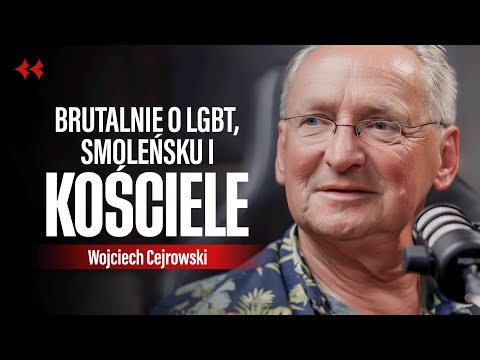
Wojciech Cejrowski's Confession – who is he really?
~103 min
Episode Brief·YouTube

Wojciech Cejrowski's Confession – who is he really?

Cyprian Majcher
Watch on YouTube Add to chat My bookmarks← All sources

TL;DR

The four things you'd lose by not watching

4 items

TL;DR

The four things you'd lose by not watching

4 items
1

Wojciech Cejrowski argues that hate speech should be legally protected because suppressing it conceals real societal hatreds, making violence harder to predict and prevent.

2

He claims all conspiracy theories eventually prove true, citing COVID-19 mask mandates, vaccine placebos, and chemtrails as examples now confirmed by mainstream sources.

3

Cejrowski calls Pope Francis an 'ordinary fool' and asserts the papacy's sole role is to preserve the deposit of faith unchanged, without adding or removing anything.

4

He advocates restoring medieval corporal punishments like hand-amputation for theft and ear-notching for pickpockets, arguing harsh penalties eliminated crime in historical Sweden.

Protocols

Concrete recipes — what, when, how much, and why

6 items

avoid-studying-other-religions

WhatDo not study or read the scriptures of other religions; the Catholic Church instructs that this is spiritually unnecessary and potentially dangerous for laypeople.
WhenThroughout one's life as a practicing Catholic.
DosePermanent avoidance, with exceptions only for exorcists (professional need) or professors teaching comparative religion.
For whomAll lay Roman Catholics.
WhyThe deposit of faith is complete in the Catholic Church; studying other religions risks spiritual danger and confusion.
CaveatsExceptions: exorcists must study satanism professionally to free people from demons; academics may study other religions as their professional field.

Cejrowski presents this as standard Catholic teaching, not his personal opinion. He argues that if someone believes another religion is better, they should logically convert to it. Since practicing Catholics believe their religion is the best, there is no need to investigate others. The Church, he says, warns against studying other faiths because it is 'spiritually dangerous' — the same way a nuclear reactor in a briefcase would be dangerous to experiment with. He applies this to himself: he does not know what 4,000 other denominations teach, and he does not need to know, because 'salvation is exclusively in the Catholic Church.' He frames this not as closed-mindedness but as logical consistency — if you believe your religion is the true one, investigating others is a waste of time at best and spiritually hazardous at worst.

Personal experience

Cejrowski states he personally does not study other religions and has no interest in their claims, because 'they are all wrong' — salvation is only in the Catholic Church.

The Catholic Church warns not to study other religions. […] One should not read the scriptures of other religions and study those other religions. If one is not a professor lecturing, it is unnecessary and may be spiritually dangerous.

Also said
“Salvation is exclusively in the Catholic Church.”— States the theological foundation for the avoidance protocol.
“If someone thought another religion was better, they would convert, leave this church, these religions, this denomination or this sect.”— Frames the protocol as logical consistency, not mere dogma.

male-emotional-restraint

WhatMen should restrain tears and emotional displays except in radical, exceptional situations; men must be a 'rock' for women who are hormonally more emotional.
WhenIn daily life, in relationships, and especially when a female partner is emotionally overwhelmed.
DoseTears are permissible only at extreme moments (e.g., at a father's grave) or when the man cannot physically restrain them; otherwise, they should be suppressed.
For whomAll men, especially those in relationships with women.
WhyWomen are hormonally more emotional and need a stable, unshakeable male presence to prevent them from 'falling apart like melted jelly.' If both partners cry, nothing gets resolved.
CaveatsTears at a father's grave are appropriate; men should not be 'mazgaj' (crybabies) or like 'Hołownia' (a Polish politician perceived as emotionally soft).

Cejrowski distinguishes between male and female sensitivity. He acknowledges that men have sensitivity and can be moved — he himself is moved by the film 'Gone with the Wind,' specifically by the degradation of the beautiful world of great estates and latifundia. But male sensitivity is different from female sensitivity. Tears are a tool women use more frequently to cope with problems; men should use them sparingly. The male role is to be a 'rock' — when a woman is 'falling apart,' the man must hold her together. If both partners are crying over the same 'constitution,' nothing will be accomplished. He insists this is not about suppressing all emotion but about choosing the right moment — when everyone else is taken care of, a man may allow himself to cry.

Mechanism

Cejrowski grounds this in a biological claim: women have more hormones, which cause emotional turmoil. Men's role is to provide stability as a counterbalance.

Personal experience

He mentions being moved by 'Gone with the Wind' (Przeminęło z wiatrem), specifically the destruction of the plantation world, and he is not ashamed of this sensitivity, but he distinguishes it from public emotional display.

A man must be a rock for a woman. A woman is full of emotions, always has more hormones than a man. […] She needs to have a rock, she needs to have a tough guy, sir.

Also said
“When she falls apart, she expects someone to hold her together. If you're both blubbering over the same constitution, nothing will work out.”— Provides the practical consequence — mutual crying achieves nothing.
“A man cannot be a crybaby. A man cannot be a Hołownia. A man must be a man.”— Defines the negative examples — what a man must not be.

refuse-personal-testimony-in-church

WhatRefuse to give personal testimony or share subjective religious experiences in church; such sharing belongs at family gatherings, not the pulpit.
WhenWhenever invited to give a 'świadectwo' (witness testimony) in a church setting.
DoseAlways refuse; the speaker states he does this 'always and firmly' (zawsze stanowczo).
For whomAll lay Catholics, but especially those invited to speak in church.
WhyThe church is for teaching, not sharing feelings. A layperson on the pulpit may inadvertently utter heresy or be possessed, causing scandal.
CaveatsThe presbytery should be separated by railings; only the priest enters or invites others. Lay testimony is always risky.

Cejrowski argues that the modern practice of laypeople giving 'testimonies' in church is corrupting. He invokes the traditional architecture of the church — the presbytery separated by railings (tralki) — as a physical manifestation of the principle that only the ordained should teach from the pulpit. He identifies several risks: the layperson might say something heretical, or might turn out to be possessed and suddenly speak about demonic experiences. The church is not a place for sharing feelings about a pilgrimage or an aunt's name day — those belong in domestic settings. He says he is 'disgusted' (brzydzę się) by the concept of lay testimony in church and considers it damaging to the Church.

Personal experience

Cejrowski states he always firmly refuses when Catholic organizations invite him to give a testimony, and he explicitly declines to do so in the interview, treating the studio as a kind of pulpit.

The church is for teaching, not for sharing feelings. I was on a pilgrimage and so on at my aunt's name day, not in church such things.

Also said
“There is no such thing that a civilian enters the pulpit and talks about some subjective impressions, because we never know if that civilian won't blurt out something that causes scandal among the rest.”— Explains the risk of scandal as the core reason.
“I always firmly refuse when various activists of Roman Catholic church organizations ask me. Let him come to us and give a testimony.”— Confirms this is his consistent personal practice.

avoid-witchcraft-and-magic

WhatAvoid all contact with witchcraft, magic, and sorcery; do not experiment with or engage in any form of it.
WhenAlways, throughout life.
DosePermanent, complete avoidance.
For whomAll Christians, especially Roman Catholics.
WhyThe Bible repeatedly forbids witchcraft in both the Old and New Testaments; it is dangerous like a nuclear reactor — demons are faster and smarter than humans and will always escape control.
CaveatsHe distinguishes between a shaman (who deals in magic) and a znachor (herbal healer who does not practice magic). Only the magical practice is forbidden.

Cejrowski approaches this topic from both scriptural and experiential angles. He cites the Old Testament's repeated prohibitions and the New Testament's warnings. He analogizes witchcraft to receiving a nuclear reactor in a briefcase — you don't experiment with it because you fear it will kill you. The danger is not illusion but real, physical, inexplicable phenomena driven by demonic forces. He says contact with the supernatural always produces a visceral reaction — goosebumps, like seeing a child with six toes (a sign of inbreeding). He acknowledges that shamans in the jungle can effectively treat bites and ailments because they know the local flora and fauna, but he sharply distinguishes between medical knowledge (znachor) and magical practice (szaman). Only the former is acceptable.

Mechanism

Cejrowski asserts that magic is real — physically unexplainable things happen. Demons are real entities that are faster and smarter than humans. When a shaman invokes them for an effect, the situation always escapes human control.

Personal experience

Cejrowski says he wrote about personal encounters with the supernatural in his book 'Rio Anaconda,' and that these experiences always produce goosebumps — a physical revulsion he compares to seeing a child with six toes from inbreeding.

Witchcraft is […] as if you received a nuclear reactor at home, someone brought you a small nuclear reactor in a briefcase. Well, you don't experiment with this equipment, because you're afraid it will kill you.

Also said
“In Holy Scripture it is written many times in the Old Testament and in the New, not to engage in witchcraft, not to play with it, to avoid it, to flee from it.”— Provides the scriptural foundation for the protocol.
“There are some demons there that are faster than you, smarter than you. He invokes them to obtain some effect. This must always escape human control.”— Explains the mechanism — demons are superior beings that inevitably escape control.

apply-local-healer-over-foreign-doctor

WhatWhen in a remote environment (jungle, Africa), seek treatment from a local healer or knowledgeable villager rather than a visiting Western doctor for local ailments.
WhenWhen bitten by a snake, suffering from a tooth infection, or experiencing common local medical issues in remote areas.
DoseAs needed for acute, locally-common conditions.
For whomTravelers in remote, non-Western environments.
WhyA local Indian has seen 400 snakebites and can identify the species from the bite pattern; a Western doctor has seen maybe four. Local healers know local medicinal plants that visiting doctors lack.
CaveatsThis applies to common, local ailments (snake bites, tooth infections), not complex conditions like brain cancer.

Cejrowski distinguishes between shamans (who practice magic — forbidden) and znachors or knowledgeable villagers (who practice herbal medicine — acceptable). He argues that in the jungle, a local healer will always outperform a visiting doctor for common ailments because they have vastly more experience with local conditions and access to local pharmacopeia. He gives the example of a tooth infection: a white doctor searches his bag for paracetamol, while an Indian picks a leaf unknown to Western medicine and applies it to the tooth with the same effect. This is not mysticism but practical epistemology — the villager has seen 400 snakebites, the doctor has seen four.

Mechanism

The mechanism is simple: local knowledge trumps imported expertise for locally-endemic conditions. An Indian villager recognizes snake species from bite patterns and knows which leaf to apply as a natural analgesic — effectively a local paracetamol.

Personal experience

Cejrowski draws on his extensive travel experience in the Amazon and other remote regions, though he does not narrate a specific personal medical incident in this segment.

An ordinary Indian will recognize from the type of bite which snake bit you and whether something can still be done about it […] if you go to a doctor, he is not so sharp because he has seen four snake bites in his life and the Indian 400.

Also said
“When you get a tooth infection, the white doctor searches his bag to see if he has paracetamol, and the Indian reaches for some leaf, which we don't know about, applies it to your tooth and you have paracetamol.”— Provides a concrete example of the local knowledge advantage.
“A villager will deal with them faster than a doctor from the university.”— Summarizes the principle bluntly.

multiple-drivers-licenses-strategy

WhatObtain a driver's license in every country you visit; this way, if one license is confiscated, you have others.
WhenWhen traveling internationally or living in multiple countries.
DoseCollect licenses from every country where possible.
For whomInternational travelers and people with multiple residencies.
WhyIt is a practical solution: if one license is taken away, you pull out another.

Cejrowski presents this as practical advice from his own life. He contrasts citizenship with nationality — you can have multiple citizenships (and thus multiple passports and driver's licenses) without changing your nationality. He recommends this as a 'very handy solution' (bardzo poręczne rozwiązanie). He applies the same logic to passports: multiple citizenships provide backup documentation.

Personal experience

Cejrowski states he personally has a driver's license from every country he can, and buys them wherever possible because it helps in life.

They take away one driver's license, you pull out the next one. I have a driver's license from every country, I buy them wherever I can and it helps in life.

What's new

Personal practice updates, fresh positions, predictions

6 items

hate-speech-protection

Cejrowski argues hate speech should be legally protected because it reveals who hates whom in society, enabling preventive policing against violence.

Why this matters: Contrarian stance in the European context where hate speech laws are expanding; he frames censorship as enabling hidden violence.

Background

European legal frameworks increasingly criminalize hate speech, but Cejrowski rejects this entirely, citing American free-speech jurisprudence.

Cejrowski builds his argument on two pillars. First, he invokes the American free-speech tradition where offensive speech is the very thing requiring protection — pleasant speech needs no defense. Second, he introduces a pragmatic security rationale: if hate speech is suppressed, authorities cannot monitor brewing hostility. He gives the example of football hooligans — knowing Legia fans hate a specific group allows police to deploy extra forces and prevent riots. Conversely, when hate speech is criminalized, it goes underground, and a 'Brown' (a hypothetical extremist) is sharpening his knife while authorities remain ignorant. He frames this as a matter of public safety, not just principle.

Hate speech should be a category that does not exist in law. […] So I value, I value hate speech. It should be protected.

Also said
“When hate speech is punished, it is suppressed. Brown inside is already preparing a pocketknife, and I know nothing about it.”— Adds the security argument — suppression enables undetected violent preparation.
“The protection of your freedom of speech must kick in when you say content that annoys someone. Then we protect you.”— Clarifies the American-derived principle that only offensive speech requires protection.

conspiracy-theories-all-true

Cejrowski claims all conspiracy theories ultimately prove correct, citing COVID-19 examples: masks being useless, one-third of vaccines being saline, and chemtrails acknowledged by a US general at the UN.

Why this matters: He positions conspiracy theorizing as superior to mainstream scientific hypothesis-testing, claiming a higher truth-discovery rate.

Background

Mainstream discourse dismisses conspiracy theories as epistemically flawed, but Cejrowski reverses this hierarchy.

Cejrowski constructs a sweeping defense of conspiracy theories across multiple domains. He points to the COVID-19 pandemic as a watershed moment: theories that masks were ineffective, that one-third of vaccine doses were saline, and that pharmaceutical companies profited corruptly are now — in his view — confirmed. He references the Pfizer corruption case involving Ursula von der Leyen's husband allegedly receiving lucrative contracts. He also claims that a US general at the UN admitted to chemtrail programs for climate control. His broader epistemological claim is that conspiracy theories have a lower error rate than scientific hypotheses in fields like chemistry or astrophysics. He encourages people to engage with conspiracy theories as mental exercise that develops logical thinking skills, even if the theories are about aliens.

Personal experience

Cejrowski recounts his own early COVID-19 predictions: weeks before the pandemic reached Poland, he told Radio Wnet host Krzysztof Skowroński that something suspicious was happening in Wuhan, noting that flights were still arriving from the locked-down city to Poland — a decision he attributes to then-Prime Minister Morawiecki.

I am a great advocate and follower of conspiracy theories, because they all come true.

Also said
“When you review the conspiracy theories before COVID predicting COVID, they all came true.”— Narrows the claim to the COVID-19 period specifically.
“A whole mass of conspiracy theories come true. Although I also don't like to call it a conspiracy theory, because we ourselves often through various such theories […] throw ourselves into the bag that this theory may not correspond with the truth.”— Acknowledges the stigmatizing effect of the 'conspiracy theory' label.

pope-francis-fool

Cejrowski calls Pope Francis an 'ordinary fool' (zwyczajny dureń), arguing the pope's role is to preserve the deposit of faith unchanged, not to adapt doctrine to modern standards.

Why this matters: Direct and harsh criticism of a sitting pope from a self-identified devout Roman Catholic, framing papal reform as a betrayal of fundamentals.

Background

Pope Francis's papacy emphasized pastoral openness, mercy, and dialogue — including on capital punishment and LGBTQ+ issues — which Cejrowski rejects as exceeding papal authority.

Cejrowski develops a strict ecclesiology: the pope is not an autonomous ruler but the steward of Jesus Christ's kingdom on earth. The papacy's mandate is to preserve the 'deposit of faith' — like a safe containing gold coins — without removing anything. He acknowledges that councils can add to the deposit but never subtract. He claims Pope Francis, by expressing personal opinions on capital punishment or other matters, caused confusion and damaged the papacy. He attributes Francis's errors to his Argentine origin, arguing Argentina has a lower average IQ than the United States — a claim he extends to the entire population, citing historical migration patterns where the 'best' went to North America and the 'worse' settled in Argentina. He hopes the new pope will repair the damage.

Francis was an ordinary fool.

Also said
“The pope is not an autonomous ruler, but is the vicar of Jesus Christ on earth. […] Their task is to preserve the deposit of faith.”— Explains the theological framework behind his criticism.
“Francis's private views did not interest me at all. They introduced confusion among people, introduced turmoil.”— Clarifies that the problem is public confusion, not private beliefs.

corporal-punishment-restoration

Cejrowski advocates restoring medieval corporal punishments like hand-amputation for thieves and ear-notching for pickpockets, citing historical Sweden and medieval 'szelmowanie' as successful models.

Why this matters: He presents this as a serious policy proposal for modern problems like San Francisco's shoplifting epidemic, not as historical trivia.

Background

Modern criminal justice emphasizes rehabilitation and proportionality; Cejrowski rejects both in favor of visible, permanent physical markers of criminality.

Cejrowski argues that certain crimes proliferate when punishments are absent or lenient. He points to San Francisco, where organized shoplifting is rampant because authorities do nothing to punish petty thieves. His solution: return to the Swedish practice of amputating thieves' hands, which he claims eliminated pickpocketing entirely. He also describes 'szelmowanie' — a medieval practice of notching or cutting a piece of a criminal's ear, creating a visible mark that identified the person as a pickpocket. The criminal remained fully functional (no loss of hearing, no missing fingers, able to work) but was permanently marked. He adds that hats were forbidden to ensure ears were visible. He calls this 'very beautiful methods' and says he would apply them today.

In Sweden they managed to exterminate thieves, pickpockets, by cutting off their hands. […] I would apply very beautiful methods today.

Also said
“When someone stole purses, that is, was a pickpocket […] they cut off a piece of his ear. […] And you saw from afar, a pickpocket is coming.”— Describes the specific mechanism of ear-notching and its social function.
“Prohibition of wearing hats, so that we could see what his ears look like.”— Adds the enforcement detail — hat prohibition to ensure visibility.

voting-rights-tied-to-taxes

Cejrowski proposes restricting voting rights to those who currently pay taxes, arguing that non-taxpayers have no moral right to decide how others' money is spent.

Why this matters: He frames this as a correction to democratic pathology where 'lumps' (lumpenproletariat) vote for politicians who redistribute tax revenue to them.

Background

Universal suffrage is a democratic norm; Cejrowski rejects it in favor of a tax-based franchise analogous to historical property censuses.

Cejrowski develops this argument in response to a question about Marcin Gortat's comment that rural, less-educated people should not vote. He partially agrees but proposes different criteria. He recalls the historical property census (cenzus majątkowy) in Britain, where only property-holders could vote because they had a stake in the state's well-being. He rejects education-based criteria because formal credentials are unreliable — he himself was a skilled anthropologist with only a high school diploma for 30 years. His alternative: only those who currently pay taxes should vote. If someone pays even 50 groszy in tax, they will feel the burden and vote for lower taxes. Non-taxpayers have no 'moral right' to decide who governs. He argues this corrects a feedback loop where the non-taxpaying 'lumps' grow in number and elect politicians who redistribute more from taxpayers to themselves.

Personal experience

He references his own biography: he was a highly competent anthropologist organizing expeditions and delivering scientific materials, yet formally had only a high school diploma for decades, illustrating the weakness of education-based voting criteria.

If someone does not pay taxes, they should not mouth off about who should be prime minister.

Also said
“Since they do not contribute to the state for any reason, they have no moral right to decide about this state.”— Frames the argument in moral rather than merely practical terms.
“If he pays 50 groszy in tax, he will feel that taxes are too high, because it was his 50 groszy and someone took it from him.”— Explains the psychological mechanism — even a tiny tax payment creates anti-tax consciousness.

american-freedom-superiority

Cejrowski claims a Polish tourist in America has more personal and civil rights than a Polish citizen in Poland, citing police traffic stops and gun rights as examples.

Why this matters: He frames the comparison as a personal grievance — his own vices draw him to America because it accommodates them better than Poland.

Background

Poland is an EU member state with constitutional rights; Cejrowski argues these are systematically weaker than American rights.

Cejrowski elaborates a detailed comparison between American and Polish freedoms. In America, police cannot conduct preventive stops — they need probable cause that a law has been broken. In Poland, routine traffic stops are conducted without any suspicion of wrongdoing, simply for statistical purposes (e.g., checking every third car on Monday after a long weekend). He also highlights gun ownership as a right equivalent to owning a hammer or drill — a personal decision about which tool one needs for self-defense. He contrasts this with the EU's centralized control, which he calls a 'sore on Western civilization' (wrzód na cywilizacji Zachodu). He describes his own experience living in Arizona during COVID-19, where freedoms were preserved at the county level, and contrasts his first flight back to Europe — where passengers were relaxed and joyful until encountering terrified, masked flight attendants at the plane door.

Personal experience

Cejrowski recounts his first COVID-era flight from Atlanta to Europe: 17 passengers in relaxed mood, drinking at an empty airport, only to be met by masked, terrified stewardesses at the plane door. He also describes a conversation with Arizona friends where he asked how much wine he could drink before driving — they found the question incomprehensible because in America, you can drink as much as you want as long as you drive straight and break no laws.

If you, a citizen of the Republic of Poland on a Polish passport, went to America now, after getting off the plane and crossing the border you have on that foreign street more civil rights and more freedom than you have being in Poland.

Also said
“In America, much more of such freedom has survived, that […] whatever can be done at a lower level, should be done at a lower level.”— Explains the structural principle of subsidiarity in American governance.
“A policeman in America cannot, cannot stop anyone preventively. There must be a reason, that is, you must first break the law for the policeman to restrict your freedom.”— Specifies the concrete legal difference in police powers.

Recommendations

Products, supplements, and tools mentioned in the episode

3 items

Replacing Polish national anthem with 'Rota'

Practice

Cejrowski argues the current Polish anthem ('Mazurek Dąbrowskiego') is servile because it references Napoleon Bonaparte as an example of how to win, while Poland has its own victories (Grunwald, Chocim, Samosierra).

Cejrowski develops a detailed critique of the Polish national anthem. He was teaching his godson the lyrics when he realized the anthem contains a servile line: 'Dał nam przykład Bonaparte, jak zwyciężać mamy' (Bonaparte gave us an example of how to win). He asks: why Bonaparte? Poland has its own military victories — Grunwald, Chocim, Samosierra. The anthem was originally a temporary soldiers' song for the Polish Legions and should never have become the national anthem. He proposes 'Rota' as the superior alternative because it contains the line 'Nie będzie Niemiec pluł nam w twarz' (The German will not spit in our face) and ends with 'Tak mi dopomóż Bóg' (So help me God). He also suggests 'Coś polskiego' (Something Polish) could work. The anthem should begin and end in Poland, not reference a foreign general.

vs alternatives

He compares 'Mazurek Dąbrowskiego' (current anthem) unfavorably to 'Rota' (proposed anthem), arguing the former is servile, temporary, and foreign-focused, while the latter is defiant, permanent, and Poland-focused.

Personal experience

He describes teaching his godson the anthem lyrics and suddenly realizing the servile nature of the Bonaparte reference.

Bonaparte gave us an example of how to win. What, what Bonaparte at all? And there Samosierra, and the Battle of Chocim, and the Battle of Grunwald. We don't need any Bonaparte to show us how to win.

Also said
“Rota should be the anthem in terms of content. The German will not spit in our face, that suits me better and so help me God.”— Specifies the alternative and its key advantages.
“The Polish anthem must begin and end in Poland, and for the salvation of the homeland he threw himself across the sea, we are constantly remembering that we had no country.”— Explains the structural critique — the anthem is about exile, not homeland.
Find Replacing

Caritas (Catholic charity) over WOŚP (Wielka Orkiestra Świątecznej Pomocy)

Service

When asked whether he supports WOŚP, Cejrowski states he donates exclusively to Catholic charities, specifically Caritas, not to Jerzy Owsiak's WOŚP.

Cejrowski frames this as a matter of personal preference and aesthetic distaste — 'Owsiak mi się nie podoba' (I don't like Owsiak). He argues that charitable activity flourishes when institutional charity disappears, because people take responsibility for each other. He contrasts this with large institutional charities that make people feel they have already 'done their part' by donating, reducing personal engagement. He also argues that state institutions like orphanages should not exist — historically, when a brother died, the family simply took in the children without state intervention.

vs alternatives

He contrasts Caritas (Catholic, preferred) with WOŚP (secular, rejected), primarily on aesthetic and religious grounds rather than effectiveness.

If I were to give money to any institution, it would definitely be Caritas, not Jerzy Owsiak.

Also said
“Charitable activity or alms, helping others appears at the moment when institutions that institutionally help others disappear.”— Explains his broader philosophy of charity — institutions crowd out personal responsibility.
Find Caritas

US Constitution as template for Poland

Practice

Cejrowski suggests a new Polish constitution should be written based on the American constitution, which George Washington expected to last 100 years but has lasted 250.

Cejrowski argues that the American constitution is a 'good creation' (dobry twór) that Poland could learn from, both in its successes and its failures. He particularly praises the American approach to free speech — even flag burning is protected as long as you own the flag. He also endorses the American principle of subsidiarity: whatever can be done at a lower level of government should be done there. He suggests the new Polish president (Karol Nawrocki) could write a new constitution incorporating these American principles.

vs alternatives

He compares the American constitution (lasting 250 years) favorably to the current Polish constitutional framework, which he sees as subordinate to EU law.

One could copy from a good creation, which is the American constitution. George Washington when they wrote down these constitutions and passed them said if this super project survives 100 years then we are guys. Well, it survived 250 and works.

Also said
“I would defend freedom of speech radically as they do. You are allowed to burn the flag provided you did not steal it from someone and it is your flag.”— Specifies the free-speech aspect he would most want to import.
Find US
Disclosed sponsorships3speaker disclosed

Gringo wśród dzikich plemion (Gringo Among Wild Tribes)

Book Sponsored · disclosed

Cejrowski references this book when discussing his respect for indigenous cultures; he mentions the cover features indigenous people, countering the accusation that he disrespects them.

DisclosureThis is the speaker's own book — his bestselling title.

He brings up this book when challenged about whether he criticizes indigenous body modification practices (tattoos, lip plates) while simultaneously criticizing similar self-expression in Europe. He argues context is everything: a Hawaiian shirt at a wedding is inappropriate, but on a 'merchant of dreams' selling tropical experiences, it is appropriate. Similarly, indigenous body modification is culturally contextualized, while European imitation lacks that context. The book documents his genuine engagement with and respect for indigenous cultures.

Of course, I do not question it. On the cover of my bestseller, my biggest, Gringo Among Wild Tribes.

Find Gringo

Chalapeno pepper scrub (peeling z papryką chalapeno)

Product Sponsored · disclosed

At the end of the interview, Cejrowski gifts the host a pepper scrub from his store, made with honey from his dog's beekeeper friend.

DisclosureCejrowski sells this product in his store; he brings it as a gift for the host.

The product is presented as a practical gift with a humorous anecdote. Cejrowski explains that his wife gave the same scrub to a friend, who later discovered an additional use: applying it to her husband's backside when he is 'naughty' (niegrzeczny). The pepper causes burning, which stimulates circulation and helps with cellulite. He warns not to apply it near the eyes. The product ties into his personal brand — everything he does is 'on the spicy side' (u mnie wszystko na ostro).

Personal experience

He shares the story of his wife's friend who used the product both for skin care and as a punishment for her husband.

Pepper scrub, chalapeno. Everything with me is spicy.

Also said
“I discovered one more use. I apply it to my husband's backside when he is naughty.”— The humorous anecdote that illustrates the product's secondary use.
Find Chalapeno

Rio Anaconda

Book Sponsored · disclosed

Cejrowski mentions this book when discussing his personal experiences with the supernatural and witchcraft in the Amazon.

DisclosureThis is the speaker's own book.

He references this book as documentation of his personal encounters with the supernatural. He says he wrote about several such experiences, and they always produce a visceral reaction — goosebumps. He uses this to support his claim that witchcraft is real and dangerous, not mere superstition.

Personal experience

He states he wrote about personal supernatural encounters in this book.

In Rio Anaconda I wrote several such points and one always gets goosebumps.

Find Rio

Notable quotes

Lines worth pulling out — contrarian, specific, or perfectly phrased

8 items
I am a great advocate and follower of conspiracy theories, because they all come true.
Unusually direct and unapologetic endorsement of conspiracy theories, framed as a superior epistemology.
Francis was an ordinary fool.
Brutally blunt dismissal of a sitting pope by a self-identified devout Catholic — extremely rare in public discourse.
I hate this Soviet carrion that is the European Union. […] I hated the Soviet carrion and I hate the EU carrion.
Equates the European Union with the Soviet Union using the same visceral language of hatred — a radical rhetorical move.
In a Marine unit you go under a common shower and you know that in this male company one guy is turned on by your backside. That is not an atmosphere for work.
Vivid, deliberately provocative analogy used to argue against LGBTQ+ inclusion in the military.
Jarosław Kaczyński is responsible for thousands of murdered unborn children in Poland. His hands drip with blood.
Extremely graphic accusation against a conservative political leader from a conservative commentator, showing independence from political tribalism.
European civilization, Western civilization is much higher than other barbaric civilizations, even in its current debased shape it is higher.
Unapologetically hierarchical view of civilizations, using the word 'barbaric' for non-Western cultures.
The church is for teaching, not for sharing feelings. I was on a pilgrimage and so on at my aunt's name day, not in church such things.
Memorable formulation rejecting modern emotional expressiveness in religious settings.
If I met Donald Tusk I would have to punch him in the face for insulting my mother and my godmother.
Explicit statement of willingness to commit violence against a former prime minister over an insult to his mother, framed as honorable male conduct.

Sign in to share feedback

Tell us if this brief hit the mark or missed it — feedback feeds back into the next iteration of the prompt.

Topics covered

hate-speech-protectionconspiracy-theoriescatholic-doctrinepapal-authoritywestern-civilization-superiorityeuropean-union-criticismsmolensk-crash-investigationmasculinity-and-gender-rolesabortion-oppositionpolish-patriotismreligious-censorshipanti-lgbtq-stancecovid-19-skepticismamerican-freedomcorporal-punishmentvoting-rightscolonialism-justificationwitchcraft-and-supernaturaltrump-reformsmedia-distrust
Free account

Make this library yours

Reading is free for everyone. A free account adds the personal layer: save protocols, follow experts, and see how the other experts weigh in on this same topic.

Create a free accountSign in

Where the experts disagree — weekly

One email a week: the sharpest new disagreements and protocols from the library. No spam, unsubscribe anytime.

Educational summary of the cited expert source — not medical advice. Open the source recording linked above and consult a qualified physician before acting on any protocol.