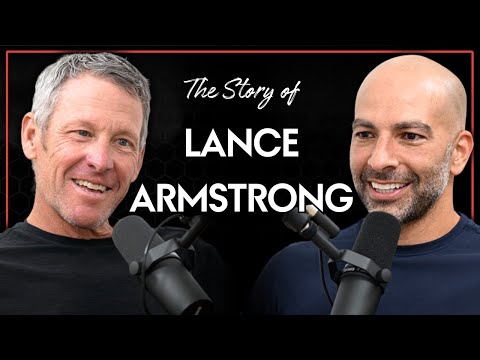
Lance Armstrong averaged 500 watts for 30 minutes up Mont Ventoux at 165 lbs (6.7 W/kg) during his peak Tour years — and estimates EPO was worth exactly 10% of that output, meaning ~450 W clean, which he frames as still elite but not dominant.
2
Armstrong's testicular cancer was stage IVB choriocarcinoma with brain mets and a beta-HCG of 100,000 (normal upper limit: 2); survival hinged on choosing Indiana's Dr. Larry Einhorn over the standard bleomycin protocol, sparing his lungs for a return to elite cycling.
3
The doping-era hematocrit management was a precise risk-calibration game: keep the crit at 46-47% rather than the 50% UCI ceiling because dehydration or illness during a Grand Tour could spike you over the line without warning.
4
After losing everything in the 2013 confession, Armstrong rebuilt entirely through independent media — podcast, investment fund, direct audience — proving that in the modern era you no longer need institutional gatekeepers to re-enter public life.
Protocols
Concrete recipes — what, when, how much, and why
8 items
Mont Ventoux 30-minute FTP test as Tour-readiness benchmark
WhatRide the Mont Ventoux climb (approximately 30 minutes, 7-8% average grade, all-seated effort) at maximal sustainable pace with a power meter. Record average watts. Use this as the primary benchmark for Grand Tour climbing readiness.
WhenPre-Tour final assessment, typically weeks before the race.
Dose30-minute maximal all-seated effort on a steady 7-8% gradient. Armstrong's peak: 500W at 165 lbs (6.7 W/kg). Clean ceiling estimate: ~450W (6.1 W/kg).
For whomCompetitive cyclists targeting Grand Tour-style long climbs. Equally valid for any cyclist benchmarking threshold power on a consistent 20-40 minute climb.
WhyA 30-minute maximal effort on a consistent grade eliminates pacing variability and gives a clean FTP proxy. The seated requirement removes standing sprint advantage and tests pure aerobic engine. The climb's ~30-minute duration is long enough to eliminate anaerobic contribution.
CaveatsRequires full recovery before the effort and consistent conditions. Armstrong estimates ~350W today at age 50 with minimal structure.
Armstrong: 'Before the tour in '99, I tested on the Mone... it's about 30 minutes, about 7-8%, so it's a straight in-the-saddle pound-away for 30 minutes.' Tony Rominger had previously held the fastest time on this test. Ferrari used the benchmark across all Tour years. Armstrong's 500W number was consistent across every Tour-winning year, which he credits to Ferrari's systematic preparation approach. The test format — known today in cycling training as a 20-30 minute FTP test — became the industry standard for threshold assessment.
Mechanism
At 7-8% grade sustained for 30 minutes, the physiological limiting factor is VO2max and lactate threshold — the same systems stressed by Tour mountain stages. Average power from this test approximates FTP, from which training zones and race-day pacing are derived.
In '99 I could — before the tour in '99 — I tested on the Mone... and what did you average for 30 minutes in '99? 500 watts.
Also said
“All those years were 500 watts for 30 minutes — yeah. And loving it.”— Confirms the 500W was consistent across multiple Tour-winning years, not a one-time peak.
Train with power, race on feel and time splits
WhatUse SRM or equivalent power meter for 100% of training sessions to build precise wattage targets and measure fitness. Race Grand Tour time trials using effort feel and radio checkpoint time splits — no power meter display during competition.
WhenTraining year-round; competition protocol during Grand Tour time trials and key climbing stages.
DosePermanent training/racing split. Power data informs all training; race day relies on perceived effort calibrated by thousands of training hours at known outputs.
For whomCompetitive cyclists at any level. Especially applicable to endurance athletes who train quantitatively but race in uncontrolled environments.
WhyPower meters enable quantitative training load management. During a race, live power numbers can create psychological interference — riders may throttle effort based on a number rather than genuine maximum. Time splits from the team car provide the competitive context that matters.
Armstrong describes the 2003 Tour final time trial: Bruyneel was in the team car feeding checkpoint splits by radio. Armstrong did not have a power meter on the bike. The race was navigated entirely through effort feel and the gap relayed by radio — this despite the high stakes of defending a near-lost lead over Ullrich. Ferrari designed all training around power data but explicitly chose not to bring that data into the race execution.
Mechanism
Thousands of training hours at known power outputs calibrates the athlete's internal perception of effort at specific intensities, enabling accurate execution without external feedback.
We didn't race with power meters — trained, you know, 100% of the time with them, but not in the races.
EPO hematocrit management — cautionary documentation of doping-era protocols
WhatCAUTIONARY CASE STUDY — NOT A RECOMMENDATION. EPO-era pro cyclists managed hematocrit to 46-47%, well below the UCI ceiling of 50%, to buffer against physiological fluctuation (dehydration, illness) that could spike a rider over the threshold during a Grand Tour stage check. After 1999-2000, autologous blood transfusions replaced race-period EPO.
WhenPre-race preparation phase. Race-day EPO use discontinued after urine EPO test introduction. Blood transfusions used mid-Grand Tour from 2000 onward.
DoseHematocrit target: 46-47% at race start. One autologous blood bag mid-race in the 2000 Tour. EPO administered out-of-competition under physician oversight.
For whomHistorical/educational documentation. The physiological mechanism — EPO raising oxygen-carrying capacity ~10% at these hematocrit deltas — informs understanding of how altitude training, iron optimization, and legitimate approaches to hematocrit management work.
WhyHARM REDUCTION LENS: At 46-47% hematocrit, the primary documented risk is regulatory (positive test) not cardiovascular. The catastrophic cardiovascular events associated with doping-era cycling were at dramatically higher hematocrits (60-66%, the 'Mr 60%' era pre-UCI ceiling). The ceiling introduction compressed the range and paradoxically reduced peak physiological risk.
CaveatsEPO carries genuine thrombotic risk, especially at rest and during sleep. Armstrong himself questions retrospectively whether his EPO use contributed to his testicular cancer, though his oncologists considered it unlikely. Multiple 1980s-90s cyclists died of cardiac events attributed to extreme hematocrit elevation.
Armstrong on the 2003 Tour starting at hematocrit 38: he was at a significant physiological disadvantage versus his normal 46-47% — roughly equivalent in watts to the EPO benefit going in reverse. Yet he still won, suggesting his intrinsic ability was substantial even without the assistance. The key insight Attia draws: 'It's not so much how you're functioning at the beginning of the Tour — it's that at the end of the Tour you could keep your hematocrit there when ordinarily it would really start to dwindle.'
Mechanism
Erythropoietin stimulates red blood cell production, raising hematocrit and hemoglobin concentration. At threshold intensity, oxygen delivery is rate-limiting — higher hemoglobin directly raises sustainable power output proportionally to the hematocrit increase (approximately linear in the 40-50% range).
50 would be too close. Because if even 47 dehydrated or you get sick, they show up — you're done.
Also said
“Is it that much of a difference if you're walking around with a hematocrit of 42-44 and you're racing 46-47? ... it's not so much how you're functioning at the beginning of the tour, it's that at the end of the tour you could keep your hematocrit there when ordinarily it would really start to dwindle.”— Attia's key mechanistic insight: EPO's primary Tour benefit was maintaining oxygen capacity in weeks 2-3, not boosting week-1 performance.
Chemotherapy protocol selection based on patient's organ-function goals
WhatWhen selecting between equivalent-efficacy chemotherapy protocols, evaluate specific organ toxicity against the patient's post-treatment life goals. If a patient's career depends on a specific organ system, route around protocols that damage it — even if the standard protocol is more convenient.
WhenAt initial chemotherapy protocol selection for cancers with multiple viable treatment regimens (especially testicular, lymphomas, others with BEP-vs-alternative choices).
DoseArmstrong received 4 cycles of VIP (vinblastine, ifosfamide, cisplatin) inpatient, after 1 cycle of BEP (bleomycin, etoposide, cisplatin) in Austin. Total treatment: ~4 months.
For whomAny patient with a career or life function dependent on a specific organ facing chemotherapy choices that differ in that organ's toxicity profile. Musicians (hearing/cisplatin ototoxicity), athletes (cardiopulmonary/bleomycin), manual workers (peripheral neuropathy).
WhyBleomycin causes cumulative pulmonary fibrosis and cardiotoxicity. For a patient planning to return to elite aerobic sport, additional bleomycin would meaningfully impair VO2 max. Dr. Einhorn's team asked directly: 'Do you ever want to race bikes again?' — making the patient's goal the primary selection criterion.
CaveatsVIP requires inpatient admission with 24/7 IV hydration due to ifosfamide nephrotoxicity — most patients default to outpatient BEP. The inpatient burden is finite. Armstrong notes cycle 1 felt like nothing, cycle 2 was minor nausea, cycle 3 was severely sick, cycle 4 was 'you just want to sleep' — cumulative toxicity is real.
Armstrong's brain metastases required craniotomy mid-treatment — performed by Dr. Shapiro, two lesions removed, one on top and one on the back of the skull. The immediate microscopic examination showed dead tumor cells, suggesting cisplatin had unexpectedly crossed the blood-brain barrier. Armstrong: 'Like doing the pumpkin for Halloween — you cut the hole, pull off the thing, dig out the seeds, put the thing back on.' Dr. Einhorn had pioneered cisplatin-based testicular cancer chemotherapy in the 1970s, converting a historically near-fatal malignancy into one with high cure rates.
Mechanism
Bleomycin damages lung tissue through free-radical generation causing progressive pulmonary fibrosis. Cisplatin achieves similar anti-tumor efficacy through DNA crosslinking without pulmonary toxicity. Trade-off: cisplatin is nephrotoxic, manageable through aggressive IV hydration (the reason for inpatient requirement).
Could have won eight if I didn't do that one cycle. Yeah. So bleomycin is a really, really toxic chemo — and people ask, why wouldn't everybody be treated the way you were treated, with the protocol called VIP?
Also said
“The downside to being treated with VIP is you have to stay as an inpatient... one of those is so toxic, not on the lungs but on the body, that you have to have 24/7 hydration.”— Explains why most patients default to BEP — VIP requires hospitalization, BEP does not.
Beta-HCG as the cancer progress scoreboard
WhatUse beta-HCG as the primary quantitative tracking metric during treatment for choriocarcinoma-type testicular cancer. Establish baseline, then monitor for logarithmic drop per cycle. A consistent log-drop per cycle = treatment is working. Plateau or rise = resistance signal.
WhenAt diagnosis and before each chemotherapy cycle throughout treatment.
DoseArmstrong's baseline HCG: 100,000 mIU/mL (normal upper limit ~2). Expected pattern: one log-drop per cycle. After 4 cycles: undetectable.
For whomPatients with non-seminomatous germ cell tumors (NSGCTs) including choriocarcinoma and mixed germ cell tumors. The general principle — identify the most direct quantitative biomarker for any cancer type and use it as primary progress metric — extends broadly.
WhyHCG is directly secreted by choriocarcinoma cells — it is the most direct available proxy for tumor burden. Unlike imaging (cost, radiation, time), serial HCG provides immediate quantitative feedback. The log-drop expectation gives the patient a concrete metric — a scoreboard — for tracking their own fight.
Armstrong describes his psychological relationship with the HCG metric: 'I said, look, what's the scoreboard? What's my metric that says I'm ahead in this game? And they said a log drop-off every cycle. And man, we were hitting it — bam, bam — it just kept coming down.' This athlete's reframing of cancer treatment as a competition with a quantifiable scoreboard is a central part of how Armstrong maintained psychological momentum through four chemotherapy cycles. Attia contextualizes: 'If you come in with 500 you have a problem. Anything above two you have a problem.' Armstrong came in at 100,000.
I said what's the scoreboard, what's my metric that says I'm ahead in this game. And they said a log drop-off every cycle, and man we were hitting it — bam bam — it just kept coming down. And I was like, I'm kicking this thing's ass.
Peloton positioning as a learnable tactical skill requiring race experience
WhatCycling peloton positioning — knowing where to be in the field relative to upcoming terrain, team dynamics, and attack patterns — is a distinct skill separate from fitness. It requires intentional development through racing, not just training rides.
WhenEarly in a cycling career, during the first 2-3 years of competitive road racing. Cannot be developed in solo or group training rides alone.
DoseArmstrong estimates several years of competitive road racing after the 1992 Olympics to feel truly comfortable in a professional peloton, despite already having a world-class aerobic engine.
For whomCyclists transitioning from individual disciplines (triathlon, time trialing, track) to road racing. Also for cyclists who train predominantly solo.
WhyThe peloton is described as 'a big organism' with emergent behavior, predictable surge points, and safe/dangerous positions that experienced riders read intuitively. Misreading wastes energy, creates crash risk, and leaves riders out of position for key moves.
Armstrong describes his tactical limitations after transitioning from triathlon: 'I didn't know how to move through the peloton and gauge and judge the peloton and the tactics and the flow of the race.' He contrasts this with George Hincapie, who raced in Central Park against adult men at age 12. Armstrong credits Johan Bruyneel's appointment as directeur sportif — 'he knew the race, knew where to be, knew the energy of this thing' — as a key structural advantage for US Postal.
I didn't know how to move through the peloton and gauge and judge the peloton and the tactics and the flow of the race... now you could throw me in any bike race and I could absolutely find my way around. But nobody's born with that skill.
Post-career fitness: exercise for mental sanity, abandon performance metrics
WhatAfter competitive retirement, abandon performance metrics (power meters, heart rate monitors, structured plans) and exercise for psychological wellbeing. Prioritize enjoyment and injury-resistant modalities over optimization.
WhenPost-competitive life when training for performance is no longer the goal.
DoseArmstrong at 50: mostly mountain biking in Aspen, no power meter, no heart rate monitor. Weight 180 lbs vs 165 lbs racing weight — 15 lbs above Tour weight with zero effort. Swimming identified as the ideal lifetime sport.
For whomRetired competitive athletes and age-group athletes who want to maintain fitness without the pressure of performance optimization.
WhyTraining without metrics removes the performance-anxiety loop. The primary driver becomes enjoyment and mental health, which is more sustainable over decades than goal-oriented training cycles.
CaveatsArmstrong's liability: running causes injury because he skips stretching. He acknowledges yoga or mobility work 3 days per week would enable running but he currently doesn't do it. His estimated residual fitness: ~350W on Ventoux with a week of preparation.
Armstrong: 'I exercise not because I want to stay a certain weight or I want to look a certain way — I need it for my own sanity. That's the only reason.' He identifies swimming as the best lifetime sport: 'You can swim your whole life. You certainly can't run your whole life.' He can still do 10x100m on a ~1:10-1:15 interval at age 50 — a meaningful fitness benchmark. He notes the pattern of former pro athletes who quit exercise entirely once it's no longer their job — Armstrong intends to ride as long as his body allows.
I find myself just — when I'm out, I ride easier as opposed to harder. No heart rate, no power meter, none of that. I need to exercise — not because I want to stay a certain weight — I need it for my own sanity. That's the only reason.
Rebuilding credibility post-catastrophe: the direct-audience model
WhatWhen institutional credibility is destroyed, bypass traditional gatekeepers entirely. Build a direct relationship with an audience through a medium you own (podcast, newsletter, YouTube). Monetize through direct relationships (subscriptions, investment partnerships) rather than advertiser-mediated relationships requiring institutional trust.
WhenAfter reputational catastrophe where traditional career paths are closed.
DoseArmstrong's rebuild: podcast started ~2016-17, investment fund with podcast-audience LPs as of ~2021. Process took approximately 3-4 years to gain sufficient traction.
For whomAnyone facing reputational destruction in a field where institutional relationships are the traditional path to income and public voice. Most powerful in current media environment.
WhyInstitutional gatekeepers require pre-existing credibility and will not partner with someone considered radioactive. Direct-to-audience media bypasses these intermediaries. The audience self-selects for nuance tolerance — they accept a complex figure where institutional partners require clean optics.
Armstrong contrasts his situation with historical alternatives: pre-internet, someone in his position would have been permanently shut out of public life. His explicit observation: 'You don't need network television, you don't need the New York Times... you did this on your own, you bought the cameras, you got the mics — you couldn't have done that 10 years ago, 20 years ago.' The investment fund component is notable: his podcast audience became his LP base, a group who chose to trust someone 'the whole world thought could never be trusted again.'
Thank God we live in 2021, 20-whatever, where you can reinvent yourself on your own. You don't need network television, you don't need the New York Times, you don't need any of that.
What's new
Personal practice updates, fresh positions, predictions
8 items
EPO's exact performance contribution: 10% power output at threshold
~slice 2, ~41 min
Armstrong, with unique authority to quantify this, states that EPO delivered a full 10% increase in threshold power — his 500W Ventoux number would have been ~450W clean. He frames this as meaningful but not transformative, noting Bradley Wiggins produced 440-450W for his one-hour record without EPO.
Why this matters: This is probably the most credible quantification of EPO's dose-response benefit ever given by a rider who could compare both states on the same climb, with the same power meter, under race conditions.
Background
Armstrong began using EPO in 1995 under medical supervision after observing the field shift between 1993 and 1994. He started using an SRM power meter in 1998 and could directly compare his Ventoux test numbers across years.
The 10% figure maps precisely onto exercise physiology: EPO raises hematocrit and therefore oxygen-carrying capacity proportionally. At threshold power, where oxygen delivery is the rate-limiting step, a 10% boost in hemoglobin translates almost linearly to a 10% boost in sustainable wattage. Armstrong notes that Riis in 1996 reportedly raced at a hematocrit of 60-66% ('Mr 60%'), which would represent a much larger delta from his natural level — implying the actual spread between riders was wide. The UCI's 50% ceiling introduced in 1998-99 compressed that spread significantly, which is why the Festina scandal was the turning point rather than any single positive test.
It would have been 450. It's I'm telling you it is 10%. You think it's a full 10%? Yeah yeah yeah. 10%. Seven watts per kilo. 450 is still pretty good by the way.
Also said
“Bradley Wiggins probably put out 450, 440 to 450 during his one hour record... that's flat and you're kinked over, so it's really hard because you're bent over.”— Establishes that 450W clean is a legitimate elite ceiling — EPO didn't create Armstrong's engine, it amplified an already exceptional one.
Hematocrit ceiling management: why 46-47%, not 50%
~slice 2, ~29 min
The UCI's 50% hematocrit limit was not a safe operating ceiling — teams managed riders to 46-47% because dehydration during a Grand Tour stage, fever, or any illness could spike a natural-state rider over 50% even without fresh EPO. Getting caught at the test = immediate exclusion.
Why this matters: Reveals that the doping-era risk management was not 'use as much as possible' but rather a conservative buffer that protected the rider from inadvertent positive tests due to physiological fluctuation during the race.
Background
The morning hematocrit test was introduced around 1998-99. Before that, there was no ceiling — Riis reportedly raced at 60-66%. Armstrong clarifies that after 1999 the team switched to autologous blood transfusions rather than EPO during the race itself.
Armstrong explains: if you came in at 47 and got dehydrated or sick, you could test at 50+ and be done. The practical ceiling was therefore 46-47%, not 49.9%. This also explains why the 2003 Tour was so difficult for him — his hematocrit was 38 at the start after a serious crash in the Dauphiné Libéré pre-race, meaning he was racing with a biological deficit the entire time yet still won. The 2000 Tour involved one autologous blood transfusion at the midpoint. Ferrari guided the transition from EPO to transfusions once the EPO test arrived.
50 would be too close. Because if even 47 dehydrated dehydrated and or you get sick or or and they show up like you're you're done I don't think so.
Also said
“After '99 we never did EPO on the tour itself. You mean you did it out of season, out of competition still, and then Ferrari had to switch to transfusion.”— Confirms the exact timeline of the EPO-to-transfusion transition and when it occurred.
Choosing VIP chemotherapy over standard bleomycin — the decision that preserved his lungs
~slice 1, ~53 min
Armstrong's Austin oncologist initially administered one cycle of bleomycin (BEP protocol). Indiana's Dr. Larry Einhorn switched him to VIP protocol (vinblastine, ifosfamide, cisplatin) — avoiding further bleomycin because it is severely pulmonary toxic and cardiotoxic. Armstrong acknowledges he could have won an eighth Tour had he not received even that single bleomycin cycle.
Why this matters: The protocol choice was directly driven by Armstrong's identity as a professional cyclist and his expressed desire to return to sport — an example of patient goals influencing chemotherapy selection in a way that had measurable performance implications a decade later.
Background
VIP requires inpatient admission with 24/7 IV hydration, which is why most patients choose BEP (outpatient). Armstrong's willingness to stay hospitalized enabled the lung-sparing swap. Dr. Einhorn at Indiana University had pioneered cisplatin-based testicular cancer treatment.
Armstrong's staging at diagnosis: non-seminomatous germ cell tumor (choriocarcinoma histology), beta-HCG of 100,000, lung metastases filling the chest X-ray ('more white than gray'), and two brain lesions found only at Indiana. The brain lesions were surgically removed by Dr. Shapiro while he was still mid-chemotherapy — when the surgeon examined them immediately under the microscope they were already dead, suggesting some cisplatin had crossed the blood-brain barrier despite expectations. Armstrong tracked his recovery through HCG log-drop each cycle.
They said okay you're a professional cyclist. Do you ever want to race bikes again? I said if I can live, yeah, they prefer to live, but that would be cool. And they said you can't keep doing bleo. It's so pulmonary toxic, so cardiotoxic.
Also said
“Could have won eight if I didn't do that one cycle. Yeah. So bleomycin is a really, really toxic chemo.”— Direct statement on the performance cost of the single bleomycin cycle — confirms its lasting pulmonary impact even at one dose.
“They were dead. Oh — this was done before? Halfway. But the response was amazing. I don't know how — the blood-brain barrier, this barrier that prevents super toxic stuff from getting to the brain — they should not have been dead.”— The unexpected efficacy of the chemo against the brain lesions.
Power meter adoption timeline and how elite cyclists trained before it
~slice 1, ~28 min
Armstrong's team used Polar heart rate monitors from the early Motorola days — primitive brick-sized devices. He began training exclusively with an SRM power meter in 1998 but raced on feel and heart rate alone. Ferrari designed all training around power data but the race itself was ridden by intuition and checkpoint splits.
Why this matters: Reveals a nuanced detail about the transition era: power meters were the training tool but not yet the racing tool — elite riders still navigated Grand Tour time trials by effort feel and radio time gaps from the team car.
Background
The SRM was the gold standard power meter of the era. Tony Rominger was an early adopter and held the fastest Mont Ventoux test time before Armstrong.
Armstrong describes the pre-power-meter era: 'Not even — I mean going back then, we had heart rate monitors and we were, when I got on Motorola, we were sponsored by Polar... these things were massive, they looked like bricks.' The shift to power in 1998 enabled Ferrari's systematic training approach: test on Ventoux, build toward a specific wattage target, then taper. Even in the 2003 Tour, Armstrong did not use a power meter during the decisive time trial — he rode by feel while Johan Bruyneel fed him checkpoint time gaps from the team car.
I first started using the SRM. The SRM, yeah, it was so good. Well — do you remember off the top of your head what your functional threshold power was in '98? Um, I remember what it was in '99.
Post-fall reinvention: independent media as the bypass mechanism
~slice 3, ~53 min
Armstrong rebuilt his public presence and financial life entirely outside traditional institutional channels — podcast, direct investor relationships, and an investment fund — exploiting the shift in media that made institutional gatekeepers irrelevant.
Why this matters: A concrete case study in how someone who is 'radioactive' to every mainstream sponsor and media outlet can reconstruct a platform and income by going direct-to-audience.
Background
After the January 2013 Oprah confession, Armstrong lost every sponsor, was removed from the Livestrong Foundation board, and faced multiple lawsuits. He started his podcast around 2016-17.
Armstrong articulates the mechanism: 'You don't need network television. You don't need the New York Times. You don't need any of that... what we're doing right here right now — you did this on your own, you bought the cameras, you got the mics.' He also describes a private investment fund whose limited partners are his podcast audience — people who chose to entrust someone 'the whole world thought could never be trusted again' with their capital.
Thank God we live in 2021, 20-whatever, where you can reinvent yourself on your own. You don't need network television, you don't need the New York Times, you don't need any of that.
Also said
“The guy that the whole world thought could never be trusted again — they've trusted me with their hard-earned money. I'm beholden to them.”— Captures the psychology of the rebuild: accountability to a direct audience rather than corporate sponsors or media institutions.
Doping detection was police work, not laboratory testing
~slice 0, ~90 min
Every major doping exposure in cycling's EPO era came through police raids rather than positive analytical tests. EPO's ~5-hour half-life made in-competition urine testing structurally ineffective.
Why this matters: Reframes the entire anti-doping conversation: the test was never the enforcement mechanism that mattered. Deterrence came from criminal investigation and whistleblowers.
Background
The Festina scandal broke when a team car was stopped at the French border carrying EPO and other substances. No positive test was ever recorded. The US Postal investigation came through federal grand jury proceedings.
Armstrong: 'The biggest hammers that have dropped in cycling in and around drugs like that were not through testing, they were through the police... Nobody tested positive in the Festina affair — through the police, a dumbass one crossing a border gets pulled over, lo and behold a car full of stuff.' He extends this to his own exposure: knowing George Hincapie had been called to the grand jury was the moment Armstrong understood the legal machinery was irreversible.
The biggest hammers that have dropped in cycling in and around drugs like that were not through testing — they were through the police.
Cortisone as a body composition tool, not just an anti-inflammatory
~slice 1, ~84 min
Armstrong confirms corticosteroids were used primarily to shed upper-body muscle mass — the 'swimmer's build' he carried from his triathlon years — rather than purely for anti-inflammatory purposes. The TUE system was the legal vehicle.
Why this matters: Reframes cortisone's role in cycling: it was primarily a body-composition drug for athletes carrying non-functional mass, not a recovery or pain drug.
Background
Armstrong was naturally 175 lbs as a classic rider, dropping to 160-165 for the Tours. Climbers like Pantani raced at 125 lbs. Cortisone reduced upper-body muscle that was dead weight on climbs.
Attia asks: 'It's amazing that cortisone helped that much, huh?' Armstrong: 'Yeah... intramuscularly. It's helpful to shed weight primarily and especially as a bulkier guy trying to shed upper body muscle. Yeah, very helpful.' The TUE route was typically documented as tendinitis. Armstrong notes the framework has since been tightened considerably.
It's helpful to shed weight primarily and especially as a as a bulkier guy trying to shed upper body muscle. Yeah, very helpful. Unbelievable.
Jan Ullrich recovery intervention — Armstrong as the last call
~slice 3, ~32 min
Two ordinary hometown friends of Ullrich contacted Armstrong after every cycling contact had been turned away — describing Armstrong as 'our last call.' Armstrong flew to visit Ullrich in severe decline. Ullrich is now reportedly two years sober, children back in his life, back on the bike.
Why this matters: Documents a private accountability story — a once-bitter rival making an intervention trip when institutional sports and former teammates had all been shut out.
Background
Ullrich's decline after retirement involved alcohol, drugs, and public incidents. Former teammates including Clodin, Zabel, Denifl, and Hondo had all tried to reach him and been rejected.
Armstrong describes the moment: 'It was like an alien had entered his body... I have never seen anything like this.' He frames Ullrich's case within a broader pattern of cyclists who rose to the very top and could not survive the fall — Pantani, Vandenbroucke — and credits himself with one disciplinary commitment: 'Just do not lose contact with your health, your wellness, your fitness, your family.'
They said you're our last call... It was like an alien had entered his body. It was — I've never, I have never seen anything like this.
Recommendations
Products, supplements, and tools mentioned in the episode
3 items
Half Man Half Bike: The Life of Eddy Merckx by William Fotheringham
Book
Definitive biography of Eddy Merckx — five Tours, five Giri, every major classic, the one-hour record. Armstrong gave Attia a copy as a gift; it sits on Attia's coffee table.
Armstrong calls Merckx the greatest cyclist of all time without hesitation. Both Armstrong and Attia identify Merckx as the standard against which all other cyclists should be measured. Armstrong: 'What does it mean to win five Giros, five Tours, every single day classic, the one-hour record — it just doesn't make any sense.'
Half Man Half Bike because you can't really understand what he did... what does it mean to win five Giros, five tours, every single day classic, the one hour record — it just doesn't make any sense.
Dr. Larry Einhorn / Indiana University for testicular cancer treatment
Service
Dr. Einhorn pioneered cisplatin-based chemotherapy for testicular cancer — converting a historically fatal malignancy into one with high cure rates for most histologies. Armstrong credits him as 'the king when it came to testicular cancer.'
Armstrong's Austin oncologist specifically named Einhorn and urged him to seek care there. Einhorn was in Australia lecturing when Armstrong was first diagnosed. His team's willingness to swap bleomycin for VIP in a patient who prioritized his lungs was the decision that made Armstrong's return to elite cycling physiologically possible.
Dr. Larry Einhorn in Indianapolis was the king when it came to testicular cancer. In fact, a lot of his work really led to platinum-based therapies really being as effective as they are.
Swimming as the preferred lifetime endurance sport
Practice
Armstrong identifies swimming as the single best lifetime sport — no impact, full-body metabolic load, can be continued indefinitely, with a swim-to-running metabolic equivalence ratio of approximately 4:1.
Armstrong swam competitively from age 12, reached state championship level in Texas, and trained with one of the best age-group teams in the country under coach Chris McTiernan. His framing for longevity: 'You can swim your whole life. You certainly can't run your whole life.' At 50 he can still do 10x100m on roughly a 1:10-1:15 interval.
vs alternatives
Running is high-impact and injury-prone past 50 — Armstrong himself keeps getting hurt running due to insufficient mobility work. Cycling has significant car-safety risk for outdoor riding. Swimming eliminates both injury risk and traffic risk while maintaining cardiovascular fitness equivalently at lower perceived exertion.
If you put a gun in my head and said okay dude, you've got one sport to choose for the rest of your life, there is no question it would be swimming. No question.
Armstrong's 2000 memoir covering his cancer diagnosis, treatment, and first Tour victory. Attia references having read it at publication.
DisclosureArmstrong's own memoir; he is the subject of the episode.
The book covers the same narrative arc as this episode but with Armstrong's cancer-survivor identity built before the doping era imploded. Revisiting it after the confession changes the framing entirely — it becomes a study in how a person constructs a public self that is partly authentic and partly myth.
It's not about the bike, which probably came out in 2000. Yeah, 2 — I vaguely remember in that era you kind of vacillated back and forth between I want to ride, I don't want to ride.
Lines worth pulling out — contrarian, specific, or perfectly phrased
8 items
It would have been 450. It's — I'm telling you it is 10%. You think it's a full 10%? Yeah yeah yeah. 10%. Seven watts per kilo. 450 is still pretty good by the way.
The most precise self-assessment of EPO's performance benefit ever stated by a user who could compare both states — puts a hard number on a question the sport has debated for decades.
50 would be too close. Because if even 47 dehydrated or you get sick, and they show up — you're done.
Reveals the counterintuitive risk-management logic of the doping era: the primary risk was detection via physiological fluctuation, so riders kept hematocrits well below the UCI ceiling.
Could have won eight if I didn't do that one cycle. Yeah. So bleomycin is a really, really toxic chemo.
A casual statement with enormous implications — a single chemotherapy cycle's cumulative pulmonary damage cost Armstrong an estimated eighth Tour victory.
I said what's the scoreboard, what's my metric that says I'm ahead in this game. And they said a log drop-off every cycle, and man we were hitting it — bam bam — it just kept coming down. And I was like, I'm kicking this thing's ass.
Armstrong's athlete mindset reframing cancer treatment as a competition with a scoreboard — a coping strategy with genuine psychological validity for patients who relate to quantitative goals.
The biggest hammers that have dropped in cycling in and around drugs like that were not through testing — they were through the police.
A direct acknowledgment from someone with inside knowledge that the entire analytical anti-doping testing apparatus was structurally insufficient — detection came only through law enforcement and whistleblowers.
I was not a good person and it took losing everything to realize it. I'm not yet at the point where I would not change a thing, but I do get the I can't change a thing, so it's useless to feel as much regret and shame as I do.
A YouTube comment about Armstrong that Attia read on-air and Armstrong acknowledged as accurate — the compressed arc of failure, loss, and earned growth that runs through the entire episode.
Just do not lose contact with your health, your wellness, your fitness, your family. Don't ever lose sight of that.
Armstrong's single guiding principle through his fall — the commitment that distinguished his outcome from Pantani, Vandenbroucke, and the other elite cyclists who could not survive the crash from the top.
There's no era in the history of this bike race where cyclists haven't turned to substances — whether they're banned or not banned is really a semantic point.
Attia's framing, which Armstrong endorses — contextualizes the EPO era not as an aberration but as a continuation of a century-long pattern of cyclists seeking physiological aids.
Sign in to share feedback
Tell us if this brief hit the mark or missed it — feedback feeds back into the next iteration of the prompt.
Reading is free for everyone. A free account adds the personal layer: save protocols, follow experts, and see how the other experts weigh in on this same topic.
Educational summary of the cited expert source — not medical advice. Open the source recording linked above and consult a qualified physician before acting on any protocol.