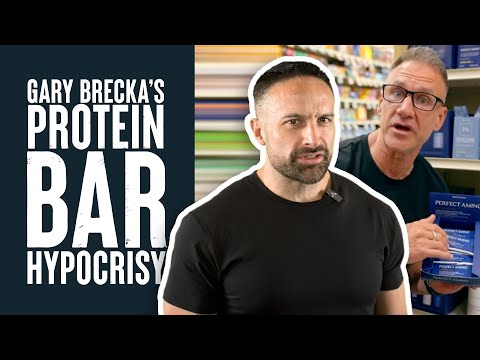
Layne Norton dismantles Gary Brecka's promotion of Perfect Amino bars as 'pressed whole foods,' revealing they are candy bars with 8g low-quality pea protein, 15g fat, and hidden proprietary blends.
2
He explains that pea protein isolate provides very little leucine and that the 1g proprietary amino acid blend cannot come close to the ~2g leucine threshold needed for muscle protein synthesis.
3
Layne reiterates his debate challenge to Brecka and mocks the inclusion of non-bioavailable ATP, highlighting a glaring lack of basic biochemistry understanding from someone calling himself a 'human biologist.'
WhatWhen consuming a protein source to support muscle growth, ensure it provides at least 2 grams (2,000 mg) of leucine per serving.
WhenAt each protein feeding, particularly post-workout and in meals designed to stimulate muscle protein synthesis.
Dose≥2g leucine per serving
For whomIndividuals aiming to build or preserve muscle mass, including athletes, older adults, and those in a calorie deficit.
WhyLeucine is the primary trigger of mTOR signaling and muscle protein synthesis; below ~2g the anabolic response is suboptimal, as shown by his own published research and studies from Stu Phillips, Doug Paddon-Jones, Kevin Tipton, among others.
CaveatsTotal daily protein intake also matters; the 2g leucine threshold is per meal, not a daily total. Some individuals with lower muscle mass may require slightly less, but 2g is a safe benchmark.
Layne Norton devotes a substantial portion of the video to explaining why the Perfect Amino bar fails as a muscle-building product: its protein content cannot deliver enough leucine. He states, 'the threshold for leucine to stimulate muscle protein synthesis is right around 2 g for most people or 2,000 mg.' He references his own published work and corroborates it with other leading research groups. He then calculates that 8g of pea protein contributes less than 1g of leucine, and even combined with the 1,000mg proprietary EAA blend (whose leucine content is unknown but certainly a small fraction) the bar falls orders of magnitude short. This protocol is the actionable takeaway for listeners: look beyond total protein grams and target the leucine content of your protein sources.
The threshold for leucine to stimulate muscle protein synthesis is right around 2 g for most people or 2,000 mg.
Also said
“8 g of pea protein is not going to be even like a gram of leucine. Not even close.”— Demonstrates that the specific bar under discussion misses the target by a large margin.
“You can read many scientific studies, including my own that I've published, as well as out of my lab groups, Stu Phillips' group, Doug Paddon Jones, Kevin Tipton, many different groups.”— Establishes the robust scientific backing for the leucine threshold.
What's new
Personal practice updates, fresh positions, predictions
4 items
perfect-amino-bar-is-candy-not-whole-food
Layne Norton breaks down the Perfect Amino bar's nutrition, showing it contains 8g of pea protein, 15g fat, 16g carbs, and 9g fiber — far from the 'pressed whole foods' claim — making it a candy bar with some fiber and a sprinkle of low-quality protein and EAAs.
Why this matters: It exposes the hypocrisy of Gary Brecka, who warns against ultra-processed foods while marketing his own ultra-processed bar. The analysis shows how clever terms like 'pressed whole foods' mask poor nutritional reality.
Background
Gary Brecka previously attacked David protein bars with fabricated claims before promoting his own bar as a whole-food product, a pattern Layne has repeatedly called out.
Layne opens by stating he is an investor in David protein and would never call his own bars whole food. He then reads the Perfect Amino bar's macros and ingredient list: almond butter, almonds, soluble tapioca fiber, sugar, chocolate, chicory root fiber, pea protein isolate, glycerin, cocoa powder, and a proprietary 'Perfect Amino' essential amino acid blend with ATP. He calculates that the bar has only 8g of protein from pea protein isolate and an extra 1,000mg of proprietary EAAs — far short of meaningful muscle-building support. He points out that you could easily find a bar with better macros in any convenience store. The inclusion of non-bioavailable ATP is just marketing fluff. His final judgment: 'This is not a protein bar, this is a candy bar with some extra fiber thrown in.'
Personal experience
Layne states, 'I am an investor in David protein. I would never try to sell you this as any kind of whole food. This is not whole foods.' He openly acknowledges his bias while still critiquing Brecka's product.
This is not a protein bar, this is a candy bar with some extra fiber thrown in and a relatively low quality source of protein and a small amount of essential amino acids sprinkled in, 1,000 mg total of nine different essential amino acids plus some extra like ATP.
Also said
“Gary Brecka says, “Don't eat ultra-processed foods except for his ultra-processed foods that he sells.””— Frames the hypocrisy immediately.
“You could like spit in a convenience store and find a bar with better macros.”— Emphasizes how underwhelming the product is even compared to common convenience items.
proprietary-blends-are-nonsense
Layne calls the use of proprietary blends in supplements 'complete nonsense' because they hide exact ingredient amounts, making it impossible for consumers to know if a product contains effective doses like the ~2g leucine needed for muscle protein synthesis.
Why this matters: It's a direct, evidence-backed attack on a widespread supplement industry tactic that often misleads buyers. He ties it directly to the failure of the Perfect Amino bar.
Background
In the supplement world, proprietary blends let companies list only the total weight of a mixture, obscuring how much of each active ingredient is present.
Layne focuses on the Perfect Amino bar's 1,000mg 'proprietary blend' of essential amino acids plus ATP. Because the blend is proprietary, you cannot know the leucine content. He explains that from his own lab's research and groups at McMaster and UTMB, the threshold for leucine to stimulate muscle protein synthesis is around 2g (2,000mg). The bar's 8g of pea protein (itself low in leucine) plus the 1g blend cannot possibly reach that threshold. He argues that proprietary blends are a deliberate tactic to prevent informed choices and should be viewed as a red flag.
Proprietary blends are done so that companies do not have to disclose to you what their actual components are. This is, in my opinion, complete nonsense.
Also said
“Even if this essential amino acid blend was 100% leucine, which it's not, it's probably a relatively low amount of leucine, but you don't know cuz it's proprietary, it's not even close to the amount that's needed to stimulate and support muscle growth.”— Quantifies the practical consequence of the hidden formula and links it to the leucine threshold.
atp-in-supplements-is-not-bioavailable
Layne ridicules the addition of adenosine triphosphate (ATP) in the Perfect Amino bar, explaining that oral ATP is not bioavailable and will be broken down during digestion, serving only as a marketing gimmick.
Why this matters: Exposes a common pseudoscientific selling point, and highlights that even basic biochemistry knowledge would dismantle it — a direct jab at Brecka's self-proclaimed 'human biologist' title.
Background
ATP is the cellular energy currency but must be synthesized inside cells; supplementing it orally does not raise cellular ATP levels.
He sarcastically asks, 'What the are we putting ATP in a protein bar for?' and then calmly explains: 'ATP, adenosine triphosphate, your body's energy currency, is not bioavailable.' During digestion, ATP is hydrolyzed and chopped into its nucleotide and phosphate parts, never arriving intact into the bloodstream. He mocks Brecka's lack of understanding: 'If anybody, I don't know, Gary, had a basic comprehension of basic ass chemistry, basic ass biochemistry, they would know this.' The inclusion of ATP is thus a superfluous add-on meant to create a 'pure energy' association that has no basis in physiology.
ATP in a protein bar? What the are we putting ATP in a protein bar for? ATP, adenosine triphosphate, your body's energy currency, is not bioavailable.
Also said
“It's going to be all hydrolyzed and chopped up during digestion and absorption. You are not getting that straight ATP into your bloodstream. THAT IS NOT HOW that works.”— Explains the mechanism of why oral ATP fails, making the critique more educational.
pea-protein-is-leucine-poor
Layne emphasizes that pea protein isolate is a very poor source of leucine and essential amino acids compared to whey, delivering roughly half the leucine, EAAs, and BCAAs per gram, making it an inferior choice for triggering muscle protein synthesis.
Why this matters: Counters the assumption that all plant proteins are equivalent and specifies precisely how pea protein falls short for muscle-building goals.
He states, 'Pea protein isolate is a very poor source of essential amino acids and leucine.' He compares it to whey: 'whey protein has about double the leucine, double the essential amino acids, and double the branched-chain amino acid content. Not quite double, but like right around double.' Therefore, 8g of pea protein yields less than a gram of leucine, far from the ~2g threshold required to maximize muscle protein synthesis. This analysis shows that even if the bar were otherwise well-composed, its protein source is inefficient for building muscle. For individuals aiming to stimulate MPS, this means they would need to consume much more pea protein (and its accompanying calories) to get the same leucine trigger as a smaller amount of whey.
Pea protein isolate is a very poor source of essential amino acids and leucine.
Also said
“If you compare pea protein to whey protein, whey protein has about double the leucine, double the essential amino acids, and double the branched-chain amino acid content.”— Quantifies the nutritional gap to support the criticism.
Recommendations
Products, supplements, and tools mentioned in the episode
1 item
avoid-products-with-proprietary-blends
Practice
Proprietary blends obscure the exact doses of individual ingredients, making it impossible to verify if a product contains effective amounts of key components like leucine.
Layne explains that the Perfect Amino bar uses a proprietary blend for its essential amino acids, meaning consumers cannot tell how much leucine — the critical amino acid for muscle protein synthesis — is actually present. He calls the practice 'complete nonsense' and argues that any company using a proprietary blend is likely underdosing effective ingredients. By avoiding products with such blends and choosing those that list each amino acid individually, consumers can ensure they hit the necessary thresholds for results.
vs alternatives
Compared to transparent products that fully disclose their amino acid profile, proprietary-blend items hide crucial information and are a red flag for poor formulation.
Proprietary blends are done so that companies do not have to disclose to you what their actual components are.
Also said
“This is, in my opinion, complete nonsense.”— Reinforces his strong negative judgment against the practice.
Whey protein provides roughly double the leucine, essential amino acids, and branched-chain amino acids compared to pea protein, making it far more efficient per gram at stimulating muscle protein synthesis.
DisclosureLayne Norton disclosed that he is an investor in David protein, a competing protein bar company. While this may influence his preference for high-quality protein sources, the leucine comparison he provides is rooted in well-established amino acid science.
Layne directly states that pea protein isolate is a very poor source of leucine, and that whey has about double the leucine, EAAs, and BCAAs. This means that to get the same anabolic trigger from pea protein, you would need to consume about twice the protein (and often twice the calories) as you would with whey. For anyone aiming to maximize muscle growth or retention while managing calorie intake, choosing whey-based protein sources is a practical strategy. This recommendation is implicit in his analysis, along with the disclosed bias that he is an investor in a protein bar that may use whey.
vs alternatives
Pea protein requires about twice the dose to match whey's leucine content, so for calorie-conscious individuals, whey is the more efficient choice. Plant-based alternatives may need leucine supplementation to be equally effective.
Pea protein isolate is a very poor source of essential amino acids and leucine. If you compare pea protein to whey protein, whey protein has about double the leucine, double the essential amino acids, and double the branched-chain amino acid content.
Lines worth pulling out — contrarian, specific, or perfectly phrased
6 items
Gary Brecka says, “Don't eat ultra-processed foods except for his ultra-processed foods that he sells.”
Perfectly captures the central hypocrisy Layne is exposing in one sentence.
This is not a protein bar, this is a candy bar with some extra fiber thrown in and a relatively low quality source of protein and a small amount of essential amino acids sprinkled in, 1,000 mg total of nine different essential amino acids plus some extra like ATP.
A devastating final verdict that sums up the entire product critique with vivid language.
Full disclosure, I am an investor in David protein, so there is my bias, but I am going to give you as unbiased an opinion as to what he's saying here.
Transparent conflict-of-interest disclosure up front, showing self-awareness before a biased topic.
Elementary, my dear Watson. He made it up.
A memorable, sarcastic dismissal of Brecka's fabricated claims, referencing Sherlock Holmes.
What the are we putting ATP in a protein bar for? ATP, adenosine triphosphate, your body's energy currency, is not bioavailable.
Funny yet educational takedown of a common supplement pseudoscience, delivered with Layne's characteristic bluntness.
You could like spit in a convenience store and find a bar with better macros.
Hyperbolic but effective illustration of how mediocre the Perfect Amino bar is.
Sign in to share feedback
Tell us if this brief hit the mark or missed it — feedback feeds back into the next iteration of the prompt.
Reading is free for everyone. A free account adds the personal layer: save protocols, follow experts, and see how the other experts weigh in on this same topic.
Educational summary of the cited expert source — not medical advice. Open the source recording linked above and consult a qualified physician before acting on any protocol.