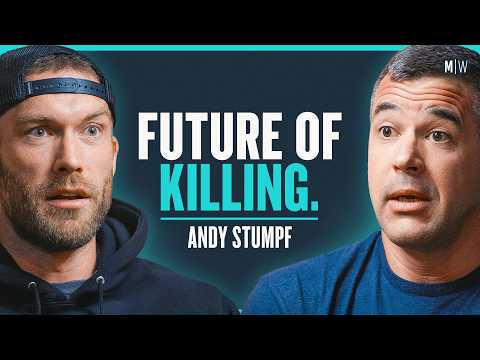
Andy Stumpf reveals that the primary reason SEAL candidates quit is psychological: they become overwhelmed by focusing on the total distance to the goal rather than the immediate next step. He calls this 'chunking' and says it's the single most important lesson of his career.
2
He shares the 'curse of psychological strength'—the very trait that allows high performers to endure pain can trap them in toxic relationships and situations because they mistake suffering for noble struggle.
3
He breaks down the three phases of AI in warfare and why 'human out of the loop' terrifies him, warning that once humans are removed, adversaries will follow, leading to an uncontrollable arms race.
4
He argues that if nobody ever died in training, the training isn't hard enough—real danger is necessary to prepare operators for combat, a controversial stance that challenges safety-first mentalities.
Protocols
Concrete recipes — what, when, how much, and why
6 items
Micro-Chunking for Overwhelm
WhatBreak any daunting goal into the smallest possible next step and focus only on that step, ignoring the total distance.
WhenWhenever facing a task that feels overwhelming or when you want to quit.
DoseContinuously, one step at a time.
For whomAnyone facing long-term goals, high-stress situations, or temptation to quit.
WhyPeople quit because they focus on how far they have to go, becoming overwhelmed. By shrinking the focus to the immediate next action, you prevent overwhelm and maintain forward motion.
CaveatsDoes not make the task easier, just more digestible. Still requires effort.
Andy discovered this as an instructor at BUD/S. He noticed that students who quit all said the same thing: they couldn't endure the cold/pain for as long as they thought they'd have to. They were projecting the suffering into the future and became overwhelmed. He realized that the perception of time was the killer. He then developed a method to either break students (by making them focus on the total distance) or to help them succeed (by shrinking their focus to the immediate). He describes it as slamming the start and end points together so there's only a microscopic step, and you only focus on that step, then the next. He used this himself to pass the diving test on his third attempt after failing twice by thinking about the 20-minute duration.
Mechanism
Psychological: The brain's perception of time and distance triggers overwhelm when the gap between current state and goal is large. By focusing on the immediate, you prevent the emotional response that leads to quitting. This is essentially a form of cognitive reframing that reduces the perceived load.
Personal experience
Andy describes failing his diving test twice because he focused on the 20-minute duration; on the third attempt, he focused only on the immediate problem and passed. As an instructor, he saw that students who focused on the next minute survived, while those who thought about the whole week quit.
People quit when they focus on how far they have to go.
Also said
“The muscle that fails at buds is not below the neck. It's between the ears.”— Reinforces that quitting is psychological, not physical.
“If you can identify that that is the main reason why people give up on their lifelong goals, you should be able to reverse engineer that.”— Shows the universal applicability.
Immediate Action in Crisis
WhatWhen ambushed or in a crisis, move immediately rather than freezing; punch through or flank.
WhenIn any sudden threat or crisis situation.
DoseImmediate, sustained until safe.
For whomAnyone in high-stakes, sudden danger situations (military, but metaphorically for life crises).
WhyStaying still leads to being found and killed; movement, even if risky, is the fastest way out.
CaveatsRequires training to override fear; not applicable to all non-physical crises but the principle of taking action over paralysis holds.
Andy explains from combat experience that the worst thing in an ambush is to stay behind cover because the enemy will maneuver on you. He extends the metaphor to life: indecision and paralysis lead to worse outcomes. He'd rather see someone take a step in the wrong direction and correct than do nothing. He notes that fear is natural but must be overridden, and that the fastest way out of an ambush is to punch through or flank, both of which require movement.
Personal experience
He's seen enemy combatants hide behind bushes thinking they were cover, and they died. He emphasizes that fear is natural but must be overridden.
Many a wrong move was made by just standing still.
Also said
“If you stay there, though, because you're scared... and your enemy starts to come around the corner, it's going to be where you die.”— Direct consequence of inaction.
Procedure Over Panic
WhatIn high-stress situations, detach emotions from decision-making and follow established procedure regardless of how you feel.
WhenDuring any stressful event where clear procedures exist (diving, combat, emergencies).
DoseAs needed during the event.
For whomMilitary, first responders, anyone in high-stakes environments.
WhyEmotions cloud judgment; following procedure ensures correct actions even when scared.
CaveatsRequires prior training and clear procedures. Not a substitute for adaptive thinking when no procedure exists.
Andy describes the diving test where students must untie knots while breathing from a regulator. The test is not about diving but about stress management: can you follow procedure when you're terrified and can't breathe? He says the test has nothing to do with diving and everything to do with stress management and following procedure regardless of what's going on around you. Students who panic and skip steps fail. He emphasizes that emotional control is critical in life-or-death situations.
Mechanism
Stress triggers fight-or-flight, impairing cognitive function. Relying on procedural memory bypasses the emotional brain.
Personal experience
As an instructor, he would see students panic and fail because they didn't follow the simple rule of starting from the mouthpiece. He himself failed twice before mastering emotional control.
This test had absolutely nothing to do with diving and everything to do with stress management and following procedure regardless of what's going on in the world around you.
Also said
“You have to be able to detach your emotions from your decision-making process.”— Core principle.
Tuition Payments
WhatView failures as tuition payments for lessons learned, not as permanent defeats.
WhenAfter any setback or mistake.
DoseAs a mindset shift, applied each time.
For whomAnyone prone to self-criticism after failure.
WhyReframing reduces the emotional sting and encourages learning from the experience.
CaveatsDoesn't make the failure hurt less, but helps extract value.
Andy says he's made more mistakes than successes, and he now sees them as tuition payments—some cheap, some nearly bankrupting him. He uses the business analogy: a $5,000 mistake that saves $500,000 later is worth it. He ties this to his own life, where staying in a bad marriage was an expensive tuition payment that taught him about the curse of psychological strength.
Personal experience
He stayed in a bad marriage 10 years too long because he viewed quitting as failure; now he sees that as an expensive tuition payment that taught him about the curse of psychological strength.
I've reframed how I view failures. I now consider them tuition payments.
Also said
“Some of my tuition payments have been relatively inexpensive and some have taken me to the brink of bankruptcy.”— Shows the range of costs.
Embrace the Grind
WhatAccept that suffering is inevitable and that the pursuit of an easy life is a mistake; instead, learn to suffer well and find joy in the journey.
WhenDaily mindset.
DoseOngoing.
For whomAnyone seeking fulfillment.
WhyThe things we value most come from hard work and shared suffering; easy things don't matter.
CaveatsNot about seeking unnecessary pain, but about not avoiding necessary hardship.
Andy says as he gets older, he realizes the grind is what life is about. He notes that things given to you without effort hold little value, while the hardest-earned achievements are most meaningful. He emphasizes shared suffering with friends as a source of joy, and that the ability to suffer well is more important than avoiding suffering. He believes the pursuit of an easy life is a mistake because it robs you of the satisfaction that comes from overcoming challenges.
Personal experience
He misses the community where they would do painful things and laugh about it together.
I actually think the pursuit of an easy life is a mistake. I think that the grind is actually what life is all about.
Also said
“There is no substitute for hard work.”— Direct statement.
Break Isolation
WhatWhen feeling alone or struggling, ask for help; you are not the only one facing that problem.
WhenWhenever you feel isolated or overwhelmed.
DoseAs needed.
For whomAnyone, especially high-performers who feel they must handle everything alone.
WhyIsolation is a dangerous lie; almost everyone shares similar struggles, and people want to help.
CaveatsRequires vulnerability, which can be difficult for those used to being the 'strong one'.
Andy shares that he has never asked for help and not received it. He notes that people often wait for you to ask because they assume you have it together. He ties this to the high suicide rate in special operations, where isolation is a killer. He says the feeling of being alone is one of the most dangerous lies we tell ourselves, and that almost everybody is dealing with similar worries. He urges people not to convince themselves they are the only one struggling.
Personal experience
He has been in tears, overwhelmed by the number of people who saw he needed help but didn't say anything until he asked.
I have never asked for help and not received it.
Also said
“The feeling of being alone is one of the most dangerous lies we tell ourselves.”— Core message.
What's new
Personal practice updates, fresh positions, predictions
7 items
drone warfare psychological impact
Andy never imagined cheap commercial drones would become a primary battlefield threat. The videos of soldiers fleeing DJI drones that detonate are horrifying, and he's glad he's not part of that generation of warfare.
Why this matters: A former SEAL's raw take on how warfare has changed in a way that was unimaginable during his service, highlighting the psychological terror of being hunted by consumer tech.
Background
During his era, drones were large surveillance platforms like Predators. Now, small FPV drones with explosives are ubiquitous in Ukraine, and anyone can order them online.
Andy explains that he never once thought about the danger of drone warfare while serving. Drones to him were overhead surveillance assets that provided situational awareness. The idea that a combatant could order a drone on the internet and use it as a kinetic weapon never crossed his mind. He's seen videos of soldiers running from drones that detonate, and he describes it as a 'hard pass.' He also notes that field medics are seeing different trauma patterns, though he's unsure if the injuries are more aggressive than IED blasts. The psychological burden of being hunted by a cheap, disposable machine is a new and terrifying dimension of modern combat.
Personal experience
He says he doesn't seek out those videos but they find you, and it's a hard pass for him.
I never once was concerned about somebody essentially ordering a drone on the internet... having that be a kinetic option on the battlefield. Didn't think about it a single time.
Also said
“I am glad that I am not a part of that because I mean I have an internet connection just like anybody else. And I don't go searching for those videos, but sometimes they find you and people running away from basically a DJI drone that detonates.”— Personal reaction to the new reality.
ai warfare human out of the loop
Andy outlines three phases of AI in warfare: human in the loop, human on the loop, and the terrifying human out of the loop. He fears that once humans are removed, adversaries must do the same, leading to an uncontrollable escalation.
Why this matters: Clear, concise breakdown from a former operator of the existential risk of autonomous weapons, including a reference to Anthropic's moral stance.
Background
Current AI assists human decisions; the next step is AI making decisions with human oversight; the final step is fully autonomous.
He explains that right now there's a human making the final decision, maybe assisted by AI. Then there's human on the loop, just overwatching. The phase that terrifies everyone is human out of the loop. He references Anthropic (Claude) and hopes they stood their ground morally on mass surveillance and autonomy. He argues that if we take humans off the loop, adversaries will have to do the same to keep up, leading to a world where robots make life-and-death decisions. He doesn't want Terminator to become a documentary. For his own role as a SEAL, he doesn't see AI crossing the threshold of a door anytime soon, so he thinks AI will help more in planning and analysis than in direct action.
Personal experience
He says as a SEAL, his job was to cross the threshold of a door; he doesn't know how AI does that, so he thinks AI will help more in planning and analysis than in direct action for now.
The phase that I think terrifies everybody is human out of the loop.
Also said
“If we take humans off the loop, I don't know how you combat that as an adversary without doing exactly the same thing.”— Escalation dilemma.
ghost murmur heartbeat detection skepticism
Andy is highly skeptical of the viral claim that the US military can detect heartbeats from aircraft to find individuals. He believes there are easier, more conventional ways to locate a downed pilot, and that the technology is not there yet.
Why this matters: Insider perspective debunking a sensationalized tech claim, while protecting TTPs.
Background
The 'ghost murmur' story claimed that quantum sensors on an Apache helicopter detected a pilot's heartbeat from miles away.
He says he doesn't want to tip his hand on TTPs (tactics, techniques, procedures), but he thinks aviators have ways to identify their location that would be picked up by aircraft, and probably the higher you are, the better line of sight. He doubts the heartbeat capability is real, saying 'I don't think we're there yet.' He also notes that pilots eject with survival gear including radios and beacons, so finding them isn't as impossible as the story suggests. He finds the idea fun but improbable.
Personal experience
He's taken 1500 people for their first tandem jump and knows the survival equipment pilots carry.
Do I think it's capable of doing it at a heartbeat? Maybe. But I don't think we're there yet. I really don't.
Also said
“There are other less complex ways to do that.”— Practical alternative.
why people quit buds time perception
After observing hundreds of students as an instructor, Andy concluded that the primary reason candidates quit is that they become overwhelmed by focusing on the total time/distance remaining rather than the immediate next step.
Why this matters: Counterintuitive: it's not physical exhaustion but a cognitive error about time. This insight became the foundation of his chunking method.
Background
Millions have been spent trying to predict who will make it through SEAL training, with little success. Attrition rates are 75-90%.
He describes how as a student, you never get to talk to those who quit because they're immediately removed. As an instructor, he spent time with them afterward and they all said the same thing: 'I couldn't be as cold as I was for as long as I thought I was going to be cold.' They had projected the suffering into the future and became overwhelmed. He realized that the view of time was the determining factor. He then developed the chunking method and found it was the single most effective tool to get people to quit (by making them focus on the distance) or to help them succeed (by shrinking the focus). He would set his watch to the wrong day and tell students he'd keep them in the water for 12 hours, and those who focused on surviving the interaction with him would make it, while those who thought about the whole week would break.
Personal experience
He failed his diving test twice because he thought about the 20-minute duration; on the third try, he focused only on the immediate problem and passed.
What they are all expressing is a moment where they became overwhelmed by the situation that they were in and they started looking at time literally time. How they viewed time was the determining factor on the decision that they made.
Also said
“If they could only see where they were... and this is graduation on average 180 days and only thing that they can see is the the gap between my two fingers. Dude, that's a lot.”— Visual illustration of the overwhelm.
curse of psychological strength
The very trait that enables high performers to endure pain and push through can become a liability in relationships, causing them to tolerate intolerable situations because they mistake suffering for noble struggle.
Why this matters: A profound and personal insight that reframes resilience as a potential trap, directly tied to Andy's own story of staying in a bad marriage too long.
Background
Andy stayed in a bad marriage 10 years too long because his identity was built on never quitting.
Chris reads an essay he wrote inspired by Andy's story. It describes how psychological strength is rewarded in the gym, business, and public life, but in relationships, it leads to self-abandonment. High performers ignore warning signs, rationalize mistreatment, and believe that if they just work harder, they can fix it. The essay notes that what you're praised for in public, you pay for in private. Andy confirms it's deeply self-reflective and that he could have written it himself. He says he denied himself prioritization and pushed through discomfort because everything valuable had come from hard work. He now sees that some suffering is pointless.
Personal experience
Andy says he denied himself prioritization and pushed through discomfort because everything valuable had come from hard work. He now sees that some suffering is pointless.
What you are praised for in public, you often pay for in private.
Also said
“Relationships don't reward endurance. They require attunement.”— Key distinction between professional and personal life.
“The qualities that make you formidable in the arena can quietly make you miserable in your own living room.”— Powerful summary of the trap.
special operators normal people
Contrary to the superhero myth, SEALs are exceptionally average people with normal flaws, and the community has both the best and worst leaders. The glorification can be dangerous.
Why this matters: Demystifies the SEAL mystique from an insider, emphasizing that they are not superhuman and that the pedestal can lead to isolation and unrealistic expectations.
Background
Media often portrays SEALs as invincible warriors.
Andy says he served with tremendous people, but they are all normal. He describes the first day of BUD/S where you see a D1 athlete who can't swim and a marathon runner who struggles. The ones who make it look like the guy checking you out at the grocery store. He warns that believing you're different can lead to a dark place, and that the divorce rate is around 80-85% because the job always comes first. He also notes that the best and worst leaders he ever saw were in that community. He wants to pull back the curtain so people understand that these are just average people who struggle in different ways.
Personal experience
He says his kids have asked about his old job maybe five times; he has nothing military at home.
The special operations community is not comprised of people that put a cape on and go to work. They are very normal people that are tasked with doing some exceptional things at times.
Also said
“You have more in common with a guy who's bagging your groceries and a special operation soldier than you could possibly think.”— Emphasizes relatability.
deaths in training necessary
Andy argues that if nobody ever died in training, the training isn't hard enough. The danger must be real to prepare operators for the reality of combat.
Why this matters: Controversial stance that challenges safety-first mentalities and explains the philosophy behind the extreme nature of BUD/S.
Background
Some people question the risks of SEAL training.
He explains that the job is very dangerous, and you cannot prepare for it by avoiding danger. If there's no risk of death, there's no sufficient skin in the game. He mentions that the last student death was post-hell week from fluid in the lungs, and that drownings have occurred. He says it's essential people die from time to time, though they try not to kill people. The training must reverse-engineer the real-world requirements, and that includes the possibility of fatal consequences.
Personal experience
He went through winter hell week and saw how destroyed people are.
If nobody ever died in training, you are not training hard enough.
Also said
“The training has to be a reverse engineering downstream real world requirements of the job that you are expected to do. And it is a dangerous job. You cannot prepare for that by avoiding danger and training.”— Justification for the philosophy.
Disclosed sponsorships3speaker disclosed
Shopify
Service Sponsored · disclosed
Chris mentions Shopify powers 10% of US e-commerce and he partnered with them. He highlights the checkout conversion rates and Shop Pay.
DisclosureSponsored ad read
Their checkout is 36% better on average compared to other leading commerce platforms.
Chris partnered with Function, which offers 160+ lab tests for $365/year, reviewed by clinicians.
DisclosureSponsored ad read
Function gives you access to more than 160 advanced lab tests spanning hormones, heart health, metabolic markers, inflammation, thyroid, nutrients, liver, and kidney function.
Reading is free for everyone. A free account adds the personal layer: save protocols, follow experts, and see how the other experts weigh in on this same topic.
Educational summary of the cited expert source — not medical advice. Open the source recording linked above and consult a qualified physician before acting on any protocol.