UNFUCG
DashboardSearchChatBookmarksNotificationsActivityPremiumProfile
?
Home
Search
Chat
Saved
Profile
Episode
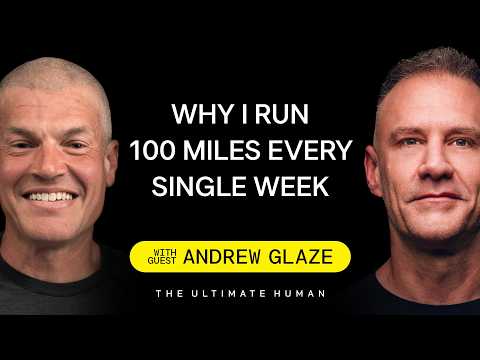
Andrew Glaze: On The Mental Health Benefits of Running 100 Miles Weekly | TUH #237
~128 min
Episode Brief·YouTube

Andrew Glaze: On The Mental Health Benefits of Running 100 Miles Weekly | TUH #237

Gary Brecka
Watch on YouTube Add to chat My bookmarks← All sources

TL;DR

The four things you'd lose by not watching

4 items

TL;DR

The four things you'd lose by not watching

4 items
1

Andrew Glaze, firefighter and ultra-endurance athlete, reveals he has run at least 100 miles every week for 300 consecutive weeks (over 60,000 miles in 10 years) and uses the extreme physical toll of races to silence PTSD symptoms.

2

He detailed his third and successful attempt at the Moab 240 (240-mile loop desert race), after a fall from sleep deprivation at mile 200 and a near-fatal heat stroke, employing a deliberate 3am-6am sleep block in a support van to beat hallucinations.

3

Glaze eats solid whole-food meals (vegan burgers, avocado) during 100+ mile races because his gut and mouth become intolerant to gels, and he splits daily mileage into two runs to prevent overuse injuries.

4

Despite the extreme volume, his biohacking is minimal: daily sauna/cold plunge, red light on feet, a vegan diet, and a targeted supplement stack (algae oil, D3+K2, magnesium, alpha GPC); he checks biomarkers annually.

Protocols

Concrete recipes — what, when, how much, and why

5 items

Two-a-day run split for injury prevention

WhatDivide total daily running mileage into two separate runs (morning and evening) rather than a single long run to reduce overuse injury risk.
WhenDaily, particularly when running high volume (e.g., 20+ miles per day). Longer run in morning, shorter in evening.
DoseE.g., 10 miles morning + 10 miles evening instead of 20 miles straight; or 13+7.
For whomHigh-mileage runners aiming for 100+ mile weeks or regular ultra training.
WhyGives tendons and bones a recovery window between bouts, preventing the cumulative strain that leads to overuse injuries when muscles outpace connective tissue adaptation.
CaveatsRequires time management; still need a base level of conditioning; on fire shift days he runs loops around the station block to achieve two sessions.

Andy emphasizes that many runners get injured because they fail to respect the slower adaptation of connective tissue. He has applied this split principle for years and credits it for his ability to maintain 100+ mile weeks for 300 consecutive weeks without significant injury. On duty, he accomplishes the split by running repeated short loops around the fire station, even on a treadmill, ensuring he stays within response range. The strategy also helps him balance family life by doing the main run while kids are at school.

Mechanism

Tendons and cartilage adapt more slowly than muscles. Breaking a long run into two parts allows partial tissue recovery and reduced peak load, lowering the risk of stress reactions and tendinopathies.

Personal experience

Andy: 'I found that in order to not get injured... it's best to break your mileage up into two runs a day. So, if you're going to do 20 miles, it's better to run 10 and 10 or 13 and seven rather than run just straight 20 miles.' He typically does the longer run in the morning and a quick 5-miler before dinner.

I found that in order to not get injured, it's best to like break your mileage up into two runs a day.

Also said
“If you go from doing nothing to going, 'Oh, I'm going to go run 100 miles tomorrow,' then you might have some knee problems. If you slowly build over, you know, a decade, yeah, you're probably fine.”— Reinforces the principle that gradual load and split sessions promote adaptation and reduce injury risk.

3am–6am sleep block for 200+ mile races

WhatAfter skipping the first night's sleep entirely, take a single 3-hour sleep block from 3 a.m. to 6 a.m. on the second night, waking at sunrise, and avoid all subsequent naps.
WhenDuring multi-day ultra races (200+ miles), beginning the second night.
Dose3 hours of sleep per block; total 6–7 hours across a ~4-day race.
For whomUltra runners attempting 200-mile or longer events who have crew/van support for safe sleeping.
WhyPrevents severe sleep-deprivation hallucinations and falls, harnesses the circadian awakening response at sunrise for renewed alertness, and condenses recovery into a single restorative block instead of fragmented naps.
CaveatsRequires discipline to skip first night and access to a secure sleep environment (camper van). Some individuals might need more sleep; heat/cold extremes can affect sleep quality.

Andy failed Moab 240 first time after staying awake ~51 hours, fell asleep while running at mile 200, fell backwards off a cliff, injured his back and DNF’d. Second attempt ended in heat stroke. For his successful third attempt, he and his crew rented a camper van; he ran through the first night, then scheduled the 3–6 a.m. sleep window during the coldest, darkest hours. He reports feeling significantly clearer, completed the race, and now considers this a replicable protocol for future 200s. He notes that the body's pain and soreness naturally limit sleep duration anyway—you wake up when you can’t stay still any longer.

Mechanism

Consolidated deep sleep provides greater restorative function than multiple short naps. Waking with natural light triggers cortisol and mood elevation, reducing sleep inertia. Avoiding naps minimizes time spent on the course in a vulnerable state.

Personal experience

In Moab 240: 'I had a much better sleep strategy where I would sleep from like 3:00 a.m. to 6:00 a.m. So that like I would wake up right as the sun was rising. ... I actually took no naps the whole race and I was only only slept for like those hours in the in the middle of the night.' He said it ‘worked really well’.

I had a much better sleep strategy where I would sleep from like 3:00 a.m. to 6:00 a.m. So that like I would wake up right as the sun was rising.

Also said
“I actually took no naps the whole race and I was only only slept for like those hours in the in the middle of the night. Um, so that's a strategy I'm probably going to use for future 200s.”— Shows he plans to adopt it long-term based on his success.

Solid whole-food fueling during ultra races

WhatEat substantial solid meals (vegan burgers, burritos, avocado) at aid stations during 100+ mile races, and in between use gels only when heat makes solids hard to digest.
WhenAt aid stations in ultras, typically every 10–20 miles; also train the gut with solid food on long training runs.
DoseAs tolerated; two vegan burgers can be consumed in one stop. Then continue running, albeit slower for the first mile or two.
For whomUltra runners who struggle with gel tolerance or want to reduce processed sugar intake during races.
WhyGels cause mouth sores and GI shutdown over multi-day events; solid food provides sustained calories without palate fatigue, and real food reduces the need to constantly switch gel brands.
CaveatsIn extreme heat, solid food becomes difficult to digest and may cause GI distress; a 1–2 mile slower pace after eating is needed until digestion settles.

Andy discovered that after many years of racing, his mouth developed sores from the acidity of gels, and his stomach would eventually reject them. He began experimenting with real food and found that he could eat a full vegan burger or a burrito and then continue running. His favorite race food is avocado for its healthy fat content. He warns that hot races require mostly gels because solid food becomes unpalatable, but in moderate conditions whole foods work and keep him satiated and psychologically happier. This flexibility eliminates brand loyalty and prevents the common race failure of 'bonking' due to gut rejection of gels.

Mechanism

Gradual gut training — repeatedly eating solids during training runs conditions the gastrointestinal tract to process food while blood is shunted to muscles, improving tolerance and gastric emptying under exercise stress.

Personal experience

'At an aid station I'll have like two burgers... and then I'll just start running and like my stomach handles it.' Also: 'I love avocado, too, during the race. That is my favorite.' He says he has 'literally trained my body to take solid food in'.

I've literally trained my body to be able to take solid food in and it works really well.

Also said
“You go a little slower the first mile or two. You're definitely not like, you know, running a six-minute mile with two burgers in your stomach.”— Provides the honest trade-off on pace.
“All those gels and stuff, they like you'll start getting like sores in your mouth and stuff just from how like acidic and everything they are.”— Explains why he sought an alternative to gels.

Waist light for night running

WhatUse a light mounted around the waist instead of a headlamp during night segments of ultra races to reduce shadow-induced visual hallucinations.
WhenDuring dark hours of any ultra race, especially after sleep deprivation sets in.
DoseContinuous use during night running.
For whomUltra runners experiencing night-time hallucinations or disorientation from headlamp bouncing.
WhyWaist-level light throws fewer dynamic shadows and provides more stable illumination, decreasing the likelihood of misperceiving terrain and hallucinating objects.
CaveatsLooks unusual but works; may require separate lighting for close tasks like map reading.

Andy recounts seeing troll dolls and robot dogs during previous sleep-deprived races, partly triggered by erratic shadows from his headlamp. Switching to a waist light markedly reduced these episodes. He still uses supplemental light from a phone or watch for navigation, but the primary running light is waist-mounted.

Mechanism

The waist position alters light incidence angle, reducing the 'bouncing' shadow effect created by head movement, which helps the brain interpret the visual environment more accurately under fatigue.

Personal experience

'I've been using a waist light and it's it's a lot better. ... it doesn't throw like shadows the same way. ... it looks weird, but um it works better.'

I've been using a waist light and it's it's a lot better.

Also said
“It doesn't throw like shadows the same way.”— Explains the direct benefit over headlamps.

Basic recovery routine for high mileage

WhatDaily sauna and cold plunge, red light therapy on feet, high food intake, and a personalized supplement stack to support recovery from 100+ mile weeks.
WhenDaily, as part of regular routine.
DoseNo duration specified; likely variable.
For whomHigh-volume endurance athletes.
WhyThe volume of running (300 weeks of >100 miles) demands consistent recovery to prevent injury and burnout.
CaveatsHe acknowledges he cannot access more advanced biohacking due to location and finances, so he keeps it simple.

Andy was asked about his biohacking and listed his minimal routine: usual sauna and cold plunge, a small red light bed used mainly on his feet (to keep them healthy), and a high calorie diet to avoid the bone and tendon injuries that come from under-fueling. He also takes many single-ingredient supplements (flax seed oil, algae oil, iron, zinc, magnesium, D3+K2, garlic oil, alpha GPC, B complex, AG1). He experiments with extra things like ketone IQ occasionally, but mainly sticks to this basic stack. He checks bloodwork annually through his fire department's wellness program and his own doctor, aiming for athlete functional ranges, not population average.

Mechanism

Sauna/heat stress improves cardiovascular recovery, cold plunge reduces inflammation, red light on feet may support mitochondrial function and healing of foot tissues. Adequate food intake prevents bone and tendon injuries from caloric deficit.

Personal experience

'I have a small red light like bed that I use mostly on my feet. ... Just because, you know, you got to keep the feet pretty healthy.' Also: 'I take a lot of supplements. Like a lot of supplements.'

I'm constantly experimenting with things. You know, I'm like, 'well, let's see if this works or let's see if that works.'

Also said
“I do get regular blood work just to kind of test my levels.”— Shows he is monitoring biomarkers, even if his physical interventions are basic.

What's new

Personal practice updates, fresh positions, predictions

5 items

Running quiets PTSD symptoms

Andy found that the intense physical pain and singular focus of ultra-distance races, especially in the 'pain cave' from miles 50–85, silences the intrusive thoughts, insomnia, and hyperarousal of firefighting-related PTSD.

Why this matters: He offers a personal, non-pharmacological strategy for managing trauma in a high-suicide profession, directly contrasting the culture of 'walk it off' and the common resort to alcohol and drugs.

Background

As a firefighter, he accumulated traumatic memories that would trigger nervous system dysregulation—insomnia, racing heart, inability to relax—often exacerbated by chronic sleep deprivation from 48-hour shifts. Standard medical response was medication, but he sought an alternative.

Andy describes PTSD as a 'stack' of terrible images and events that periodically activate, throwing off the entire nervous system. He initially learned that exercise could calm his anxiety and depression in his 20s, so when PTSD emerged later, he pushed himself harder with triathlons and obstacle-course racing, eventually landing on ultra running. He realized that the profound physical distress and the brain's singular command to 'stay alive' during the most grueling miles effectively displaces intrusive PTSD thoughts. The pain cave becomes a sanctuary where he feels most alive and free from mental torment. He also frames it as intentional mental training for uncontrolled life hardship, because in a race you can stop if truly needed, but life offers no such safety net.

Personal experience

Andy: 'I kept trying to push myself harder and harder to try to deal with that because... my initial thing was, oh, if you feel weird in your brain, just exercise. ... I had to start doing a little bit more to get that to calm down. And that led to me doing all sorts of other things... and then that sort of led to the ultra running.' He adds that during races, 'the brain goes real quiet when it comes to the PTSD symptoms... because you're really just trying to stay alive.'

The brain goes real quiet when it comes to the PTSD symptoms in in that because you're really just trying to stay alive.

Also said
“You need to train your brain to be able to handle a lot of very tough situations. And what better way to do that than in an ultramarathon.”— Shows the deliberate framing of ultra running as mental resilience training, not just physical challenge.
“I think that the brain inherently is sort of lazy and wants to take it easy and if you don't constantly remind it that it can go further than it thinks it can then it forgets.”— Explains why he regularly seeks out the pain cave—to stave off mental complacency.

Solid food fueling during ultra races

Andy has trained his gut to consume large solid meals like vegan burgers, burritos, and avocado at aid stations during 100+ mile races, avoiding the mouth sores and GI shutdown that repeated gel use causes over multi-day events.

Why this matters: Most ultra runners rely heavily on liquid and gel fuel; his ability to eat real food mid-race and still run is unconventional and solves a common failure point (gel fatigue and mouth trauma).

Background

Gels and sugary race fuels, while initially handy, become increasingly acidic, cause oral sores, and can lead to stomach refusal after successive days of racing. Andy himself has gotten sick of every product on the market, forcing him to adapt.

Andy explains that during ultra races, especially in moderate weather, he will eat two vegan burgers at an aid station and then immediately resume running. He has conditioned his stomach to process solid food while moving, though he notes that the first mile or two afterward are slower. He identifies avocado as his ideal race food—a perfect fat that provides sustained energy. The ability to handle solids is built through deliberate practice: he consumes real food on training runs so his gut adapts. In very hot races, however, he reverts to gels because solid food becomes difficult to digest. This adaptative flexibility allows him to avoid the constant swapping of gel brands mid-season and circumvent the cumulative mouth and gut irritation that plagues many ultra runners.

Personal experience

Andy: 'at an aid station I'll have like two burgers... and then I'll just start running and like my stomach handles it.' He adds, 'I've literally trained my body to be able to take solid food in and it works really well. I love avocado, too, during the race.'

I've literally trained my body to be able to take solid food in and it works really well. I love avocado, too, during the race.

Also said
“You go a little slower the first mile or two. You're definitely not like, you know, running a six-minute mile with two burgers in your stomach.”— Adds a practical caveat—acknowledges the immediate performance trade-off.
“All those gels and stuff, they like you'll start getting like sores in your mouth and stuff just from how like acidic and everything they are.”— Explains the specific pathology that drives him away from gels, making the solid food strategy a direct solution.

Two-a-day run split to prevent injuries

To avoid overuse injuries while maintaining 100+ mile weeks, Andy splits his daily mileage into two separate runs (e.g., 10+10 or 13+7) rather than a single long effort.

Why this matters: Directly contradicts the common runner's assumption that breaking mileage is less effective and offers a practical, injury-mitigation protocol for high-volume training.

Background

Many runners fear repetitive stress injuries like tendonitis and bone stress from high mileage. Common advice sometimes lumps them into single long runs, which may heighten cumulative strain on connective tissues.

Andy discovered through years of ultra running that splitting mileage drastically reduces his injury risk. He runs a longer morning session while his kids are at school and a shorter evening session before dinner. This strategy spreads mechanical load across two recovery windows, allowing tendons and bones to better adapt instead of being overloaded in one continuous bout. On fire station shifts, he maintains the same principle by running loops around the station block, still breaking the distance into two outings. He emphasizes that muscles adapt faster than tendons, so shorter intermittent bouts protect the slower-adapting connective tissue.

Personal experience

'I found that in order to not get injured, it's best to like break your mileage up into two runs a day. So, if you're going to do 20 miles, it's better to run 10 and 10 or 13 and seven or something like that rather than run just straight 20 miles.' He adds: 'I normally run twice a day... I try to get my longer run done in the morning... and then I'll run again at night like right before dinner.'

I found that in order to not get injured, it's best to like break your mileage up into two runs a day.

Also said
“If you go from doing nothing to going, 'Oh, I'm going to go run 100 miles tomorrow,' then you might have some knee problems. If you slowly build over, you know, a decade, yeah, you're probably fine.”— Highlights the principle of gradual adaptation behind the split-run strategy.

3am-to-6am sleep block for 200-mile races

After two DNFs caused by sleep-deprivation hallucinations and heatstroke, Andy implemented a deliberate single 3-hour sleep block (3 a.m. to 6 a.m.) during the Moab 240, waking at sunrise, and avoided all naps—resulting in his first finish.

Why this matters: Reveals a race-tested, circadian-aligned sleep hack that substitutes for the haphazard napping that often fails in ultra-distance events.

Background

In his first Moab 240, he stayed awake so long that he fell asleep while running at mile 200, fell off a cliff, and DNF'd. The second attempt ended with heat stroke at mile 85. Clearly, sleep and thermoregulation were key failure points.

Having crew and a camper van in his third attempt allowed him to pre-plan sleep. He chose to skip the first night entirely (running through it), then from 3 a.m. to 6 a.m. the second night he slept in the van. Waking at sunrise provided a circadian boost—the natural light and cortisol awakening response refreshed him without grogginess. He took zero naps for the remainder of the race, relying on that single consolidated block. Total sleep was about 7 hours over 98 hours of racing. He contrasts this with his first failure, where micro-sleep caused the catastrophic fall. The new protocol will become his standard for future 200-milers.

Personal experience

'I had a much better sleep strategy where I would sleep from like 3:00 a.m. to 6:00 a.m. So that like I would wake up right as the sun was rising. ... I actually took no naps the whole race and I was only only slept for like those hours in the in the middle of the night.'

I had a much better sleep strategy where I would sleep from like 3:00 a.m. to 6:00 a.m. So that like I would wake up right as the sun was rising.

Also said
“I actually took no naps the whole race and I was only only slept for like those hours in the in the middle of the night. Um, so that's a strategy I'm probably going to use for future 200s.”— Confirms he evaluated the protocol as successful and will adopt it long-term.

Waist light over headlamp for night running

Andy switched from a headlamp to a waist-mounted light for overnight segments of ultras, finding it throws fewer dancing shadows and reduces odd visual perceptions.

Why this matters: A simple gear hack born from years of nighttime hallucination struggles; contrasts with the standard ultrarunner headlamp setup.

Background

Running at night with a headlamp bouncing on your head creates erratic shadows and visual distortions that can trigger or amplify hallucinations during prolonged sleep deprivation.

Andy describes how artificial headlamp light becomes exhausting and disorienting after many hours, with shadows jumping unpredictably. By moving the light source to the waist, the illumination angle is more natural, shadows are fewer, and he experiences fewer 'squirly' visual episodes. It looks unusual but has noticeably improved his night stability and mental clarity.

Personal experience

'I've been using a waist light and it's it's a lot better. ... the waist light it looks it looks weird, but um it works better.'

I've been using a waist light and it's it's a lot better.

Also said
“It doesn't throw like shadows the same way.”— Clarifies the main biomechanical reason for the improvement.

Recommendations

Products, supplements, and tools mentioned in the episode

5 items

Red light therapy bed for feet

Tool

He uses a small red light bed specifically on his feet to maintain foot health under the immense mileage.

Feet are a common failure point for ultra runners; Andy uses red light as a preventive strategy, believing it helps with tissue recovery and injury avoidance.

Personal experience

'I have a small red light like bed that I use mostly on my feet. Just because, you know, you got to keep the feet pretty healthy.'

I have a small red light like bed that I use mostly on my feet.

Find Red

Algae oil (DHA/EPA)

Supplement

He takes an algae oil supplement for the DHA and EPA, likely because his vegan diet lacks fish-based omega-3s.

Andy lists algae oil alongside flax seed oil to ensure he gets long-chain omega-3 fatty acids, which are important for anti-inflammatory response and brain health, particularly relevant given his history of depression and the physical stress of running.

Personal experience

'I take um like an algae oil. So um so it has like the DHA and EPA in it.'

I take um like an algae oil. So um so it has like the DHA and EPA in it.

Find Algae

Vitamin D3 and K2

Supplement

Despite frequent sun exposure, he tested deficient in vitamin D and takes D3 plus K2 daily.

Andy was surprised by his deficiency given he runs outdoors all day, but notes that even during a 300-mile week with constant sun, his levels were low, so supplementation is necessary. He takes it in combination with K2 for proper calcium utilization and bone health.

Personal experience

'I take D3 and K2, which is for some reason I've had like deficiencies in that, which is weird because I'm in the sun all the time.'

I take D3 and K2, which is for some reason I've had like deficiencies in that, which is weird because I'm in the sun all the time.

Also said
“But yeah, but that's just cuz I did 300 miles in a week, but...”— Shows he acknowledges the irony and that supplementation is still required.
Find Vitamin

Alpha GPC

Supplement

He uses alpha GPC when he needs to use his brain, for cognitive support.

Alpha GPC is a choline compound that can support focus and mental clarity. Andy likely uses it on days when sleep deprivation from firefighting or heavy training demands extra cognitive sharpness.

Personal experience

'I like uh alpha GPC when I need to use my brain.'

I like uh alpha GPC when I need to use my brain.

Find Alpha

Waist light (generic)

Tool

He recommends using a waist light instead of a headlamp for night running to reduce visual hallucinations and disorientation.

No specific brand mentioned; just the concept of waist-mounted lighting as a superior alternative to headlamps for ultra runners. He has found it reduces the 'dancing shadow' effect and helps keep his perception stable during sleep-deprived hours.

vs alternatives

vs. headlamps, which create bouncing shadows and can contribute to hallucinations.

Personal experience

'I've been using a waist light and it's it's a lot better. ... it doesn't throw like shadows the same way.'

I've been using a waist light and it's it's a lot better.

Find Waist
Disclosed sponsorships2speaker disclosed

Athletic Greens (AG1)

Supplement Sponsored · disclosed

He takes AG1 every morning as a nutritional insurance policy to cover any gaps in his vegan diet, given his extreme caloric expenditure.

DisclosureAndy explicitly stated he is not sponsored.

Andy includes AG1 in his morning ritual, viewing it as a convenient way to fill potential micronutrient deficiencies despite eating a lot of whole food. He does not rely on it as a primary source but appreciates the catch-all nature.

Personal experience

'I take AG1. Not sponsored, but like I I do take it every morning just in case I'm like you missed anything. I'm like I might as well throw it in the mix.'

I take AG1. Not sponsored, but like I I do take it every morning just in case I'm like you missed anything.

Find Athletic

Smile or You're Doing It Wrong

Book Sponsored · disclosed

Andy has written a book encapsulating his life philosophy; it was in pre-release at the time of this recording and will be released in the coming year.

DisclosureAuthor is Andy Glaze himself (self-promotion).

The book is an extension of his positive mindset mantra—his tagline 'Smile or you're doing it wrong.' He wrote it to share his lessons on resilience, positivity, and endurance, and is beginning to monetize his social media presence through it and select sponsorships.

Personal experience

'I wrote a book... Smile or you're doing it wrong. That's like my tagline.'

Smile or you're doing it wrong.

Find Smile

Notable quotes

Lines worth pulling out — contrarian, specific, or perfectly phrased

5 items
The brain goes real quiet when it comes to the PTSD symptoms in in that because you're really just trying to stay alive.
Succinctly captures how extreme physical duress quiets trauma-related mental turmoil.
You need to train your brain to be able to handle a lot of very tough situations. And what better way to do that than in an ultramarathon.
Frames ultra running as deliberate mental resilience training for life, not merely sport.
I'm competing against myself.
Defines his personal, non-comparative approach after years of balancing a demanding career and family with elite endurance.
Motion's the lotion.
A pithy truth about how movement helps loosen stiff, sore muscles after sleeping during a race.
I was convinced it was these robot dogs.
Vividly illustrates the bizarre visual hallucinations that occur after 51 hours without sleep during a 200-mile race.

Sign in to share feedback

Tell us if this brief hit the mark or missed it — feedback feeds back into the next iteration of the prompt.

Topics covered

ptsd-in-first-respondersultrarunning-as-mental-therapymoab-240-racesleep-deprivation-hallucinationsrace-nutrition-solid-foodtwo-a-day-training-splitinjury-prevention-runningmental-toughness-trainingfirefighter-career-balancesupplement-stackvegan-diet-athleterecovery-protocols-minimalrace-sleep-strategywaist-light-night-runningsocial-media-impactbook-smile-or-youre-doing-it-wrongfather-inspirationbiomarker-monitoring
Free account

Make this library yours

Reading is free for everyone. A free account adds the personal layer: save protocols, follow experts, and see how the other experts weigh in on this same topic.

Create a free accountSign in

Where the experts disagree — weekly

One email a week: the sharpest new disagreements and protocols from the library. No spam, unsubscribe anytime.

Educational summary of the cited expert source — not medical advice. Open the source recording linked above and consult a qualified physician before acting on any protocol.