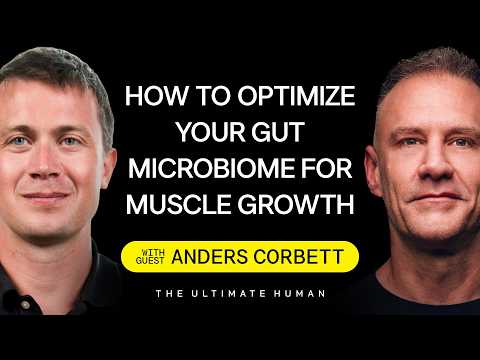
Anders Corbett runs a direct-to-consumer service (Craft Microbiome) where he sequences your stool/saliva, isolates your own bacteria, and ships back freeze-dried custom probiotics—letting you 'craft' your microbiome for goals like recovery, hormone optimization, or reduced inflammation.
2
He highlights specific bacteria-performance links: Lactobacillus reuteri and L. plantarum boosted a Lyme patient’s testosterone from low to 800‑900 ng/dL, while Veillonella (found in Olympic swimmers) clears lactate from blood to speed recovery.
3
A core protocol: bank your stool now while you’re young and healthy, then re‑inoculate with your own frozen bacteria after antibiotics, surgery, or as you age to preserve the 'young' microbial profile linked to centenarians.
4
He self‑tested a glucose‑eating bacterium by eating the same Wendy’s meal daily—post‑probiotic, glucose spikes dropped from 120‑140 to 115‑120 mg/dL; a client later saw the same effect.
Protocols
Concrete recipes — what, when, how much, and why
7 items
Send stool/saliva sample to Craft Microbiome for personalized probiotic banking and custom capsules
WhatProvide a stool or saliva sample (size of a penny); Corbett isolates your own bacteria, identifies strains, freeze‑dries them into capsules and banks a reserve for future use.
WhenAnytime; ideally before antibiotics, surgery, or while young and healthy to capture a robust microbial profile.
DoseDaily capsule(s) taken orally; specific dosage depends on the bacterial strains and individual goals (no fixed dose mentioned).
For whomAnyone interested in optimizing gut‑derived outcomes; especially those with gut dysbiosis, athletes, or individuals with a family history of neurodegenerative disease.
WhyYour own bacteria are low‑risk, biocompatible, and can be chosen to target specific outcomes (testosterone, recovery, inflammation, glucose control).
CaveatsNot FDA‑cleared to treat, cure, or prevent disease; the process is experimental. Some strains may not grow in culture. Allergies to garlic/onions indicate caution with certain Lactobacillus strains.
Corbett’s service, Craft Microbiome, is built on the idea that personalized probiotics outperform generic ones. He mails a collection kit; after receiving a sample, he plates the bacteria under conditions matching their original environment (aerobic, anaerobic, specific nutrients). Genomic sequencing confirms strain identity. The client receives a menu of bacteria associated with published functions (bone density, serotonin/dopamine, androgens, oxygen utilization, etc.) and chooses targets. Corbett then grows those strains from the client’s own sample, freeze‑dries them, and returns them in capsules. The whole process turns gut‑microbiome modulation into a bespoke service, akin to ordering a tailored supplement stack from your own biological material. He emphasizes starting small with one or two benign strains, especially for people with IBD, and building from there based on subjective feedback—‘I’m sleeping better, I’m feeling better.’
Personal experience
Corbett isolated his own early commercial strains from his stool; clients include LeBron James, UFC fighters, and World’s Strongest Man competitors.
I take about as much stool or saliva that covers a penny. … Once I have that ID verified I put it in a media jar or a bioreactor … freeze dry the bacteria … and then I put the rest in these capsules and then ship it to you.
Also said
“There's a list of bacteria that I'm confident that I can isolate from a lot of different people. So I present someone with like a menu.”— Explains the customization philosophy.
“I like the consumer to kind of drive the … what's important to you?”— Shows goal‑driven selection.
Overload Veillonella to enhance lactate clearance and recovery
WhatTake a high‑dose probiotic of your own Veillonella bacteria (isolated and capsule‑formulated) to pull lactate out of the blood and metabolize it.
WhenBefore and after intense physical stress (UFC fights, competitions, heavy training).
DoseNo specific dose given; the concept is to ‘overload’ the gut with Veillonella so it remains abundant and actively consumes lactate.
For whomElite and recreational athletes seeking faster recovery; also those with high training volumes who struggle with persistent muscle soreness.
WhyVeillonella sits at the blood‑gut barrier, captures lactate from the blood, and excretes a less fatiguing metabolite, aiding recovery between events.
CaveatsEffectiveness is based on correlational data from athlete sampling and animal models; human controlled trials are lacking. Must be your own strain to avoid immune or digestive issues.
Corbett discovered Veillonella’s potential by sampling World’s Strongest Man competitors and UFC fighters before and after extreme exertion. He saw that Veillonella levels remained high for weeks after competition, indicating the bacteria were feeding on residual lactate. He then isolates that same Veillonella from a client’s sample and returns it in high numbers. The rationale is straightforward: the more of these lactate‑eating bacteria you have, the faster you clear the byproduct that causes muscle burn and performance decline. He has applied this for NBA players, where travel and back‑to‑back games impair recovery; by keeping Veillonella populations high during the season, they can theoretically bounce back faster.
Mechanism
Veillonella resides between the blood and gut barrier and actively transports lactate from the circulation into the gut, where it serves as a fuel source. The bacteria then release alternative metabolites that do not contribute to fatigue.
Personal experience
He tested this approach with Forest Griffin’s UFC roster, taking saliva samples within minutes after fights to measure Veillonella shifts.
The Veillonella bacteria sits between the blood and gut barrier and it pulls the lactate out of the blood and consumes it in the gut and then excretes another metabolite.
Also said
“I could tell which athletes had competed two weeks earlier based on the amount of bacteria that eats lactate inside of them because there was still food for that bacteria.”— Demonstrates the persistence of lactate‑consuming bacteria after exertion.
“Overloading that over time, I think, would help recovery.”— States the intended intervention directly.
Boost testosterone with Lactobacillus plantarum + L. reuteri probiotic
WhatTake a custom probiotic containing Lactobacillus plantarum (with a South Korean substrate) and a substrain of Lactobacillus reuteri.
WhenAfter a prolonged antibiotic course, significant gut dysbiosis, or when bloodwork shows low testosterone (no medical claim intended).
DoseNot specified beyond daily intake; in the Lyme case, the effect was sustained for 4‑5 years after introduction.
For whomMen with low testosterone linked to gut depletion (antibiotics, Lyme disease, chronic infections); possibly others seeking a non‑TRT boost.
WhyL. reuteri reduces interleukin‑17 alpha, which allows Leydig cells and testes to enlarge and the body to increase endogenous testosterone production.
CaveatsNot a substitute for medical TRT when clinically indicated; the effect is described anecdotally. People with onion/garlic intolerance may need to avoid certain Lactobacillus strains.
Corbett’s friend suffered years of Lyme disease, a PICC line for antibiotics, and eventual leg amputation from misdiagnosis. His gut was virtually sterile. Corbett gave him ‘craft strength’ — a targeted probiotic with L. plantarum and L. reuteri. Within a few months, the man’s testosterone climbed from low to 800‑900 ng/dL and remained there for years, accompanied by the ability to run a flat mile and live a normal life. Corbett sees this as unblocking growth‑hormone pathways that had been shut down by dysbiosis. He notes that similar effects appear in bloodwork for other clients — B vitamins rise, testosterone jumps 300 points — simply by repopulating the gut with the right strains.
Mechanism
Lactobacillus reuteri produces metabolites that lower IL‑17α, a cytokine that suppresses testicular function. Reduced IL‑17α removes inhibition on Leydig cells, allowing them to grow and produce more testosterone.
Personal experience
Corbett witnessed this personally with his friend and monitored his bloodwork over years.
Lactobacillus reuteri … a substrain that has been shown to lower interleukin 17 alpha and so your Leydig cells and your testes get larger and then you produce your own testosterone.
Also said
“I give him the craft strength and then it sits at like eight or nine hundred and it's been there for like four or five years.”— Highlights the long‑term stability of the effect.
“These growth hormone pathways in your body, they don't function. They get blocked … this lactobacillus reuteri … is able to remove those blocks and then your body can start producing its own growth hormone.”— Broadens the claim beyond testosterone to include growth hormone.
After antibiotics, restore gut order with Bifidobacterium infantis
WhatTake a probiotic containing your own Bifidobacterium infantis (or the most benign Bifidobacterium from your sample) to re‑colonize and settle the gut.
WhenImmediately after a course of antibiotics, especially before attempting other probiotic strains.
DoseNo dose specified; subjective feedback used — usually within a few days the gut ‘quiets down’.
For whomAnyone after antibiotics, with IBS/IBD, or with gut‑related inflammation.
WhyB. infantis is the first colonizer at birth and appears to have a ‘seniority’ effect, organizing other bacteria and dampening inflammation.
CaveatsPeople with allergies to garlic/onions may react poorly to some Lactobacillus strains, so Bifidobacterium is the safer starting point.
Corbett draws on studies showing that bacteria acquired during birth seem to hold hierarchical authority — they can ‘tell other bacteria what to do.’ B. infantis, by most evidence, is that first colonizer. He uses it as his go‑to for restoring order after antibiotics, before layering on other functional bacteria. In patients with severe gut inflammation (diverticulitis, ulcerative colitis, Crohn’s), he starts with the most benign Bifidobacterium from their own stool, aiming solely to cut inflammation before attempting any performance‑oriented strains. The feedback is typically rapid — less bloating, better sleep, and a calmer gut within days. He credits the supercentenarian data (118‑year‑old with Bifidobacterium levels like a 35‑year‑old) as indirect support for its central role.
Personal experience
He has used this protocol with his own clients and says ‘that seems to like settle down a lot of people's guts.’
Bifidobacterium infantis … seems to have seniority over the other bacteria to tell them what to do to organize and that seems to like settle down a lot of people's guts.
Also said
“The bacteria you get at birth in the birth canal or through the breast milk seems to have like seniority over the other bacteria.”— Basis for the hierarchy idea.
“I would try to find something called a bifidobacterium infantis, which by most indications is the first bacteria that inhabits your gut and it's one I was talking about earlier for that seems to have seniority.”— Confirms it’s the go‑to first step after antibiotic wipeout.
Take a glucose‑eating bacterium 90 minutes before a meal to blunt blood‑sugar spikes
WhatIngest a probiotic strain that directly consumes glucose (isolated from your own stool) about 90 minutes before eating.
WhenBefore meals, particularly high‑carb or restaurant meals, to reduce post‑prandial glucose excursions.
DoseSpecific dose not given; Corbett self‑tested daily at Wendy’s until spikes lowered.
For whomIndividuals with post‑meal glucose spikes, pre‑diabetes, or those wearing continuous glucose monitors who want non‑drug interventions.
WhyThe bacterium acts as a biological ‘sink’ for dietary glucose in the gut, reducing the amount that enters the bloodstream.
CaveatsStill experimental; the bacterium must be confirmed safe and should be your own strain. Not a replacement for medical diabetes management.
After trying an oral rinse with the bacteria (signaling approach) that failed, Corbett searched for a bacterium that directly consumes glucose. He wore a CGM and ate the identical Wendy’s meal every day. Initially, his glucose rose to 120–140 mg/dL. When he took the bacterium 90 minutes before the meal, the spike dropped to 115–120 mg/dL — a meaningful reduction for a small intervention. After seeing the effect on himself, he provided the same formulation to a client who had morning glucose readings around 200 mg/dL, and the client’s spikes also diminished. He sees this as a proof‑of‑concept that you can use your own bacteria to manage acute glycemic responses, and it fits into his broader philosophy of ‘overloading’ beneficial bugs to achieve a desired metabolic outcome.
Personal experience
Corbett did this himself: ‘I would go to Wendy's every day, eat the same meal. I'd take the bacteria … until my glucose wasn't spiking crazy.’
Finding a bacteria that actually consumes glucose and loading the person up like take this 90 minutes before a meal. It eats glucose … I'd go to Wendy's every day, eat the same meal. I'd take the bacteria and I'd tri it.
Also said
“The glucose pre‑supplement would spike to like 120, 140, something like that. And then post taking the bacteria gets up to like 115, 120.”— Quantifies the effect size.
“Now I've handed off to the client and now his glucose doesn't spike.”— Shows replication.
Bank your stool/saliva sample young to preserve a ‘young microbiome’ for future re‑inoculation
WhatHave your stool and saliva collected, sequenced, and frozen/stored by a service (like Craft Microbiome) while you are healthy, so you can later re‑introduce your own youthful bacteria.
WhenIdeally in your 30s, 40s, or 50s — before age‑related decline in microbial diversity.
DoseStorage is indefinite; re‑inoculation would involve taking capsules as needed.
For whomAnyone concerned about future health, especially those with family history of Alzheimer’s, Parkinson’s, or autoimmune disease.
WhyThe gut microbiome loses diversity and oxygen tolerance with age; restoring young bacteria can counteract those shifts and potentially lower risk of neurodegenerative and metabolic diseases.
CaveatsRe‑inoculation with stored bacteria is still experimental; no guarantee it will prevent any specific condition. The sample must be kept viable in culture.
Corbett cites large‑scale studies showing that specific bacteria decline with age and that the gut becomes less oxygen‑tolerant, a change correlated with the number of pharmaceuticals a person takes. He also highlights the 118‑year‑old supercentenarian who had Bifidobacterium levels typical of a 35‑year‑old. Storing a young sample creates a ‘biological backup’ — as the technology improves, you could go back to that original sample and isolate more strains. This aligns with his view that early gut dysbiosis is the first domino in chronic disease. By banking your youth microbiome, you preserve the option to re‑introduce those bacteria years later, potentially restoring some of the resilience you had when younger.
Mechanism
Age‑related gut changes include loss of oxygen tolerance, reduced diversity, and a shift toward pro‑inflammatory species. Re‑colonizing with one’s own youthful bacteria could theoretically reset the ecosystem toward a less inflammatory, more diverse state.
You're 30s, 40s or 50s … you can always go back to that young bacteria that we have in storage. So if you … have the genetic predisposition to one of these conditions … saving your original young bacteria is really important.
Also said
“The amount of oxygen tolerance in the gut goes down as you age … and what that means is the bacteria that they're fed by the … increase relative to the number of pharmaceuticals you're on.”— Details one mechanism of age‑related microbiome decline.
“There are changes in the gut that happen years before the symptoms develop. And one of the easiest things you can do is … get your microbiome sequenced over time.”— Connects early monitoring with storage.
For eczema/psoriasis, target inflammation by outcompeting pro‑inflammatory bacteria with your own anti‑inflammatory strains
WhatAfter stool analysis and literature search, isolate bacteria from your own microbiome that produce anti‑inflammatory metabolites or consume pro‑inflammatory compounds, then take them as a probiotic.
WhenWhen suffering from chronic inflammatory skin conditions, especially when steroid use is the only option.
DoseNot specified; the goal is to ‘outcompete’ the bad bacteria by high‑dose supplementation of the good ones.
For whomChildren and adults with eczema, psoriasis, or other chronic inflammatory conditions linked to gut dysbiosis.
WhySpecific bacterial deficiencies correlate with eczema/psoriasis; reintroducing those strains from your own gut can reduce systemic inflammation without immunosuppressants.
CaveatsIdentifying the exact missing bacteria and cultivating them is complex; success not guaranteed. Not a substitute for medical care.
Corbett doesn’t claim a cure but describes his approach: he dives into research to find which metabolites are over‑ or under‑produced in the condition, then aims to either consume the harmful ones or overproduce the beneficial ones using the client’s own bacteria. He acknowledges it’s harder to eliminate ‘bad’ bacteria than to ‘outcompete’ them by flooding the system with the beneficial strains. For eczema/psoriasis, he would try to find the specific missing anti‑inflammatory bacteria from the client’s sample and return them in high numbers. This is a personalized, literature‑guided version of the probiotic approach, and it’s why he emphasises storing the original sample — as research advances, more strains can be isolated from the banked sample.
Mechanism
By increasing anti‑inflammatory bacterial metabolites (like short‑chain fatty acids) and decreasing pro‑inflammatory cytokines via bacterial competition, the gut barrier and systemic immune tone can improve, which may reduce skin inflammation.
Personal experience
He shared a case of an actress with chronic inflammation who lost hair and weight; after receiving her own inflammation‑reducing bacteria, hair grew back and she felt better.
My process would be to do deep into the research to try to find some sort of metabolite … it'd be my intention to either find bacteria that … outcompete the bad bacteria.
Also said
“I took the sample I evaluated it. I produced a report and then it turned out I just need to continually reduce the inflammation in her body and so I just made extra powerful inflammation reducing bacteria.”— Describes a successful application with a specific client.
“Variety is good and there's like a collapse in these western stomachs about the variety of bacteria that we have.”— Contextualizes why individualized restoration matters.
What's new
Personal practice updates, fresh positions, predictions
6 items
Personalized microbiome crafting using your own bacteria
Instead of generic probiotics, Corbett isolates, banks, and returns freeze‑dried capsules of a person’s own gut bacteria, allowing targeted modulation of performance, inflammation, and hormones.
Why this matters: Moves probiotic intervention from off‑the‑shelf strains to an individual’s own biome, avoiding guesswork and leveraging the bacteria the body already recognizes.
Background
Standard probiotics are one‑size‑fits‑all; some people don’t respond or get bloating. There was no easy way to preserve and re‑inoculate your exact microbial profile.
Corbett’s process starts with a stool or saliva sample the size of a penny. He plates the bacteria under the specific oxygen and nutrient conditions each strain needs, then genomic‑sequences colonies to identify strain and substrain. Once verified, he grows large quantities in a bioreactor, freeze‑dries the ‘goo’, and ships it back in capsules—while banking a reserve. The service is presented like a menu: ‘Here are the bacteria and their documented effects—what goals do you have?’ Customers pick outcomes (focus, testosterone, recovery, lower inflammation), and he isolates the matching strains from their own sample. He emphasizes the low‑risk nature: ‘It’s your own bacteria.’ He contrasts this with generic probiotics that can cause problems for some (e.g., people with allergies often react poorly to Lactobacillus). The approach also allows ‘overloading’ a chosen bacterium to influence pathways.
Personal experience
Corbett originally isolated all his early direct‑to‑consumer strains (strength, endurance, complete) from his own microbiome; he gained 25 pounds of muscle in one month using that self‑derived formulation.
I present someone with like a menu like, 'Hey, this bacteria does this, this bacteria does that.' Like which ones do you think would be valuable for you?
Also said
“There's a list of bacteria that I'm confident that I can isolate from a lot of different people.”— Shows he believes the menu approach is reproducible across individuals.
Using Veillonella bacteria to actively clear blood lactate and enhance recovery
Veillonella sits at the blood‑gut barrier, pulls lactate out of the blood, and consumes it; overloading this bacteria may speed recovery between bouts of intense exercise.
Why this matters: Gives a mechanistic link between gut microbiome and athletic recovery—previously considered only a digestive or immune factor.
Background
Lactate clearance was thought to rely on liver conversion or oxidation by muscles; no probiotic strategy existed to actively remove lactate from the blood.
Corbett discovered this by sampling before and after stressful events (UFC fights, World’s Strongest Man, Olympic events). In World’s Strongest Man athletes, he measured Veillonella levels four times before, during, and after competition. He could distinguish athletes who had competed two weeks earlier because they still had elevated Veillonella—the bacteria were still consuming leftover lactate. He correlated his findings with papers describing Veillonella’s lactate‑consuming ability. He then isolates Veillonella from a client’s own microbiome and returns it as a high‑dose targeted probiotic. For an elite NBA player like LeBron James, Corbett’s focus was recovery; the hypothesis is that maintaining a high Veillonella population helps clear lactate from intense basketball games and travel fatigue. He phrases it as a simple engineering principle: if you have a performance‑limiting byproduct and you introduce a biological ‘factory’ that consumes it, performance improves.
Personal experience
Corbett has worked with UFC fighters, NBA players, and World’s Strongest Man competitors to apply this; he shares that he uses the before/after stress data to choose which bacteria to isolate and feed back to the athlete.
The Veillonella bacteria sits between the blood and gut barrier and it pulls the lactate out of the blood and consumes it in the gut and then excretes another metabolite.
Also said
“I could tell which athletes had competed two weeks earlier based on the amount of bacteria that eats lactate inside of them because there was still food for that bacteria.”— Demonstrates the real‑world persistence of lactate‑eating bacteria.
“Overloading that over time, I think, would help recovery.”— Direct statement of the performance intervention.
Probiotic‑driven testosterone restoration via Lactobacillus plantarum and L. reuteri
Corbett used a two‑strain custom probiotic to raise a Lyme‑disease patient’s testosterone from low to 800‑900 ng/dL—and it stayed there for years—without TRT.
Why this matters: Shows gut bacteria can directly modulate the hypothalamic‑pituitary‑gonadal axis and endogenous testosterone production, offering a non‑pharmaceutical alternative.
Background
Lyme disease and long‑term antibiotics devastate the gut microbiome; many men end up on testosterone replacement therapy. The mainstream rarely links gut dysbiosis to low testosterone.
The patient had been on a PICC line with antibiotics for years, leaving virtually no gut bacteria. His blood tests showed low testosterone. Corbett gave him ‘craft strength,’ a probiotic containing Lactobacillus plantarum (plus a substrate from South Korea) and a substrain of Lactobacillus reuteri. The L. reuteri substrain is documented to lower interleukin‑17 alpha, which in turn allows Leydig cells and testes to enlarge and produce the body’s own testosterone. After repopulation, the man’s testosterone settled at 800‑900 ng/dL and remained so for four to five years. Beyond testosterone, the patient recovered athletic ability—running a flat mile with Corbett—and returned to a normal life. Corbett notes that such results show up on quarterly blood work: B vitamins rise, testosterone jumps 300 points. He frames it as removing a ‘block’ that prevents the body’s own growth‑hormone pathways from functioning.
Personal experience
Corbett personally designed the formulation and monitored the patient’s blood work over years, witnessing the sustained hormonal rebound.
Lactobacillus reuteri … a substrain that has been shown to lower interleukin 17 alpha and so your Leydig cells and your testes get larger and then you produce your own testosterone.
Also said
“I give him the craft strength and then it sits at like eight or nine hundred and it's been there for like four or five years.”— Highlights the durability of the effect.
“These growth hormone pathways in your body, they don't function. They get blocked … this lactobacillus reuteri … is able to remove those blocks and then your body can start producing its own growth hormone.”— Links the mechanism to broader growth pathways.
Bifidobacterium infantis as the ‘senior’ organizing bacterium for gut recovery after antibiotics
Corbett advocates using Bifidobacterium infantis—the first colonizer at birth—as a foundational probiotic after antibiotics to settle the gut and re‑establish microbial order.
Why this matters: Challenges the notion that all probiotics are equal; suggests a hierarchical structure where one bacterium can ‘lead’ the re‑colonization and calm dysbiosis.
Background
After antibiotics, people often take a cocktail of probiotics without a clear strategy; results are inconsistent and can cause bloating.
Corbett references papers showing that bacteria acquired during birth (from the birth canal or breast milk) seem to have ‘seniority’—they can organize the other bacteria. Bifidobacterium infantis, by most indications, is that first colonizer. He says after a massive antibiotic course (e.g., for dental surgery), the first step is to give the patient their own isolated B. infantis, which ‘settles down a lot of people’s guts’ within days. He uses it as a baseline before building up other strains for specific goals. He also ties this to the supercentenarian study where a 118‑year‑old woman had high levels of Bifidobacterium relative to a 35‑year‑old, supporting its central role in longevity.
Personal experience
He has used this approach on multiple clients, reporting that symptoms quiet down quickly (‘I'm sleeping better, I'm feeling better’) before they move on to other custom bacteria.
Bifidobacterium infantis … seems to have seniority over the other bacteria to tell them what to do to organize and that seems to like settle down a lot of people's guts.
Also said
“The bacteria you get at birth in the birth canal or through the breast milk seems to have like seniority over the other bacteria. So you can like take that bacteria and it'll organize everyone else like time to get in line.”— Explains the biological hierarchy driving this strategy.
“Just the most benign bacteria I can … and that's usually a bifidobacterium like you know one of the animalis or infantis … just the most benign bacteria I can from them.”— Shows this is his go‑to for reducing inflammation in sensitive conditions like IBD.
Glucose‑spike reduction with a glucose‑consuming gut bacterium
Corbett self‑experimented at Wendy’s, taking a bacterium that consumes glucose; his post‑meal spikes dropped ~20–25 mg/dL, an effect replicated with a client.
Why this matters: Demonstrates that a single strain, taken before meals, can measurably blunt post‑prandial glucose—providing a non‑drug tool for blood sugar management.
Background
Continuous glucose monitors are popular, but interventions beyond diet and exercise are limited; most people don’t think of probiotics for acute glucose control.
To solve a client’s high morning glucose (~200 mg/dL), Corbett first tried oral sequencing to see which bacteria were missing. He found peer‑reviewed papers linking specific bacteria absence to pre‑diabetes or diabetes. He then isolated those missing bacteria from himself (as a safe initial test), then made a mouthwash to signal the brain before meals—it didn’t work. He pivoted to finding a bacterium that directly consumes glucose. He wore a CGM and ate the same Wendy’s meal each day. Pre‑supplement, his glucose spiked to 120–140 mg/dL; after taking the bacterium 90 minutes before the meal, spikes lowered to 115–120. He handed the formulation to the client, who then saw similarly reduced spikes. This is an example of his iterative ‘try, measure, refine’ approach using his own body first.
Personal experience
Corbett personally ate Wendy’s every day tracking glucose; he says, ‘I would go to Wendy's every day and eat the same meal. It was horrible. But I'd take the bacteria and I'd tri it … until my glucose wasn't spiking crazy.’
I would go to Wendy's every day, eat the same meal. I'd take the bacteria … until my glucose wasn't spiking crazy.
Also said
“The glucose pre‑supplement would spike to like 120, 140, something like that. And then post taking the bacteria gets up to like 115, 120.”— Provides the specific numbers from his self‑experiment.
“Now I've handed off to the client and now his glucose doesn't spike.”— Shows replication beyond himself.
Bacteria‑virus (phage) interactions improving memory and cognition in animal models
Corbett points to early research showing that bacterial viruses (phages) that infect gut bacteria make mice solve mazes faster and flies retain longer memories.
Why this matters: Opens a speculative but direct avenue where gut‑microbiome‑phage interactions might enhance human cognition, beyond neurotransmitter production alone.
In discussing where the field is heading, Corbett mentions a ‘crazy paper’ where bacteria infected by a phage made mice smarter and flies have longer memory. The phage targets only a specific bacterium (e.g., Lactobacillus), but the interaction alters the host’s cognition. No one knows why yet. He sees this as an unexplored lever—potentially using engineered phages to tweak bacterial function to boost memory or processing speed—a futuristic extension of the ‘crafting’ concept.
Bacteria infected by a phage makes mice and makes flies smarter. … In the flies they have a longer memory and in the mice they can solve the maze quicker.
Recommendations
Products, supplements, and tools mentioned in the episode
1 item
Mutflor (E. coli strain from WWI veteran)
Product
A historical probiotic still sold today containing the same E. coli strain isolated from a healthy WWI soldier who survived dysentery while others in his trench died; helps constipation, diarrhea, and digestive issues especially for travelers.
Corbett tells the story of a scientist nearly 100 years ago who isolated an E. coli strain from the one soldier who remained healthy in the dysentery‑ridden trenches. That strain, still sold under the name Mutflor, is used for constipation, diarrhea, and traveler’s gut issues. He mentions it as a testament to how a single, well‑chosen bacterium from a resilient individual can have lasting benefits, and he calls it ‘a great product.’ He uses it as an example of the power of targeted probiotic strains discovered from exceptional human phenotypes.
vs alternatives
It’s a single‑strain product with a unique origin story, compared to modern multi‑strain blends that may not have the same historical track record of human survivorship.
It's called mutaflor … you can buy it and it's still the same isolate of that same bacteria from that World War I veteran.
Also said
“To this day, it's a const — It helps constipation, helps diarrhea, it helps all sorts of digestive issues for travelers.”— Outlines practical benefits.
Craft Microbiome (personalized microbiome banking and custom probiotics)
Service Sponsored · disclosed
Corbett’s lab can handle current volume; he sequences the microbiome, presents a menu of clinically‑linked bacteria, and returns capsules of the client’s own bacteria selected for their chosen goals (recovery, testosterone, cognition, etc.).
DisclosureAnders Corbett is the founder/owner of Craft Microbiome; he offers direct‑to‑consumer stool/saliva collection, sequencing, banking, and custom freeze‑dried probiotic capsules.
The service is the embodiment of the entire podcast’s theme: you send a sample (stool or saliva), he isolates your unique strains, grows them under precise conditions, freeze‑dries them, and ships them back. He offers a foundational model for general wellness and tiered customization. He can also store a portion of the sample for future use as science improves. He works with elite athletes, everyday people, and those with chronic gut issues; he starts slow with benign bacteria for sensitive cases. He emphasizes that the client drives the goal selection—‘what’s important to you?’—and that because the strains come from the person, the risk of adverse reaction is low. The website contains published studies linking each offered bacterium to specific health outcomes.
vs alternatives
Unlike generic shelf probiotics (which may contain strains not native to you), this service uses your own bacteria, theoretically ensuring compatibility and avoiding the bloating or allergic reactions some people experience with store‑bought Lactobacillus.
Personal experience
Corbett isolated the early strength/endurance/complete formulas from his own microbiome and gained 25 lbs of muscle in one month. He has also personally handled samples from LeBron James, UFC fighters, and the World’s Strongest Man.
I take about as much stool or saliva that covers a penny. … Once I have that ID verified I put it in a media jar or a bioreactor … freeze dry the bacteria … and then I put the rest in these capsules and then ship it to you.
Also said
“I present someone with like a menu like, 'Hey, this bacteria does this, this bacteria does that.'”— Shows the goal‑based personalization.
Lines worth pulling out — contrarian, specific, or perfectly phrased
6 items
Put yourself in places you don't belong because that's where you learn the most.
George Church’s advice that drove Corbett’s unconventional path from clothing retail to Harvard Medical School; a mindset mantra for the episode.
I present someone with like a menu like, 'Hey, this bacteria does this, this bacteria does that.' Like which ones do you think would be valuable for you?
Encapsulates the revolutionary idea of treating the microbiome like a customizable supplement stack.
The Veillonella bacteria sits between the blood and gut barrier and it pulls the lactate out of the blood and consumes it in the gut and then excretes another metabolite.
Succinct, vivid explanation of a gut bacteria’s direct performance effect.
There are changes in the gut that happen years before the symptoms develop. And one of the easiest things you can do is … get your microbiome sequenced over time.
Positions microbiome monitoring as an early‑warning system for neurodegenerative disease—actionable and proactive.
Bifidobacterium infantis … seems to have seniority over the other bacteria to tell them what to do to organize and that seems to like settle down a lot of people's guts.
Introduces the compelling ‘seniority’ concept that challenges the probiotic free‑for‑all and gives a clear starting point after antibiotics.
I would go to Wendy's every day, eat the same meal. I'd take the bacteria … until my glucose wasn't spiking crazy.
Shows the extreme self‑experimentation (daily fast food) to validate a glucose‑controlling probiotic—rare real‑world data.
Sign in to share feedback
Tell us if this brief hit the mark or missed it — feedback feeds back into the next iteration of the prompt.
Reading is free for everyone. A free account adds the personal layer: save protocols, follow experts, and see how the other experts weigh in on this same topic.
Educational summary of the cited expert source — not medical advice. Open the source recording linked above and consult a qualified physician before acting on any protocol.