
UNFUCG
DashboardSearchChatBookmarksNotificationsActivityPremiumProfile
?
Home
Search
Chat
Saved
Profile
Episode
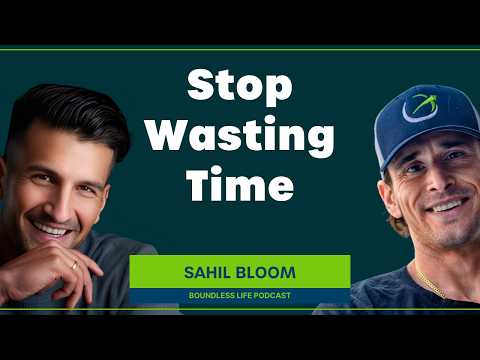
Why You're Wasting Time (And How to Stop) with Sahil Bloom
~249 min
Episode Brief·YouTube

Why You're Wasting Time (And How to Stop) with Sahil Bloom

Ben Greenfield
Watch on YouTube Add to chat My bookmarks← All sources

TL;DR

The four things you'd lose by not watching

4 items

TL;DR

The four things you'd lose by not watching

4 items
1

Sahil Bloom, author of 'The Five Types of Wealth', explains the concept of 'time billionaire' — that young people are rich in time, the most precious non-renewable resource, and that recognizing this can reframe how you spend your days.

2

He introduces the 'energy calendar exercise' to identify energy-creating vs. energy-draining activities, and the four types of professional time (management, creation, consumption, ideation) to ensure a balanced, productive schedule.

3

Using personal stories and data, he emphasizes that 95% of the time you'll ever spend with your children is over by age 18, and that you can 'hack the averages' by intentionally prioritizing relationships — as he did by moving 3,000 miles to be near his parents.

4

Practical protocols include a 4 a.m. cold plunge, time-blocking with a simple note card, replacing phone calls with walking meetings or runs, and using a sauna for ideation — all aimed at maximizing time wealth.

Protocols

Concrete recipes — what, when, how much, and why

6 items

Morning routine with cold plunge and creative work block

WhatWake at 4am, do a cold plunge for 3-7 minutes, then focus on 2-3 priority tasks during a 4:30-7:30am creative work block.
WhenDaily, starting at 4am.
DoseCold plunge: 3-7 minutes. Creative work block: 3 hours (4:30-7:30am).
For whomAnyone seeking to maximize creative output and build discipline, particularly those with flexible schedules.
WhyThe early morning is quiet and free from distractions, allowing deep creative work. The cold plunge builds stress tolerance and mental resilience.
CaveatsRequires going to bed early (around 8-8:30pm) to get adequate sleep. May not be suitable for night owls or those with late-night obligations.

Sahil explains that he goes to bed at the same time as his 3-year-old son, around 7:30-8pm, and wakes at 4am. He immediately does a cold plunge in his backyard, which he finds especially challenging in winter. He uses the cold plunge as a form of stress inoculation — he often films a short video while in the plunge to practice speaking under physical stress, which has improved his public speaking. After the plunge, he enters his most important work block of the day, from about 4:30 to 7:30am, before his wife and son wake up. This is when he does his creative work (writing, content creation). He plans the 2-3 priority tasks the night before using a simple note card, so he can start immediately without decision fatigue.

Mechanism

The cold plunge triggers a sympathetic nervous system response, and practicing speaking while cold builds tolerance to stress, which transfers to public speaking. The early morning creative work leverages the brain's peak cognitive function after sleep, and time-blocking reduces context-switching costs.

Personal experience

Sahil shares that he's always been a morning person, but this specific routine evolved over time. He notes that the cold plunge is especially brutal in New York winters, but he finds it gets easier in spring. He also mentions that he doesn't do a specific breathing technique; instead, he uses the time to film a short video or practice speaking, which has helped him become a more confident public speaker.

I get up right around 4:00 every morning. ... I do my cold plunge every morning out in the backyard. ... That morning block from about 4:30 to about 7:30 is my most important work block of the day.

Also said
“I don't have like a specific breathing thing that I do to be honest. Like normally I'll film a little video just like something that comes into my mind when I woke up in the morning.”— Shows how he uses the cold plunge for content creation and stress adaptation.
“The night before, I spend 5 minutes sketching out the two to three priority tasks for my morning focus work block.”— Details the planning aspect of his routine.

Energy calendar exercise

WhatAt the end of each day, color-code each activity on your calendar as green (energy-creating), yellow (neutral), or red (energy-draining). After a week, lean into green activities and reduce red ones.
WhenDaily, for at least one week.
Dose5 minutes per day to review and color-code.
For whomAnyone feeling drained by their work or personal life, especially those in high-stress jobs.
WhyOutcomes follow energy. By identifying what gives you energy vs. drains it, you can restructure your schedule to maximize productivity and well-being.
CaveatsRequires honest self-reflection. Some red activities may be unavoidable, but you can modify how you do them (e.g., walking calls instead of sitting calls).

Sahil explains that he first did this exercise while working 80-100 hour weeks in finance. He discovered that phone calls and Zoom meetings were massively energy-draining. He couldn't eliminate them, so he turned half of them into walking calls, which were energy-creating for him. This small change dramatically improved his week. He emphasizes that the exercise is not about perfection but about awareness and incremental improvement. He also notes that you can apply the same principle to non-work activities.

Mechanism

By tracking energy levels, you become aware of patterns and can make intentional choices. This leverages the psychological principle of self-monitoring to drive behavior change.

Personal experience

Sahil shares that when he first did this, he realized phone calls and Zooms were red for him. He couldn't eliminate them because of his job, so he experimented with walking calls, which turned them green. Now, as an entrepreneur, he has a rule: no phone calls or Zooms; he offers people to join him on a run instead.

At the start of a week, look at your calendar... and color code the activities... according to whether they created energy... mark them green. If it was neutral, mark it yellow. And if it was energy draining, mark it red.

Also said
“Outcomes follow energy. So, if you lean into the things that are creating energy, you are going to feel better and you're going to drive better outcomes.”— The core principle behind the exercise.
“I identified that phone calls, Zoom meetings were massively energy draining for me. ... I took half my phone calls and turned them into walking calls. And that made a dramatic difference.”— Personal example of applying the exercise.

Walking calls instead of sitting calls

WhatInstead of sitting phone calls or Zooms, take them while walking, or offer to meet people for a run instead of a call.
WhenWhenever possible, especially for get-to-know-you chats or non-urgent meetings.
DoseAs often as possible.
For whomAnyone who spends significant time on calls, especially those who find them draining.
WhyWalking calls increase energy, improve focus, and provide health benefits. They also prevent multitasking and make you more present.
CaveatsSome calls require screen sharing or note-taking; those may not be suitable. Also, some people expect video, so you may need to explain the benefits.

Sahil explains that when he sits at his desk on Zoom, he's tempted to check emails or notifications, reducing the quality of the conversation. Walking calls force him to be present. He also finds that people are more open and creative when walking. He now has a rule: he doesn't do phone calls or Zooms; if someone wants to pick his brain, he invites them to join him on a run. Ben Greenfield adds that he walks during podcasts and finds he's more focused and gets cardiovascular benefits.

Mechanism

Walking increases blood flow and BDNF, which may enhance cognitive function. Removing the ability to multitask forces attention on the conversation, improving communication.

Personal experience

Sahil shares that when he worked in finance, he turned half his phone calls into walking calls and it made a dramatic difference. Now, he tells people: 'I run at this time at this place basically every single day. If you want to come join me for an easy run, more than welcome to.'

I don't do phone calls or Zooms. If people want to get together in person, I always offer for them to come join me on a run.

Also said
“When I'm sitting on Zoom, if I'm at my desk, ... everyone's just looking at themselves. ... versus if I'm out for a walk and my phone is in my pocket, I'm just with you.”— Explains why walking calls are more focused.

Evening sauna for ideation

WhatUse a sauna session in the evening for reading and thinking, allowing ideas to intermingle.
WhenEvening, before bed.
DoseDuration not specified, but Sahil uses it daily.
For whomAnyone with access to a sauna, especially those seeking to incorporate more thinking time.
WhyThe sauna provides a distraction-free environment for consumption (reading) and ideation (thinking), and the heat stress may have health benefits.
CaveatsRequires a sauna. Books may get damaged by heat/moisture, so use printed articles or magazines.

Sahil explains that after his son's bath time, he goes to the sauna. He prints out articles or brings a book to read, then spends time thinking. He calls the sauna the 'single highest ROI investment' he's made in recent years because it combines health benefits with dedicated ideation time. He notes that the heat helps him relax and clear his mind, leading to creative insights.

Mechanism

Heat stress from sauna may improve cardiovascular health and longevity. The quiet, tech-free environment promotes deep thinking and memory consolidation.

Personal experience

Sahil says he does a sauna every evening before bed. He prints out reading material because technology can't go in. He finds it's when he does some of his best thinking.

The sauna has been the single highest ROI investment that I've made over the last few years.

Also said
“In the evening after my son's bath time, I always do a sauna before going to bed. ... That's when I do some of my best clear the head thinking.”— Describes his routine.

Note card planning for next day's priorities

WhatSpend 5 minutes each evening writing down the 2-3 most important tasks for the next morning on a physical note card.
WhenEvery evening.
Dose5 minutes.
For whomAnyone who struggles with morning productivity or gets lost in complex productivity systems.
WhyReduces decision fatigue in the morning and ensures you start your most important work immediately. Physical note cards are simpler and less distracting than digital tools.
CaveatsRequires discipline to actually do it each night. May not be suitable for those who need collaborative task management.

Sahil explains that he's tried every fancy productivity system but found that a simple note card works best. He writes down the 2-3 priority tasks for his morning creative block. This eliminates the need to decide what to work on when he sits down at 4:30am, so he can dive right in. He argues that complex systems often become a form of procrastination — people spend more time managing the system than doing the work. The note card is a physical, tangible reminder that keeps him focused.

Mechanism

The act of writing by hand may improve memory and commitment. Limiting to 2-3 tasks prevents overwhelm and forces prioritization.

Personal experience

Sahil says he uses a note card and a pen. He's tried every productivity system and found the note card better because it doesn't become a distraction. He also mentions that the routine should serve you, not own you — if you miss a day, you can still get things done.

I've tried every single fancy productivity system in the world. And what I found is that the note card is better than all of them.

Also said
“The best routine in the world is the one that actually you can break and still get things done. The routine is supposed to serve you, not supposed to own you.”— Philosophy behind keeping it simple.

Cold plunge for stress tolerance and speaking practice

WhatDo a cold plunge (3-7 minutes) and use the time to practice speaking or filming content while under physical stress.
WhenFirst thing in the morning.
Dose3-7 minutes in cold water.
For whomAnyone looking to improve stress tolerance, public speaking, or discipline.
WhyBuilds resilience to stress by forcing you to perform cognitively demanding tasks (speaking) while under physical stress, which transfers to real-world high-pressure situations like public speaking.
CaveatsCold exposure can be dangerous for those with heart conditions. Start gradually.

Sahil explains that he doesn't do a specific breathing technique; instead, he often films a short video or practices a talk while in the cold plunge. He got the idea from his baseball training: practice the way you're going to play. By simulating the elevated heart rate and stress of public speaking while in the cold, he became more comfortable speaking under pressure. He also mentions that he used to practice talks while doing zone 2 cardio to prepare for the elevated heart rate of being on stage.

Mechanism

Cold exposure triggers a stress response (increased heart rate, cortisol). Repeated exposure while performing a task builds stress resilience through habituation. The practice of articulating thoughts under stress may improve performance in high-pressure situations.

Personal experience

Sahil shares that he used to be a nervous public speaker. He started practicing talks while doing zone 2 cardio, and later incorporated the cold plunge as a more intense stress simulator. He now feels much more confident on stage.

I do the cold plunge for 3 to 7 minutes... I'll film a little video just like something that comes into my mind... It also is like a way for me to build up stress tolerance.

Also said
“I used to be a really nervous public speaker. ... One of the things that I did to conquer that was I started doing practice sessions of the talk while doing zone 2 cardio.”— Background on his stress inoculation practice.

What's new

Personal practice updates, fresh positions, predictions

5 items

time-billionaire

The idea that young people are 'time billionaires' because they have billions of seconds left in their lives, making time their most precious asset.

Why this matters: Reframes the common pursuit of financial wealth by highlighting that time is the ultimate non-renewable resource, and that even billionaires would trade all their money for more time.

Background

The concept originated from investor Graham Duncan, who observed that young people aspiring to be billionaires overlook the immense wealth of time they already possess.

Sahil Bloom explains that when you ask a young person if they would trade lives with Warren Buffett, the answer is always no because Buffett is 95 and has little time left, despite his $130 billion net worth. This thought experiment reveals that time has incalculable value, yet people waste it daily on scrolling, anxiety, and trivial pursuits. The key to unlocking time wealth is awareness (recognizing time's value) and attention (focusing on what truly matters). He uses the analogy of Lionel Messi walking on the soccer field to conserve energy and then sprinting at the perfect moment to score — a metaphor for directing your attention only to the highest-impact activities.

Personal experience

Sahil shares that his own life changed when he realized he wouldn't trade lives with the people he read about in books, because they often sacrificed relationships and health for financial success. He now defines wealth as being able to take his son to the pool on a Tuesday afternoon.

They quite literally have billions of seconds left in their lives.

Also said
“Would you trade lives with Warren Buffett? ... you would never trade lives with him because he's 95 years old. There's no way you would agree to trade the amount of time that he has left for all of the money that he has.”— Illustrates the incalculable value of time over money.
“My life fundamentally changed when I realized that I would never trade lives with the people I was reading books about.”— Personal turning point that led to his philosophy.

four-types-of-professional-time

Sahil categorizes professional time into four types: management (reactive tasks like email), creation (producing new work), consumption (reading/learning), and ideation (thinking/reflecting). Most people only do the first two, neglecting the latter two which are crucial for long-term success.

Why this matters: Provides a framework for auditing your calendar to ensure you're not just busy but productive, and explains why high performers schedule time for thinking and learning.

Background

In traditional work environments, management time (meetings, calls, emails) dominates, often consuming 80% of the day. Creation time is squeezed in, while consumption and ideation are rarely scheduled.

Sahil explains that management time is reactive and often energy-draining. Creation time is where you produce your best work. Consumption time is for reading and learning, which fuels new ideas. Ideation time is for letting those ideas intermingle and spark new insights. He personally schedules creation in the early morning when he's most creative, management in the late morning, and consumption/ideation in the afternoon and during his evening sauna. He argues that neglecting consumption and ideation leads to burnout and stagnation, as you're constantly outputting without inputting new knowledge or allowing your brain to connect dots.

Personal experience

Sahil shares that he used to fill his calendar with management tasks, but after identifying the four types, he now ensures each week includes all four. He does his best thinking in the sauna, where he prints out articles to read and then lets his mind wander.

There's four types of professional time. ... management time ... creation time ... consumption ... ideation. ... I try to make sure that I have all four of those types during the course of the week.

Also said
“The sauna has been the single highest ROI investment that I've made over the last few years.”— Shows how he incorporates ideation into a daily health practice.
“You can hack it for a short period of time, but in the long run, people who have had longevity in whatever it is that they're doing professionally have had to engage that consumption and that ideation time on a regular basis.”— Emphasizes the necessity of these neglected time types for sustained success.

time-with-loved-ones-data

Using data from the American Time Use Survey, Sahil shows that 95% of the time you'll ever spend with your children is over by age 18, with the bulk concentrated in the first 10 years. He moved 3,000 miles to be closer to his parents after realizing he'd only see them 15 more times.

Why this matters: Provides a stark, data-driven wake-up call to prioritize relationships, and demonstrates that you can intentionally 'bend the curve' by making life changes.

Background

The American Time Use Survey tracks how Americans spend their time over decades. Sahil created charts showing the average time spent with parents, children, siblings, and friends over a lifetime.

Sahil explains that the charts reveal specific windows of time with different people. For children, the high-density time is the first 10 years; after 18, 95% of total lifetime time is gone. For parents, the curve declines sharply after childhood. He shares that a friend pointed out he'd only see his parents 15 more times if he continued his current lifestyle, which prompted him to quit his job, sell his house, and move across the country to be near both sets of parents. Now he sees them multiple times a month. He emphasizes that you can 'hack the averages' by making intentional choices, like creating a family compound that attracts kids and grandkids.

Personal experience

Sahil recounts the conversation with his friend that made him realize he was on the tail end of the curve with his parents. He and his wife sold their house in California and moved to the New York area to be near family. He now sees his parents hundreds of times, not 15.

95% of the time you have with your children is over by the time they turn 18. ... the bulk of that 95% is in that first 10 years.

Also said
“I was going to see my parents 15 more times before they died. ... We sold our house in California and we moved 3,000 miles across the country to live closer to both of our sets of parents. That number 15 is now in the hundreds.”— Personal story of bending the curve.
“The goal is to take actions to bend those curves. Use it to drive awareness. ... then take action to harness your attention into the things that matter.”— Actionable takeaway from the data.

rocking-horse-analogy

Sahil uses the metaphor of a rocking horse — constantly moving but never making progress — to describe how people fill their days with busywork that doesn't move the needle.

Why this matters: A memorable, vivid analogy that encapsulates the trap of 'fake productivity'.

Background

Many people default to obvious, easy tasks that feel productive but don't contribute to their most important goals. Sahil calls this 'rocking horse work'.

Sahil explains that there are always shiny, obvious tasks staring at you, but they are often distractions from the harder, more important work. He calls this 'rocking horse stuff' — you're moving but not going anywhere. He admits he still falls into this trap, but being aware of it helps him refocus on the 2-3 things that truly move the needle. The antidote is to identify your top priorities and say no to everything else, even if it feels uncomfortable.

Personal experience

Sahil shares that he often finds himself defaulting to easy tasks because they feel like progress, but he now recognizes the pattern and redirects his attention to the high-impact activities.

You become a rocking horse. Meaning you are constantly moving but never actually making progress, never going anywhere.

Also said
“There's so many very obvious pieces of work or tasks that are in front of you that stare at you. They're shiny. They feel abundantly obvious to go and do and all they are is a fancy distraction.”— Describes the trap of busywork.

choose-your-regrets

Sahil argues that life is a series of trade-offs, and you must consciously choose which regrets you're willing to live with. He defines his own 'enough' and rejects opportunities that conflict with his priorities.

Why this matters: Offers a liberating framework for decision-making: instead of seeking perfect balance, accept that you'll have regrets and choose the ones you can live with.

Background

Society often pushes a single definition of success (money, status), but Sahil realized that many 'successful' people had Pyrrhic victories — they won the battle but lost the war in terms of relationships and health.

Sahil explains that we celebrate billionaires with broken families, ignoring the trade-offs they made. He decided he didn't want to win that game. He defines his wealth as being able to take his son to the pool on a Tuesday. He says if offered $10 million a year to travel 300 nights, he'd refuse because he already has enough. The key is to know your 'yes' — what you truly want — so you can say no to everything else. He calls this 'choosing your regrets' because every decision involves sacrifice; the goal is to choose the regrets you can live with.

Personal experience

Sahil shares that he no longer feels insecure in rooms full of wealthy people because he's comfortable with his own definition of wealth. He's turned down lucrative opportunities that would take him away from his son.

My definition of wealth is being able to take my son in the pool at 1:00 p.m. on a Tuesday.

Also said
“If you came and offered me $10 million a year to travel 300 nights out of the year, I wouldn't take it. ... I already have enough.”— Demonstrates his commitment to his definition of enough.
“We all know people who have made hundreds of millions of dollars... and we ignore the fact that they have three ex-wives and four kids that don't talk to them. And we tell that person that they won the game.”— Critique of society's narrow definition of success.

Recommendations

Products, supplements, and tools mentioned in the episode

3 items

Physical note card

Tool

Sahil uses a simple note card and pen to plan his 2-3 priority tasks for the next morning.

He argues that complex productivity systems often become a distraction. The note card is simple, tangible, and forces prioritization. He writes down the tasks the night before so he can start immediately in the morning.

vs alternatives

Compared to digital tools like Notion, Todoist, or Superhuman, the note card has zero learning curve, no notifications, and can't be used for multitasking.

Personal experience

Sahil has tried every productivity system and found the note card superior because it doesn't become a time sink.

I've tried every single fancy productivity system in the world. And what I found is that the note card is better than all of them.

Also said
“People spend more time on the productivity system than on getting the things done that the productivity system was supposed to help you with.”— Critique of complex systems.
Find Physical

Sauna for ideation

Practice

Sahil uses a sauna every evening to read and think, calling it his highest ROI investment.

He prints out articles to read, then spends time thinking. The heat and isolation promote deep thought.

vs alternatives

Compared to other ideation practices like walking or meditation, the sauna adds a health benefit and a tech-free environment.

Personal experience

Sahil says it's been the single highest ROI investment of the last few years.

The sauna has been the single highest ROI investment that I've made over the last few years.

Also said
“That's when I do some of my best clear the head thinking.”— Describes the cognitive benefit.
Find Sauna

Energy calendar exercise

Practice

Color-code activities as green, yellow, or red based on whether they create or drain energy, then adjust your schedule accordingly.

Sahil explains how to do it and how it helped him identify draining phone calls and turn them into walking calls.

vs alternatives

Unlike generic time management advice, this focuses on energy rather than time, recognizing that not all hours are equal.

Personal experience

Sahil used this while working in finance and it dramatically improved his week.

Outcomes follow energy. So, if you lean into the things that are creating energy, you are going to feel better and you're going to drive better outcomes.

Also said
“I identified that phone calls, Zoom meetings were massively energy draining for me. ... I took half my phone calls and turned them into walking calls.”— Example of applying the exercise.
Find Energy

Notable quotes

Lines worth pulling out — contrarian, specific, or perfectly phrased

8 items
My life fundamentally changed when I realized that I would never trade lives with the people I was reading books about.
Encapsulates the core philosophy of the book: rejecting society's narrow definition of success.
They quite literally have billions of seconds left in their lives.
The 'time billionaire' concept in a nutshell, reframing youth as wealth.
95% of the time you have with your children is over by the time they turn 18.
A stark, data-driven wake-up call to prioritize family time.
The best routine in the world is the one that actually you can break and still get things done.
A liberating counterpoint to rigid productivity dogma.
My definition of wealth is being able to take my son in the pool at 1:00 p.m. on a Tuesday.
A personal, memorable definition of 'enough' that challenges financial wealth as the ultimate goal.
You become a rocking horse. Meaning you are constantly moving but never actually making progress, never going anywhere.
A vivid analogy for busywork that feels productive but isn't.
I don't do phone calls or Zooms. If people want to get together in person, I always offer for them to come join me on a run.
A concrete, contrarian rule that protects his time and energy.
This is what's required for me to perform at the level I'm capable of, the level that I expect for myself and to bring you along on this trip.
Sahil's father's words that taught him the value of hard work through embodiment, not lecture.

Sign in to share feedback

Tell us if this brief hit the mark or missed it — feedback feeds back into the next iteration of the prompt.

Topics covered

time-wealthtime-billionaireenergy-calendarprofessional-time-typeswork-life-harmonytime-blockingcold-plungesaunahybrid-trainingparentingmortalityproductivity-systemswalking-callsrocking-horse-analogychoose-your-regrets
Free account

Make this library yours

Reading is free for everyone. A free account adds the personal layer: save protocols, follow experts, and see how the other experts weigh in on this same topic.

Create a free accountSign in

Where the experts disagree — weekly

One email a week: the sharpest new disagreements and protocols from the library. No spam, unsubscribe anytime.

Educational summary of the cited expert source — not medical advice. Open the source recording linked above and consult a qualified physician before acting on any protocol.