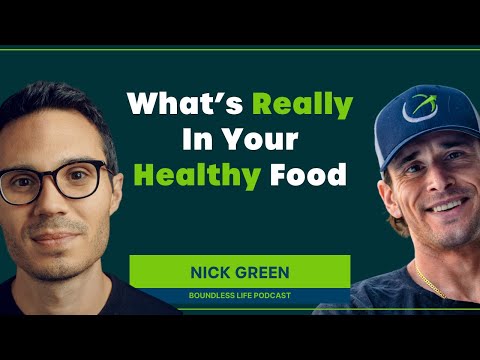
Thrive Market is a membership-based online grocer ($60/year) curating 100% non-GMO foods and banning 600+ ingredients, with a mission to make healthy food accessible and affordable, now expanding into frozen meat, seafood, and produce.
2
Nick Green exposes how the USDA's dual mandate to promote agriculture and set nutrition standards creates conflicts of interest, while the FDA’s ‘generally recognized as safe’ (GRAS) loophole allows ingredients like food dyes to enter the food supply without robust safety testing.
3
Artificial food dyes such as Red 3 (a petroleum byproduct) are banned in Europe and even in US cosmetics since 1990, yet still allowed in food, linked to behavioral issues in children; the FDA is finally banning Red 3 but gave manufacturers a two-year grace period.
4
Industrial seed oils are ultra-processed, extracted with solvents like hexane, and drive chronic inflammation; the alternative of beef tallow is only truly healthy when sourced from 100% grass-fed, regeneratively raised animals to avoid toxins concentrated in fat.
Protocols
Concrete recipes — what, when, how much, and why
5 items
Use Thrive Market’s AI cart builder to simplify healthy grocery shopping
WhatAfter completing an onboarding quiz about dietary preferences and health goals, allow Thrive Market’s machine learning algorithm to pre-populate a shopping cart with recommended items, then review and edit before checkout.
WhenWhenever you start a new Thrive Market order, especially if you are new to healthy eating and feel overwhelmed by choices.
DoseUse the auto-built cart as a starting point; 15% of the time items match exactly what you want, and on average half of all checked-out items come from the AI-loaded suggestions.
For whomAnyone new to Thrive Market, busy individuals, or those with specific dietary needs who want a personalized, quick shopping experience.
WhyReduces decision fatigue, saves time building a cart from scratch, and surfaces products you might not have considered, all while you retain final control to swap or remove items.
CaveatsAlways review the AI-generated cart—like any recommendation engine, it may suggest close substitutes that you might not want (e.g., cashews instead of macadamia nuts). Over 90% of auto-ship orders are edited by members before shipment, demonstrating the need for human oversight.
Thrive Market collects data from user onboarding (diet, restrictions, values) and long-term purchase behavior to build a personalized profile. Using large-scale machine learning correlation models, it predicts which products a member is likely to buy and pre-loads them into the cart. Nick Green describes this as moving from a ‘Ben Greenfield aisle’ (a curated virtual shelf) to a ‘Ben Greenfield cart’ that anticipates needs. The goal is to make healthy shopping effortless while still putting the member in control—the AI acts as an intelligent default, not an auto-pilot subscription trap. This contrasts with problematic e-commerce subscriptions that ship products you don’t remember ordering; Thrive’s approach insists on final human edit. Green says there is ‘so much headroom’ to improve accuracy further, and the direction is toward giving everyone a personal shopping assistant-like experience they historically needed an executive assistant to have.
Personal experience
Ben Greenfield mentions that he travels with a specific list of items (avocado, dark chocolate, sardines, blueberries) his EA orders for him, and this concept of a personalized ready-made list is what Thrive aims to automate for all members.
We're creating like the Ben Greenfield cart... now that machine learning algorithm is powerful enough that we can recommend products that are like so close to what you actually want to buy. In fact, 15% of the time approximately they are what you want to buy and we'll just build the cart for you.
Also said
“We think about that cart build is not set it and forget it. It's like that's an intelligent default. You then edit it... over 90% of those orders are edited before they go out.”— Emphasizes the member-control aspect.
Choose frozen produce over fresh for better nutrient retention in many cases
WhatOpt for flash-frozen fruits and vegetables—especially leafy greens and broccoli—over their fresh counterparts that have been sitting in a supply chain for days or weeks.
WhenWhen shopping for produce, particularly items with a short shelf-life or when you do not plan to consume them immediately.
DoseSubstitute frozen for fresh whenever convenience or nutrient density is a priority; meat and seafood can also be kept frozen long-term without loss of quality.
For whomAnyone concerned about maximizing nutrient intake from produce, those with limited access to daily fresh markets, or families wanting to reduce food waste.
WhyFlash-freezing at the point of harvest locks in micronutrients that otherwise decay rapidly during transport and storage; many fresh vegetables can lose 40–90% of their vitamin content before consumption.
CaveatsNot all fruits and vegetables freeze well (e.g., lettuce for salads, melons). Texture may change for some, so use frozen items in cooked dishes, smoothies, or where texture is less critical. Ensure frozen products are free from added sauces or preservatives.
Nick Green ties this protocol directly to Thrive Market’s recent strategic move to in-house frozen fulfillment, citing strong consumer demand. He notes that for many shoppers, the frozen aisle is associated with low-quality processed meals, but it can actually be a source of high-quality, nutrient-dense whole foods. The science of nutrient loss in fresh produce is well-documented; the key is the time-temperature history from field to fork. By freezing at peak ripeness, the nutrient ceiling is captured. He also extends the logic to meat and seafood: there is no nutrient difference between fresh and frozen meat, and frozen allows access to better supply chains (e.g., grass-fed beef from distant regions) that couldn’t be delivered fresh without spoilage or quality loss. This protocol directly challenges the ‘perimeter shopping’ rule when applied to the freezer section.
Mechanism
Fresh produce continues to respire and degrade after harvest; vitamins like C and B complex are particularly susceptible to oxidation and enzymatic breakdown over time. Flash freezing rapidly lowers the temperature to halt metabolic activity and enzyme function, preserving the nutrient profile close to the moment of harvest. This is especially impactful for leafy greens, which have a ‘precipitous decay curve’.
Personal experience
Ben Greenfield mentions buying flash-frozen fish from Sitopia and notes the texture remains excellent, supporting the practice.
When you're buying lettuce, broccoli, etc. at the grocery store, they may have lost anywhere from 40 to 80 or 90% of its nutrient value micronutrient value by the time you are consuming it... properly frozen veg and fruit... is actually got better nutrient density.
Also said
“If you think from a supply chain standpoint you flash freeze at the point of pick... like if you look at the decay curve on nutrient...”— Concise description of the mechanism.
“There's an argument and I find pretty compelling that the nutritional quality on those products is actually better.”— Shows personal endorsement.
Source 100% grass-fed, pasture-raised meat and tallow to avoid grain-finishing and toxins
WhatWhen buying beef or beef tallow, verify the animal was exclusively grass-fed and grass-finished, ideally from regenerative farms like White Oak Pastures.
WhenWhenever purchasing beef products, tallow for cooking, or any fat-based animal product.
DoseNo specific dose; this is a sourcing principle for all beef purchases.
For whomHealth-conscious consumers, those seeking to reduce inflammatory seed oils and replace with animal fats, and anyone concerned about animal welfare and environmental sustainability.
WhyGrain-finished beef, even if labeled ‘grass-fed’, has a fat profile similar to grain-fed beef, with higher omega-6 levels and potentially concentrated toxins. Truly grass-fed beef from regenerative farms offers a healthier fatty acid profile and lower toxin burden.
CaveatsThe term ‘grass-fed’ alone is insufficient; you must verify ‘grass-finished’ or ‘100% grass-fed’. Beef tallow from industrial feedlot cattle will concentrate the same toxins and have an inferior fatty acid profile, so merely switching from seed oils to tallow without sourcing transparency can be counterproductive.
Nick Green responds to a question about whether the beef tallow trend could inadvertently prop up factory farming by using a previously low-value byproduct. He agrees that if tallow comes from typical feedlot operations, the health benefits over seed oils are marginal at best, and the environmental and animal welfare costs remain high. The solution is to support farms that raise cattle on pasture from start to finish, using regenerative practices that improve soil health and animal welfare. He cites White Oak Pastures as an example of a farm doing it right at scale. However, he acknowledges that such supply chains are tiny compared to industrial agriculture and will take years to grow. The protocol is thus to seek out and pay premium for verified sources, and to understand that simply swapping one fat for another without context misses the point.
Mechanism
Cattle that are finished on grain (typically corn and soy) rapidly gain weight and deposit fat with a higher ratio of omega-6 to omega-3 fatty acids, mirroring the fat quality of conventional grain-fed beef. Additionally, fat-soluble toxins (pesticides, environmental pollutants) accumulate in adipose tissue, so the quality of the animal’s diet and living conditions directly affects the safety of the rendered tallow.
If you take factory farmed animals and using the fat byproduct to create beef tallow that's going to have a high toxin load. It's going to be poor omega profiles.
Also said
“You can argue whether it's better or worse than seed oils. Probably from a health standpoint it's a little bit better but not much. And from a environmental standpoint and a animal welfare standpoint for sure not better.”— Adds nuance to the tallow replacement debate.
“There is only a handful of farms really doing that... it's going to be years if not decade plus for those supply chains to grow.”— Sets realistic expectations about availability.
Use Thrive Market’s barcode scanner to find healthier alternatives in-store
WhatOpen the Thrive Market app, scan the barcode of any food item at a grocery store to see if Thrive carries it at a better price or, if it’s an unhealthy product, discover a healthier alternative.
WhenWhile grocery shopping, especially in the center aisles where ultra-processed foods dominate.
DoseUse as needed whenever you encounter unfamiliar or suspicious products.
For whomAny Thrive Market member who shops at brick-and-mortar stores and wants to avoid harmful ingredients.
WhyEmpowers consumers to make real-time healthier swaps without having to memorize ingredient lists; leverages Thrive’s curated database to guide better choices.
CaveatsThe feature requires the Thrive Market app and an active membership. It currently works for packaged goods; it does not replace the principle of eating whole, unpackaged foods when possible, but rather improves the quality of packaged food choices.
Nick Green mentions the barcode scanner in the context of an audience member’s idea of scanning items linked to genetic data to auto-populate a cart. He describes the current scanner as a stepping stone toward more personalized, AI-driven health shopping. The feature not only drives sales for Thrive by highlighting price advantages but also serves as an educational tool, showing consumers why certain products are excluded and what healthier alternatives look like. He envisions layering AI on top of this scanner in the future so that it could learn a user’s preferences and automatically build a cart from scanned items. The scanner thus fits into a larger strategy of bridging the physical and digital grocery experience.
Mechanism
The scanner accesses Thrive Market’s catalog and standards database to compare the scanned item’s ingredients against the 600+ banned ingredients list. If it matches a product that doesn’t meet Thrive’s standards, the app suggests a similar product that does, allowing the user to order it online or simply learn about better options.
We've got a scan a barcode scanner where you can literally take like scan any item... either find out if we carry it at a better price at Thrive... or if it's an unhealthy item find a healthier better for you alternative.
Also said
“You think about putting AI on top of that... you know help people build a cart with that as like the seed for it.”— Shows future direction.
Snack smart with allulose-sweetened chocolate and cacao nibs
WhatReplace conventional sugar-laden or artificially sweetened chocolate with allulose-sweetened chocolate, and use cacao nibs or coconut flakes as toppings or stand-alone snacks.
WhenWhen craving something sweet or looking for a healthy dessert or smoothie add-in.
DoseModerate as a treat; a small handful of cacao nibs or a few squares of allulose chocolate.
For whomAnyone looking for healthier sweets, especially those managing blood sugar or avoiding sugar alcohols that cause digestive distress.
WhyAllulose provides sweetness with minimal impact on blood sugar and insulin, and cacao nibs offer antioxidants, fiber, and mild stimulation without the sugar of processed chocolate. Both are cleaner alternatives to conventional candy or desserts.
CaveatsEven healthy snacks can be hyper-palatable; it’s still possible to overeat. Pay attention to portion sizes. Allulose chocolate is processed and may not suit a strict whole-foods diet, but it is a significantly better choice than standard chocolate or sugar alcohol-sweetened bars.
Nick Green and Ben Greenfield discuss the fine line between ‘healthier’ and ‘healthy’ in the context of processed foods. Nick acknowledges that many products on Thrive Market, while free from the worst ingredients, are still processed and palatable, and shouldn’t be eaten in limitless quantities. The allulose chocolate is an example of meeting members where they are—if someone is going to eat chocolate anyway, giving them a version without high-fructose corn syrup and with a metabolically neutral sweetener is a win. Ben Greenfield shares that he uses cacao nibs and coconut flakes daily in his smoothie and sometimes eats nibs straight for a pick-me-up. Both agree that cacao nibs provide a bitter, satisfying crunch and mild stimulant effect without the sugar spike.
Mechanism
Allulose is a rare sugar with a similar taste to sucrose but is poorly absorbed, contributing negligible calories and not raising blood glucose or insulin levels. Some studies even suggest it may improve glycemic variability. Cacao nibs are the raw pieces of cacao beans, rich in polyphenols, theobromine (a mild stimulant), and anandamide (a neurotransmitter linked to mood elevation, sometimes called 'bliss molecule').
Personal experience
Ben Greenfield says he eats allulose chocolate and notes it doesn’t cause bloating like sugar alcohol-based bars (e.g., Lily’s). He adds cacao nibs and coconut flakes to his smoothies and eats nibs straight for a slight dopamine/anandamide boost.
Allulose sweetened chocolate has been... it's awesome. It's really good. Does not give you like bloat like that... my wife and I used to mow through those (Lily's) and realized just a crap ton of sugar alcohols in it.
Also said
“Cacao nibs are like a little stimulating. It's a little caloric and it's a little bitter. You get your anandamide, you get your dopamine. Nature's feel-good drug.”— Ben Greenfield’s enthusiastic endorsement of cacao nibs.
What's new
Personal practice updates, fresh positions, predictions
5 items
The USDA’s inherent conflict of interest between promoting commodity agriculture and setting nutritional guidelines
Nick Green argues that the USDA was originally founded to support farmers, and only later took on food safety and dietary guidelines, creating a structural tension where promoting crops like corn, soy, and wheat can override advice on what humans should eat.
Why this matters: This institutional conflict explains why dietary guidelines like the food pyramid pushed refined carbs and seed oils while ignoring food quality and processing, and why ultra-processed foods filled with corn and soy derivatives became the norm.
Background
The USDA was established in 1862 to promote agriculture; its food safety and nutrition roles were added later, so it simultaneously works for farmers and sets health standards. This leads to situations where, for example, high-fructose corn syrup and industrial seed oils get entrenched because they benefit agricultural lobbies, even when science shows harm.
Nick Green describes the USDA as having a ‘twin mandate’ that creates a conflict of interest: it is supposed to support the agricultural industry (particularly commodity crops like corn, soy, and wheat) while also setting safety standards and nutritional guidelines. This tension is not just theoretical; it directly shaped the infamous food pyramid that put refined carbohydrates at the base and demonized fats without distinguishing between types. The result, he says, is that the agency has often failed to warn against ultra-processed foods because cheap processed ingredients are good for agribusiness. He notes that the USDA has done a good job on pathogen safety (e.g., raw eggs are safe in the US), but on nutritional standards and dietary guidelines, there has been a ‘total failure’. The food pyramid was both wrong in what it emphasized and utterly silent on food processing and quality, which he calls the biggest miss. This is not a coincidence but a predictable outcome of the USDA’s dual role.
The fundamental challenge that the USDA has is the inherent conflict of interest between being an agency that is there to promote you know commodity crops like corn, soy and wheat on behalf of farmers and then setting safety standards and nutritional guidelines.
Also said
“I think the biggest failure of the of the overarching paradigm was like the absolute lack of attention to food quality and food processing.”— Highlights the missing dimension in USDA guidelines that allowed ultra-processed foods to dominate.
“That is not a coincidence, right? Like the reason for the push towards ultra processing is it benefits businesses and suppliers and manufacturers and the agriculture industry because it's cheap.”— Directly ties the conflict of interest to the proliferation of ultra-processed foods.
The FDA’s GRAS loophole allows ingredients into the food supply without proving safety
Nick Green distinguishes the EU’s precautionary principle (ingredients must be proven safe before use) from the US ‘Generally Recognized as Safe’ (GRAS) process, which allows companies to add substances unless they are definitively proven unsafe, effectively placing the burden of proof on consumers or regulators after the fact.
Why this matters: This explains why ingredients banned in Europe for decades, like certain food dyes, remain legal in the US, and why novel additives can enter the market with minimal pre-market testing.
Background
In Europe, an ingredient must demonstrate safety through studies before being allowed. In the US, GRAS allows a substance to be used if it is ‘generally recognized as safe’ among qualified experts, but often without rigorous, up-to-date studies. This has led to ingredients that were reviewed decades ago—or never reviewed—remaining in food, including food dyes derived from petroleum.
Nick Green contrasts the two regulatory philosophies. The European system is essentially ‘guilty until proven innocent’, meaning no additive enters the food supply unless studies show no long-term health consequences. The US flips the burden: a substance is allowed until the FDA or consumer groups can prove it is harmful. This is not just a theoretical difference; it has real-world consequences like Red 3 dye, which was banned in cosmetics in the early 1990s because of links to thyroid cancer in rats but remained in food until a state-level ban in California in 2023 and a forthcoming FDA ban that gives manufacturers two more years. He notes that many ingredients the FDA hasn’t reviewed in decades sit on the GRAS list unchallenged. He argues that this loophole is a major reason the US food supply is filled with synthetic additives and ultra-processed ingredients that would not be permitted in Europe, underscoring the need for private curation like Thrive Market’s banned-ingredient list.
Generally recognized as safe is a loophole that allows companies to put what they want in until it is shown definitively to be unsafe. So the burden is actually on the consumer groups or on the FDA itself to prove that an ingredient shouldn't be there.
Also said
“In Europe, they basically take a they use like what's called the precautionary principle where it is an ingredient has to be proven safe before it is allowed to be added to the food supply. So it's like a guilty until proven innocent.”— Clarifies the opposite regulatory approach.
“There are ingredients that the FDA hasn't re-reviewed or hasn't reviewed at all in decades, right? So like this is the food dye issue.”— Shows the real-world consequence of the GRAS backlog.
Red 3 food dye ban: symbolic of regulatory failure and consumer harm
The FDA’s recent announcement to ban Red 3, a petroleum-based dye linked to behavioral issues and thyroid cancer in rats, comes decades after Europe banned it and after it was already barred in US cosmetics, yet even this ban includes a two-year compliance period.
Why this matters: It illustrates the painfully slow pace of US food regulation, the disconnect between scientific evidence and policy, and the disproportionate impact on children who consume brightly colored ultra-processed snacks.
Background
Red 3, along with Yellow 5 and Blue 1, are byproducts of petroleum. They have been associated with hyperactivity and cognitive developmental issues in children, and Red 3 specifically has been linked to thyroid dysfunction and cancer in animal studies since the 1980s. Europe banned these dyes long ago, but the US only began acting after California’s 2023 ban pushed the FDA to follow suit in early 2025.
Nick Green walks through the absurdity of the situation: Red 3 was banned from cosmetics like lipstick in 1990 because it could not be safely applied to skin, yet it remained legal in food that children eat. He points out that these dyes are disproportionately used in ultra-processed products aimed at kids because the processing strips away natural color, making the food look gray and unappetizing, so manufacturers add vibrant synthetic colors for cents per ton to trick the brain into perceiving healthfulness. He calls it a ‘sleight of hand’ or ‘beer goggles for kids’—using color to mask nutrient-void industrial byproducts. The FDA’s eventual ban gave manufacturers a two-year grace period, which Nick Green finds baffling: if it’s a toxin, why allow it in the food supply for two more years? This, he says, epitomizes the slow-motion failure of US food regulation.
Red three was banned from cosmetics. So like it can't be in lipstick and yet it's still allowed in food. You can't smear it on your lips, but you can ingest it.
Also said
“They gave manufacturers two years to come into compliance. So like they've acknowledged that this is a you know it's a toxin. It shouldn't be in the food supply... but then they said we're going to give manufacturers another two years to actually do it.”— Emphasizes the absurdity of the delayed enforcement.
“One of the effects of ultrarocessed food they like they make it taste really good but it ends up looking really bad... you just put a bunch of artificial coloring in which costs cents per ton.”— Explains why dyes are so prevalent in processed children’s food.
Flash-frozen produce is often more nutrient-dense than ‘fresh’ produce stored for weeks
Nick Green argues that flash-freezing fruits and vegetables at the point of harvest locks in nutrients, while ‘fresh’ produce can lose 40–90% of its micronutrient value during transport and shelf time, making frozen a superior option for many items.
Why this matters: This challenges the common belief that fresh is always best and supports Thrive Market’s expansion into frozen categories as a health-forward strategy.
Background
Perishable produce like leafy greens have a rapid nutrient decay curve. By the time lettuce, broccoli, or berries reach a typical grocery store shelf, they have often lost a significant portion of their vitamins and phytonutrients. Flash freezing at peak ripeness halts this decay, preserving nutrient density.
Nick Green explains that the nutritional quality of fresh produce is highly dependent on the time between harvest and consumption. For example, leafy greens can lose 40% to 90% of their micronutrient value over a couple of weeks. Flash-freezing immediately after picking essentially pauses that degradation, meaning frozen spinach or broccoli may actually be more nutritious than the ‘fresh’ versions sitting in a produce aisle for days. He acknowledges that this doesn’t apply to all fruits and vegetables (some, like certain melons, don’t freeze well), but for many, frozen offers a convenient and nutrient-dense alternative. This insight is driving Thrive Market’s fastest-growing category—frozen foods—which they recently brought in-house after strong demand. For meat and seafood, freezing doesn’t change nutrient quality and allows sourcing from better supply chains that might not support fresh distribution.
When you're buying you know lettuce, broccoli, etc. at the grocery store, they it may have lost anywhere from 40 to 80 or 90% of its nutrient value micronutrient value by the time you are consuming it... properly frozen veg and fruit... actually got better nutrient density.
Also said
“If you think from a supply chain standpoint you flash freeze at the point of pick... the decay curve on nutrient...”— Briefly restates the core mechanism.
“There's an argument and I find pretty compelling that the nutritional quality on those products is actually better.”— Adds personal conviction to the claim.
The misleading ‘grass-fed’ label on beef and the importance of grass-finished
Nick Green reveals that many ‘grass-fed’ beef products in the US are actually grain-finished, which alters the animal’s fat profile to resemble conventional grainfed beef, and stresses that 100% grass-fed, pasture-raised sourcing is key for health.
Why this matters: Consumers often pay a premium for ‘grass-fed’ expecting better omega-3 profiles and lower toxin loads, but the label can be deceptive. Only grass-fed and grass-finished beef delivers those benefits.
Background
In the US, even beef labeled as grass-fed is frequently finished on grain to speed up weight gain and alter flavor, which changes the fatty acid composition—making it more like grain-fed beef in terms of omega-6 to omega-3 ratio and overall nutrient profile. Truly 100% grass-fed beef is harder to find and often requires regenerative farming.
Nick Green points out that this is a common frustration: a steak labeled ‘grass-fed’ can still taste and behave nutritionally like grain-fed because the animal spent its last months on a grain-heavy diet. This grain finishing is allowed under loose labeling standards. The fat profile of such animals—where toxins also accumulate—is not significantly different from conventional feedlot beef. He ties this to the broader theme that food quality and finishing practices matter more than a single label. For beef tallow, which some advocate as a healthier replacement for seed oils, he cautions that using tallow from factory-farmed, grain-finished animals would concentrate toxins and have poor omega profiles, undercutting the health benefit. He recommends farms like White Oak Pastures, which practice regenerative agriculture and provide truly grass-fed, pasture-raised meat.
Even grass-fed beef is often grain finished and so if you look at the fat profile for example of those animals they're not that different than a grainfed animal.
Also said
“It's like if grass-fed if it tastes like grainfed it's because it probably has a nutrient profile that's more like grainfed.”— A simple heuristic for consumers.
“If you take factory farmed animals and using the fat byproduct to create beef tallow that's going to have a high toxin load. It's going to be poor omega profiles.”— Extends the concern to the beef tallow trend.
Disclosed sponsorships5speaker disclosed
Thrive Market membership
Service Sponsored · disclosed
An online membership-based grocery platform focused on healthy, natural, organic, sustainable products. $60/year, each membership sponsors a free one for a low-income family. Offers a highly curated selection—100% non-GMO food, 600+ banned ingredients—with prices at or below conventional equivalents. Includes AI cart builder, dietary filters, barcode scanner, and frozen food delivery.
DisclosureNick Green is co-founder and CEO of Thrive Market; Ben Greenfield is an early investor and affiliate with a discount code.
Thrive Market is positioning itself as a full-stack solution to the accessibility problems in healthy eating: geography (ships to lower 48), price (membership model keeps costs down), intimidation (curated, filtered shopping with no need to read every label), and convenience (auto-ship with member control, AI assistance). Nick Green describes the selection as ‘an order of magnitude fewer SKUs’ than Whole Foods, meaning the decision is outsourced to Thrive’s standards. The recent addition of in-house frozen fulfillment expands the offering to the ‘perimeter’ of the grocery store—meat, seafood, vegetables—making it more of a one-stop shop. The company also advocates for policy changes (petitioned USDA to accept SNAP benefits online, first pure-play e-commerce to do so) and works on packaging and plastic reduction.
vs alternatives
Compared to Amazon, Thrive Market is purpose-built for health, so every product meets a strict standard and personalization is based on health dynamics, not general purchase history. Compared to Whole Foods or local health food stores, Thrive often has lower prices due to the membership model and ships nationwide, reaching those far from a physical store.
Personal experience
Ben Greenfield has been a customer since near launch, invested early, and relies on Thrive for staples like dark chocolate-covered almonds, and his EA uses a list mirroring Thrive’s personalized aisle when he travels.
We think healthy, natural, organic, sustainable products should be accessible, affordable, available to anyone... Thrive Market is aiming to be the platform that makes healthy living accessible to anyone.
Also said
“Our theoretical goal... is let's get the natural organic better for you product at or below a conventional equivalent.”— Highlights the pricing advantage.
A chocolate bar sweetened with allulose instead of sugar or sugar alcohols, available on Thrive Market. Described as delicious and bloat-free, it avoids the digestive issues common with sugar alcohols like erythritol.
DisclosureThrive Market brand product; Nick Green is CEO.
Ben Greenfield shared his personal experience of previously eating a popular low-sugar chocolate brand (likely Lily’s) that used sugar alcohols and caused digestive discomfort. He was pleased to discover that Thrive Market’s allulose-sweetened version does not cause bloating and still tastes great. Nick Green explained that allulose is a rare sugar that behaves differently metabolically, and Thrive Market uses it as a preferred sweetener in many products because it can improve glycemic variability. This product exemplifies the company’s approach of offering better-for-you alternatives that meet members where they are, rather than demanding they give up treats entirely.
vs alternatives
Compared to sugar-sweetened chocolate, it avoids blood sugar spikes and excess calories. Compared to sugar alcohol-sweetened chocolate (maltitol, erythritol), it does not cause gastrointestinal distress. Compared to extremely dark 90-100% chocolate, it is more palatable while still being a cleaner option.
Personal experience
Ben Greenfield says, 'I used to mow through those (Lily's). We're like, Why do we have so much gas? And we realized just a crap ton of sugar alcohols in it. I did not know you guys had allulose chocolate. But that's a plus.'
Allulose sweetened chocolate has been... it's awesome. It's really good. Does not give you like bloat like that.
Cacao nibs and unsweetened coconut flakes (Thrive Market)
Product Sponsored · disclosed
Ben Greenfield regularly uses cacao nibs and coconut flakes as smoothie toppings and standalone snacks, purchasing them from Thrive Market. They provide a crunchy, slightly bitter, nutrient-dense addition to meals.
DisclosureSold on Thrive Market; Nick Green is CEO, Ben Greenfield is a customer.
Nick Green mentioned these as his personal go-to snacks—walnuts, cacao nibs, and coconut flakes—for adding calories and texture to a diet when trying to maintain weight. Ben Greenfield enthusiastically agreed, stating that cacao nibs and coconut flakes are the ‘meat’ of his smoothies. He also eats cacao nibs straight for a mild stimulant and mood lift. The conversation highlighted that even on a platform with many hyper-palatable processed items, there are simple, minimally processed whole-food options like these that fit perfectly into a health-optimized diet. They embody the perimeter-shopping principle in a shelf-stable format.
vs alternatives
Compared to granola or sweetened coconut flakes, these are unsweetened and minimally processed. Compared to chocolate bars, cacao nibs offer the same polyphenols without any sugar. A simple whole-food solution vs. complex energy bars.
Personal experience
Nick Green says, 'I eat a lot of just nuts and seeds... walnuts, that's the go-to snack for me. I'm big on the cacao nibs and the unsweetened coconut flakes are probably my two... the meat of everything I put on top of my smoothies is cacao nibs and coconut flakes.' Ben Greenfield adds, 'I will eat cacao nibs straight... it's like a little stimulating, it's a little caloric and it's a little bitter. You get your anandamide, you get your dopamine.'
I'm big on the cacao nibs and the unsweetened coconut flakes are probably my two... the meat of everything I put on top of my smoothies.
A mobile app tool that scans any food barcode to see if Thrive Market sells it at a lower price, or if the item contains banned ingredients, suggests a healthier alternative.
DisclosureFeature of Thrive Market app; Nick Green is CEO.
This tool empowers consumers in real time at any grocery store. It’s particularly useful in the center aisles where ultra-processed foods dominate. Rather than requiring consumers to memorize ingredient lists or decipher labels, it leverages Thrive Market’s curation to instantly flag items that don’t meet standards and offers a compliant substitute. Nick Green hinted at future AI integration that could compile a cart from scanned items, deepening the utility. The scanner thus bridges the physical and digital shopping experience, acting as a pocket nutritionist.
vs alternatives
Compared to standalone food scanning apps like Yuka or Fooducate, Thrive’s scanner is integrated with its own marketplace and standards, so the healthier alternative is directly purchasable at a potentially lower price. It also uses a more stringent, self-imposed banned-ingredients list rather than a generic rating system.
We've got a scan a barcode scanner where you can literally take like scan any item... either find out if we carry it at a better price at Thrive... or if it's an unhealthy item find a healthier better for you alternative.
A source of 100% grass-fed, pasture-raised beef tallow from a regenerative farm, suitable for cooking as a replacement for seed oils. Available through Thrive Market’s meat and pantry selection.
DisclosureNick Green mentions Thrive Market works with White Oak Pastures; not a paid endorsement but a business relationship.
Ben Greenfield raised the concern that the growing trend of replacing seed oils with beef tallow might inadvertently support industrial feedlot operations if tallow is sourced from those cattle. Nick Green agreed and emphasized that the health benefits of tallow are only realized when the animals are raised on their natural diet and not exposed to the toxins concentrated in fat. White Oak Pastures is held up as an exemplary partner because they practice regenerative agriculture, which improves soil health and animal welfare. However, Nick acknowledged that such supply chains are currently limited in scale, and consumers should verify sourcing rather than assuming all tallow is healthy. This recommendation is a specific implementation of the broader protocol to source animal fats from truly grass-fed operations.
vs alternatives
Compared to conventional beef tallow from grain-finished cattle, this tallow has a superior omega-3 to omega-6 ratio and lower levels of accumulated pesticides and other fat-soluble toxins. Compared to plant-based cooking oils like avocado or olive oil, tallow has a higher smoke point and different flavor, but should still be used in balance.
We work with White Oak Pastures that does regenerative... they're great, they're amazing... there is only a handful of farms really doing that.
Lines worth pulling out — contrarian, specific, or perfectly phrased
7 items
The fundamental challenge that the USDA has is the inherent conflict of interest between being an agency that is there to promote commodity crops like corn, soy and wheat on behalf of farmers and then setting safety standards and nutritional guidelines.
A succinct, blunt diagnosis of the structural flaw in the US food regulation system, from someone who has engaged with the USDA directly.
Generally recognized as safe is a loophole that allows companies to put what they want in until it is shown definitively to be unsafe. So the burden is actually on the consumer groups or on the FDA itself to prove that an ingredient shouldn't be there.
Translates ‘GRAS’ into plain English, exposing the pro-industry default of the US system vs. Europe’s precautionary principle.
Red three was banned from cosmetics. So like it can't be in lipstick and yet it's still allowed in food. You can't smear it on your lips, but you can ingest it.
A sharp, memorable illustration of the absurdity of US food dye regulation—safe enough to eat but not to put on your skin.
They gave manufacturers two years to come into compliance. So like they've acknowledged that this is a toxin, it shouldn't be in the food supply... but then they said we're going to give manufacturers another two years to actually do it.
Captures the exasperation with regulatory delay even when a health risk is acknowledged; a perfect example of how slowly the system moves.
Even grass-fed beef is often grain finished and so if you look at the fat profile for example of those animals they're not that different than a grainfed animal.
A counterintuitive reveal that a popular health label is often misleading, with direct nutritional implications.
Seed oils are like by definition ultrarocessed foods, right? They're like extracted using chemical solvents, things like hexane.
A crisp definition that frames seed oils as industrial products rather than foods, reinforcing the ‘ultra-processed’ critique.
Allulose sweetened chocolate has been... it's awesome. It's really good. Does not give you like bloat like that.
An enthusiastic personal endorsement from a health-conscious influencer who had bad experiences with sugar-alcohol-based chocolates, giving social proof for allulose.
Sign in to share feedback
Tell us if this brief hit the mark or missed it — feedback feeds back into the next iteration of the prompt.
Reading is free for everyone. A free account adds the personal layer: save protocols, follow experts, and see how the other experts weigh in on this same topic.
Educational summary of the cited expert source — not medical advice. Open the source recording linked above and consult a qualified physician before acting on any protocol.