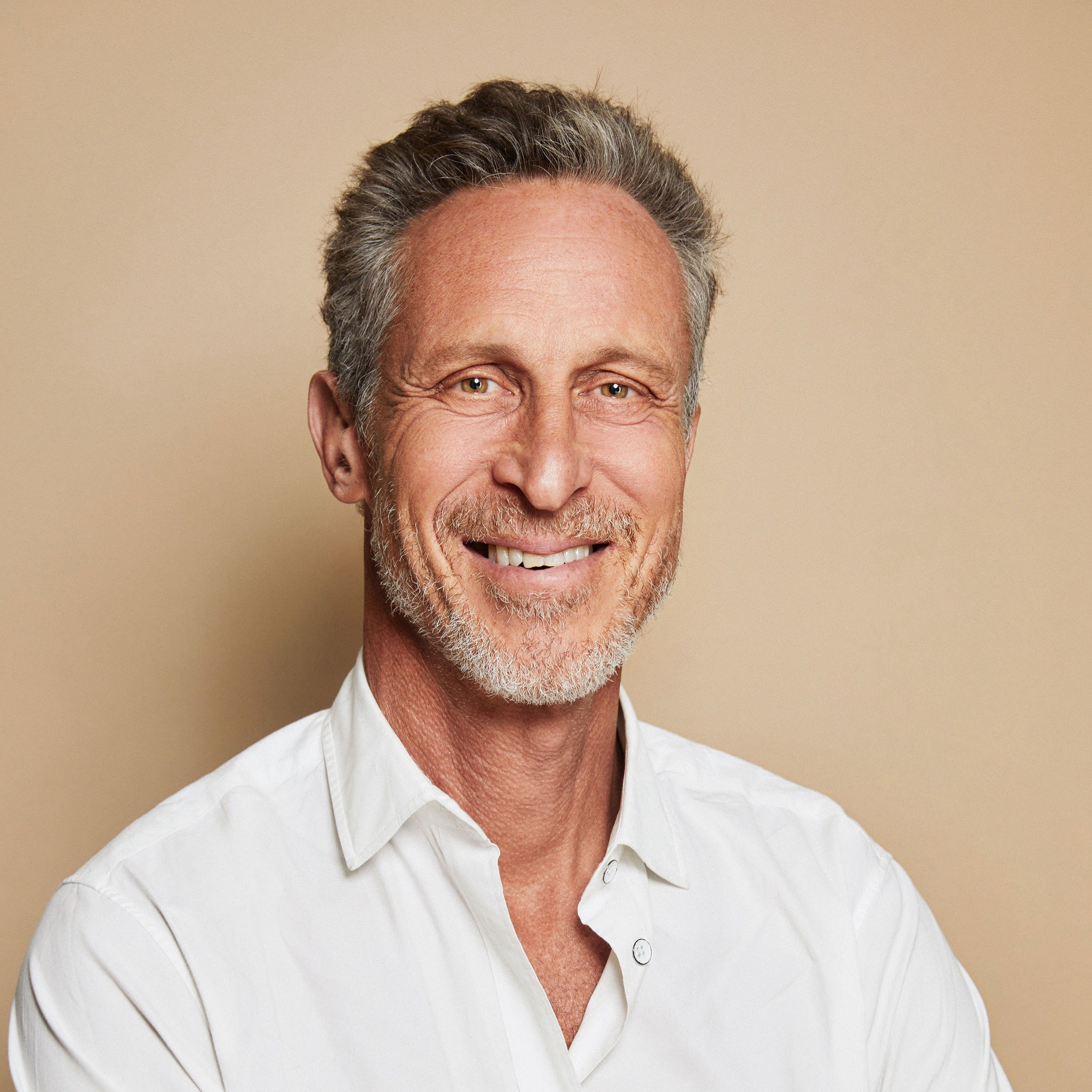
Only 7% of health outcomes are driven by genes; daily behaviors like food, sleep, movement, stress, and connection have up to 10x more impact than genes and surpass what medical care can do for the healthy.
2
Thrive Global's behavior change method relies on 'micro steps'—tiny, 'too small to fail' habits like a 60‑second reset, charging your phone outside the bedroom one night a week, or food swaps instead of deprivation—which build sustainable change and avoid the 80% New Year’s resolution failure rate.
3
The upcoming Thrive AI Health platform (partnered with OpenAI and Function Health) will deliver personalized, non‑judgmental digital coaching that learns from your biometrics, calendar, and preferences—acting like a GPS that recalculates without criticism.
4
Mark Hyman personally uses habit stacking (only watching shows while on a treadmill/bike), tracks his CRP, ApoB, and A1C, stopped drinking after seeing its impact on sleep via an Oura ring, and overcame a cheese addiction by trialing 40 plant‑based alternatives.
Protocols
Concrete recipes — what, when, how much, and why
6 items
60-second stress reset (micro pause)
WhatPause for 60–90 seconds to consciously breathe, focus on an image that brings joy or gratitude, listen to music, or reflect on a quote—shifting the nervous system from sympathetic to parasympathetic activity.
WhenThree times per day during work, especially after a long or escalated call; can be triggered by voice stress detection or rules (e.g., call >20 min).
Dose60–90 seconds. Three resets per day; enterprises sometimes limit to 60 seconds to fit handle‑time requirements.
For whomOriginally designed for high‑stress contact center operators, but applicable to anyone with a packed schedule.
WhyCumulative stress is avoidable even though acute stress is inevitable; short re‑centering moments prevent the buildup that leads to burnout and poor health choices.
CaveatsThe reset must be deliberately chosen—free‑form breaks often lead to phone scrolling or snacking, which increase stress.
Thrive Global developed hundreds of these resets based on the neuroscience of moving from sympathetic to parasympathetic dominance. They are deployed via dashboards; some clients use sophisticated voice‑stress detection, others use rules like call duration. A striking finding from Synchrony: when offered the choice between three 60‑second resets or three five‑minute breaks, 78% of employees chose the resets because a standard break, in their experience, led to doom‑scrolling or social comparison, leaving them more stressed. Arianna Huffington explains that the resets work because they don't create a new state—they simply uncover a place of calm that already exists within everyone, a concept she ties to Thich Nhat Hanh’s teaching that 'it’s never been easier to run away from ourselves.' A personalized reset can be built in five minutes using pictures of loved ones, a favorite song, and meaningful quotes. Because gratitude and anxiety cannot coexist, the reset effectively flips the emotional state.
Mechanism
The 60–90 second practice shifts autonomic balance away from sympathetic ('fight or flight') toward parasympathetic ('rest and digest') by engaging conscious slow breathing, which stimulates the vagus nerve. Activating positive emotional memories through images or music further dampens the amygdala’s stress response. Over time, this becomes a conditioned self‑regulation tool.
In 60 to 90 seconds, as you know, by focusing on conscious breathing, focusing on images that bring you joy or gratitude, music, quotes. You can change how you show up in your life.
Also said
“Stress is inevitable. There isn't anybody who doesn't have stress in their lives. But cumulative stress is avoidable.”— Frames the problem the reset solves.
“78% shows the resets. And the reason is that if people are given a five minute break, what do they do? Have coffee sugar. They go online or they go online and they doom scroll the news.”— Demonstrates that structured resets outperform unstructured time off.
Phone‑free bedtime one night a week
WhatTurn off your phone at least one night per week and charge it outside the bedroom.
WhenStart with one night a week (not every night).
DoseOne night per week, all night.
For whomAnyone with a phone, especially those who feel they can't disconnect.
WhyThe phone is a 'nuclear weapon' containing all your projects and problems; separating from it improves sleep quality and likely reduces late‑night stress scrolling.
CaveatsNot presented as an every‑night demand; the small ask is designed to demonstrate benefit so that the person may voluntarily increase frequency.
Arianna Huffington calls the smartphone 'not really a phone… it’s a nuclear weapon that has all your projects and problems.' She first recommended a dedicated sleep section in 2007 when the culture said 'I'll sleep when I'm dead' and 'you snooze, you lose.' This micro step is the antithesis of that culture, and by starting with one night, it removes the fear of total disconnection. The promise is that after one night you will see the difference—presumably better sleep onset, deeper rest, and a clearer morning—and be motivated to continue.
Mechanism
Removing the phone eliminates blue light exposure before sleep, reduces electromagnetic stimulation, and cuts off the psychological loop of checking notifications. It also breaks the conditioned reflex that the bedroom is a place of work or worry.
My favorite micro step is turn off your phone and at least one night a week we don't say every night charge it outside your room you'll see the difference because the phone you know it's not really a phone nobody calls anybody anymore you know it's a nuclear weapon that has all your projects and problems and you want to separate yourself from it.
Habit stacking — treadmill/elliptical TV rule
WhatNever watch any show unless you are simultaneously on a treadmill, bike, or elliptical machine.
WhenAnytime you want to watch TV or streaming content.
DoseNo fixed duration; the workout lasts as long as the viewing. Mark has sustained this rule for years without exception.
For whomMark Hyman (personal anecdote), particularly those who are not 'naturally athletic' and would rather curl up with a book or show.
WhyLinking a desired sedentary activity (TV) to movement makes exercise feel effortless and rewarding, turning willpower into a non‑issue.
CaveatsRequires home access to a treadmill, bike, or elliptical; Mark emphasizes that the equipment becomes the gatekeeper—no equipment, no show.
Mark Hyman created this rule during COVID when he saw friends gaining weight from couch‑binge‑watching. He explicitly contrasts it with relying on willpower, which he calls 'a diminishing resource.' The rule is absolute: he has never broken it. He recalls being so engrossed in Succession that he ended up on the treadmill for 2.5 hours. This protocol is a concrete example of habit stacking, which Thrive Global endorses more broadly. Hyman also shares how he overcame his biggest obstacle to exercise—travel—by booking a hotel trainer, even if he had to multitask on the phone during the session. Arianna reinforces that the overarching principle is 'make it easy, make it fun,' because willpower fails.
Mechanism
Habit stacking leverages the brain’s tendency to bind co‑occurring activities into a single routine. By pairing a high‑dopamine reward (a favorite show) with movement, the brain begins to crave the workout in anticipation of the show, reducing the perceived effort.
Personal experience
Mark Hyman describes himself as 'not a naturally athletic person… I would rather curl up on the couch and read a good book.' He started this rule during the pandemic when he saw friends gaining weight from binge‑watching. He says, 'I have not broken since which is I do not allow myself to watch any show unless I'm on my treadmill or my bike or my elliptica.' He adds, 'I remember when succession was on and I was obsessed with it. I ended up being on my treadmill for 2 and 1/2 hours.' He also pre‑books trainers when traveling to keep moving, even if he ends up on the phone.
I made this rule for myself which I have not broken since which is I do not allow myself to watch any show unless I'm on my treadmill or my bike or my elliptica.
Also said
“I remember when succession was on and I was obsessed with it. I ended up being on my treadmill for 2 and 1/2 hours because I wanted to get to the end.”— Shows the rule in action and the enjoyable overflow effect.
“Willpower is a diminishing resource. A lot of people think they're going to get healthier through willpower. Has to be fun.”— Provides the philosophical underpinning for why stacking works.
Track your three core biomarkers
WhatRegularly measure and trend hs‑CRP, ApoB, and HbA1c, either through a service like Function Health or your doctor.
WhenAt least annually, but with enough frequency to see behavior‑driven trends; ideally uploaded into a platform like Thrive AI Health for continuous feedback.
DosePeriodic blood draws; no fixed interval other than tracking over time.
For whomAnyone wanting to take charge of their health, especially those at risk for diabetes, heart disease, or inflammatory conditions.
WhyThese numbers reflect inflammation, atherogenic particle load, and glucose control—three pillars that directly respond to lifestyle and predict chronic disease.
CaveatsApoB is a better marker than LDL/HDL but is still not widely used in primary care. Interpretation is best when trended, not as a single snapshot.
Mark Hyman champions 'know your numbers' as a foundational behavior‑change tool. He points out that most people never see their own blood tests and doctors rarely trend them over time. The partnership with Function Health will allow Thrive AI Health users to upload their full biomarker panels; the AI coach will then use trends to generate personalized micro steps. Hyman specifically calls out CRP, ApoB, and A1C as his top three because they map tightly onto the most prevalent chronic diseases. He notes that ApoB is emerging as a more powerful predictor than traditional cholesterol metrics. The larger vision is a closed loop: a poor biomarker trend triggers a nudge, the user tries a swap or habit, and the next lab draw shows improvement—building evidence that behavior is medicine.
Mechanism
CRP indicates systemic inflammation, which underlies heart disease, metabolic syndrome, and many autoimmune conditions. ApoB reflects the number of atherogenic lipoprotein particles directly causing plaque. A1C shows average blood glucose over ~3 months, revealing insulin resistance and diabetes risk.
CRP as your inflammation marker. Apo B. As your uh lipid cholesterol number. And Apo B now there's a lot of evidence is a a more powerful marker than LDL and HDL and then A1C.
Also said
“If you can know these numbers… and then you check them and you see the trend lines.”— Emphasizes the trend, not a single value.
Food swaps instead of total deprivation
WhatIdentify your favorite unhealthy food (e.g., Cheetos, cheese, sugar) and systematically test healthier alternatives until you find acceptable substitutes.
WhenWhenever a craving hits; can also be a proactive pantry/habit redesign.
DoseOngoing; the goal is to find replacements that satisfy enough to stick, applying an 80/20 rule—occasional indulgence is fine, chronic pattern is what matters.
For whomMark Hyman (personal journey with cheese and sugar), and anyone struggling to give up a beloved processed food.
WhyCold‑turkey deprivation often fails; a gradual, swap‑based approach lowers the bar and makes healthy eating sustainable without feeling punitive.
CaveatsNot all substitutes are equal; many plant‑based alternatives are still processed. The key is to trial many options and pick the ones that work genetically and taste‑wise.
Arianna Huffington describes working with Alice Walton, who loved Cheetos, and introducing a Lesser Evil brand swap that removed dyes and many chemicals. Mark Hyman shares his own deep dive: as a 'high absorber' of cholesterol, cheese was wrecking his lipid profile. He tried 40 plant‑based/nut‑based cheeses, hated 90% of them, but found one or two he liked and now uses an 80/20 rule—he’ll occasionally eat a piece of Parmesan but no longer lives on cheese. He also gradually eliminated sugar, so that now a couple of spoonfuls of cake make him feel 'poisoned.' The nutrition director Tess Braderson is the swaps expert. The principle is: don’t let perfect be the enemy of the good. Start somewhere, and the cumulative effect—combined with other behavior changes like sleep and stress—takes over.
Mechanism
Swaps reduce the glycemic load, inflammatory additives, and hyper‑palatable combinations that hijack appetite regulation. Over time, taste buds recalibrate, reducing the reward signal from ultra‑processed foods.
Personal experience
Mark Hyman: 'Mine was cheese. Like if you left me alone, I could live on cheese.' After genetic testing showed he is a high absorber of cholesterol, he tried 40 substitutes, 'hated like 90% of them. But I found, you know, one or two that I I liked.' Now he applies an 80/20 rule, occasionally having Parmesan. He also gradually gave up sugar: 'Now, like if I'm at my daughter's birthday party and I have like two spoonfuls, I feel like I poisoned myself.'
It's what you do chronically that matters. It's not what you do occasionally.
Also said
“You can't make the perfect the enemy of the good of beginning somewhere.”— Core mindset for the swap approach.
“I found, you know, one or two that I I liked. And it's like the 80/20 rule.”— Mark Hyman’s lived example of the strategy working.
Stop drinking alcohol (for sleep and longevity)
WhatEliminate alcohol, especially if you notice it disrupts sleep quality or recovery as shown on a wearable.
WhenMark stopped drinking after seeing the data; he prefers the feeling of waking up clear.
DoseComplete cessation (for the host).
For whomMark Hyman (personal choice), and potentially others who track their sleep and see a clear detriment from even moderate drinking.
WhyAlcohol significantly degrades sleep architecture and, over a certain age, impacts the body more. Wearables like the Oura ring make this cost‑benefit visible.
CaveatsNot a blanket prohibition; the nudge is to let objective data guide the decision rather than habit.
Mark Hyman wears an Oura ring and noticed that on nights after drinking, his sleep quality metrics were poor. He stopped drinking not out of a sense of sacrifice but because he prefers the immediate reward of easier sleep onset and morning clarity. Arianna adds that she also stopped drinking; it’s not a sacrifice because she likes the feeling more than the alcohol-induced state. This is presented as an example of how self‑quantification can make the invisible harms of alcohol visible and thus motivate behavior change without guilt.
Mechanism
Alcohol suppresses REM sleep, fragments sleep in the second half of the night, and raises resting heart rate, all of which are captured by heart rate variability and movement trackers.
Personal experience
Mark Hyman: 'I stopped drinking. So that's not an issue. But you know, I mean, people who I and I stopped drinking because I think over a certain age, it has a bigger impact on your body and and I prefer how I feel. ... It's not a sacrifice because I like the feeling of going to sleep more easily, waking up with clarity.'
I stopped drinking because I think over a certain age, it has a bigger impact on your body and I prefer how I feel.
Also said
“If I don't get a good night's sleep I can see what did I do differently. I stop drinking.”— Shows the wearable-feedback loop driving the decision.
What's new
Personal practice updates, fresh positions, predictions
6 items
Behavior change as the real 'miracle drug'
Daily behaviors—not genes or pills—are the primary driver of health outcomes, a position the host frames as the scientific antidote to the chronic disease epidemic.
Why this matters: Reframes the entire healthcare conversation from treatment to prevention, emphasizing that solutions lie 'at the end of your fork, on your pillow, or in your connections'.
Background
Most of the $4.9 trillion US healthcare spend goes toward 'sick care'—drugs, surgeries, procedures—while behaviors that cause or worsen 80%+ of chronic illness are neglected.
Mark Hyman opens by stating that only 7% of health outcomes depend on genes; daily behaviors can have 10x more influence than genes and even more than medical care for those who are not acutely sick. He calls this 'science‑based, not warm and fuzzy wellness.' Arianna Huffington adds that the five behaviors Thrive works on—food, sleep, movement, stress management, connection—are foundational. They contrast behavior change with rescue medicine: America excels at acute care but has no real healthcare system. The conversation repeatedly returns to the moral and economic cost of ignoring behavior, illustrated by the 150,000 diabetes‑related amputations each year. They argue that if we treated behavior change as seriously as we treat drug development, we would reverse the chronic disease crisis and avoid trillions in wasted spending.
The solutions aren't at the bottom of a pill bottle. you know, they're pound at the end of your fork or on your pillow or in the gym, you know, and your in your connections.
Also said
“7% of our health outcomes are dependent on our genes. But our daily behaviors impact if we're healthy more than not just more than our genes like 10 times more than our genes but more than medical care if we are healthy.”— Quantifies the claim and underlines the science-first framing.
“Nobody should be having their legs amputated because of diabetes. And 150,000 people have their legs or toes amputated every year.”— Concrete, visceral example of preventable suffering that behavior change could avert.
Micro steps — 'too small to fail' habits vs. New Year's resolutions
Instead of ambitious resolutions that 80% of people abandon within two weeks, Thrive Global advocates micro steps—tiny, concrete actions that build 'success muscles' and make change sustainable.
Why this matters: Challenges the cultural myth that dramatic willpower is the path to health; reframes failure as a design problem solvable by starting ridiculously small.
Background
New Year’s resolutions (e.g., gym an hour a day, give up all sugar) set people up for failure because willpower is a limited resource, and the subsequent shame makes it harder to try again.
Arianna Huffington explains that Thrive spent eight years developing a behavior‑change methodology with scientists including BJ Fogg (Stanford) and Kevin Volpp (Wharton). The core insight: break goals into micro steps that are 'too small to fail.' Examples: a 60‑second breathing reset, turning off your phone one night a week, or trading Cheetos for a cleaner snack. She contrasts this with the typical makeover approach that triggers guilt and giving up. They want people to 'build success muscles' so each tiny win creates momentum. This principle is embedded in all five health behaviors and is the foundation of the AI coach's nudges. Even in tightly scheduled contact centers, three 60‑second resets a day yielded such profound results that 78% of employees preferred them to a five‑minute break.
The key is to break it down into micro steps that we call too small to fail which is the exact opposite of New Year resolutions.
Also said
“New Year resolutions, you know, I'm going to go to the gym an hour a day. I'm going to give up all sugar. And within two weeks, 80% of people give up their New Year resolutions. They feel like a failure and it's harder to get back on the horse.”— Quantifies the resolution failure rate and explains why tiny steps avoid that trap.
“We want to build success muscles.”— Pithy phrase that captures the counter‑psychological approach.
AI health coach that doesn’t judge — the GPS model
Thrive AI Health leverages an AI coach that offers personalized, judgment‑free guidance, analogous to a GPS that recalculates without criticism when you stray.
Why this matters: Solves the access and engagement problems of human coaching, and removes the shame and judgment that often cause people to abandon health efforts.
Background
Human coaching is expensive and hard to scale. Generic health advice struggles to move the needle. Digital health tools often lack personalization and don’t integrate deeply into daily life.
Arianna emphasizes that AI’s superpower for health behavior change is personalization plus memory. Onboarding pulls in biometrics, lab data (via Function Health), food preferences, movement likes, and calendar access to build a rich user model. The coach then delivers micro‑step nudges tailored to that individual. Crucially, the coach is non‑judgmental; Huffington repeatedly contrasts it with the shaming many feel from doctors, family, or themselves. She uses the GPS metaphor: if you take a wrong turn, the AI doesn’t call you an idiot, it simply recalculates and suggests the next right step. This no‑judgment environment, combined with the ability to learn over time and store memory of what worked, is presented as far more effective than traditional top‑down medical advice. Mark Hyman adds that his friend already uses a GPT for therapy precisely because it doesn’t judge.
The AI coach does not judge you. No, it's a little bit like a GPS. Google Maps. If you make a wrong turn, doesn't say you stupid idiot. Why did you go that way? Exactly. Just make turn at the next left.
Also said
“The power of AI is personalization.”— Directly states the core advantage over generic advice.
“AI will help us know ourselves and also know us better than we know ourselves.”— Underscores the memory and insight dimension of the coach.
Non‑communicable diseases are actually contagious
Drawing on the Framingham Heart Study, Mark Hyman notes that obesity and related behaviors spread through social networks, making health as contagious as disease.
Why this matters: Reframes loneliness and community as active biological levers, not soft emotional add‑ons, and justifies community‑based behavior change interventions.
Background
Genetics are often blamed for chronic diseases, but the Framingham data showed that having an overweight friend predicts weight gain better than having overweight family members.
Mark Hyman brings up Chris Christakis’s work with the Framingham dataset, which tracked people over decades and found that obesity, diabetes, and other conditions move through social ties—they are 'not infectious, but they’re contagious.' This insight underpins Thrive Global’s employer‑based model: the workplace becomes a community where role model stories, challenges, and accountability groups make healthy behaviors spread. Arianna describes the Walmart project, where associates earned financial rewards for meeting goals and shared moving personal stories—not just about weight loss, but about climbing stairs with a baby or better relationships with spouses. Hyman concludes that building community is a powerful, scalable mechanism for reversing the chronic disease epidemic, akin to Paul Farmer’s vision of a million community health workers.
We call these diseases non-communicable diseases, but that's not accurate. They're not infectious, but they're contagious.
Also said
“Health is also contagious.”— Flip side of the insight, making the case for positive social contagion.
“People were much more likely to be overweight if their friends were overweight than if their family members were overweight.”— Concrete stat that de‑emphasizes genetics.
Three biomarkers to own — CRP, ApoB, A1C
Mark Hyman advocates tracking hs‑CRP, ApoB, and HbA1c as the critical triad for monitoring inflammation, cardiovascular risk, and metabolic health, and notes that ApoB is superior to LDL/HDL.
Why this matters: Condenses complex lab work into three actionable numbers, empowering individuals to see the real‑time impact of their behaviors, without needing a doctor’s permission.
Background
Most people never see their own blood test results, or they get a fragmented view. Doctors seldom track trends across years.
Through the partnership between Thrive AI Health and Function Health, users will be able to upload their full biomarker panel, and the AI coach will use those data to personalize nudges. Hyman singles out CRP (inflammation), ApoB (atherogenic particles, now considered a more powerful metric than traditional cholesterol panels), and A1C (glucose control) as the three most important numbers to know and track over time. He argues that when you see a poor A1C trend, the AI can immediately suggest a micro step—like a food swap or movement habit—then show the trend improve, creating a closed feedback loop. This 'know your numbers' approach moves the locus of control away from the annual physical and into daily life.
CRP as your inflammation marker. Apo B. As your uh lipid cholesterol number. And Apo B now there's a lot of evidence is a a more powerful marker than LDL and HDL and then A1C.
Also said
“That's the key. What are you doing and how are you how are you monitoring how your behaviors are affecting your health?”— Frames the biomarker triad as a feedback tool, not just a diagnostic.
Wisdom over intelligence in the age of AI
As AI rapidly surpasses human cognitive ability, the speakers argue we must stop defining humanity by intelligence and instead cultivate soul, compassion, and wisdom.
Why this matters: Sets a philosophical anchor for the entire health‑tech mission, insisting that technology should serve human flourishing rather than fueling productivity alone.
Background
AI leaders project that within a few years, AI will be more intelligent than humans. The risk is that society doubles down on cognitive abilities while neglecting deeper human qualities.
Arianna recalls asking Sam Altman what world his children will inherit; he replied they would be the first generation never more intelligent than AI. She counters: 'Good for the machines. Let's let them be more intelligent and let us be more wise.' Mark Hyman strongly agrees, adding that we are 'drowning in data and starved for wisdom.' They connect this to health by arguing that physical, mental, and spiritual health cannot be separated. Huffington believes every person has a center of peace and wisdom that technology often buries; the 60‑second resets are designed to tap into that. The conversation closes with the vision that for‑profit companies can—and should—profit by appealing to what’s best in humans, rather than exploiting addiction and anger.
Let's let them be more intelligent and let us be more wise. We need to stop defining humanity by our intelligence.
Also said
“We're at the moment drowning in data and starved for wisdom.”— Mark Hyman’s concise diagnosis of the current era.
“We are more than our cognitive abilities. You know, we have a soul. We have the capacity to love, to feel compassion, to be resilient.”— Expands on what wisdom entails beyond IQ.
Recommendations
Products, supplements, and tools mentioned in the episode
3 items
Oura Ring (Gucci edition)
Product
A wearable sleep and activity tracker that gives detailed metrics on sleep quality, readiness, and activity, enabling the user to link behaviors like late meals or alcohol to poor sleep.
Mark Hyman specifically uses the data from his Oura ring to correlate actions (like drinking) with sleep disruption, leading him to stop drinking. He mentions the Gucci collaboration ring, which is no longer produced but underscores his personal enjoyment of the device. The ring makes the invisible visible, turning subjective feelings into objective data that motivate behavior change.
vs alternatives
Compared implicitly to other wearables (mention of 'a hoop or whatever you are wearing'), the Oura ring is praised for its sleep‑specific insights.
Personal experience
Mark Hyman: 'I'm wearing an aura ring. ... I love it because if I don't get a good night's sleep I can see what did I do differently. I stop drinking.'
I love it because if I don't get a good night's sleep I can see what did I do differently. I stop drinking.
A structured micro‑pause using breath, imagery, gratitude, or music to rapidly down‑shift the nervous system; can be self‑created on the Thrive platform in 5 minutes with personal photos and quotes.
Described under protocols, but as a recommendation it can be adopted independently. The resets are used widely in corporate settings and have been validated by user preference (78% over breaks) and by stress‑reduction data. Mark Hyman endorses the concept strongly, noting how close people are to feeling good with such small steps.
vs alternatives
Outperforms unstructured breaks or mindfulness apps that don’t integrate into the workflow or calendar.
Gratitude and stress and anxiety cannot coexist. So suddenly you have 60 seconds of what you love about your life.
The overarching behavior‑change method of breaking goals into minuscule, easy actions that accumulate into major lifestyle shifts.
Micro steps are the antidote to failed resolutions. They are chosen by the user from a library of hundreds, then grow over time into bigger habits. The key is they feel so small they cannot fail, thereby building confidence ('success muscles'). The methodology is evidence‑based, drawing on behavior change scientists. This philosophy underpins all of Thrive’s programs and the AI coach’s nudge design.
vs alternatives
Contrasts with typical wellness advice that demands large, immediate changes and results in high dropout rates.
We want to build success muscles. We start really really small.
Behavior change platform that works with self‑insured employers to deliver micro‑step challenges, coaching (real and digital), and community storytelling around food, sleep, movement, stress, and connection.
DisclosureFounded by Arianna Huffington, who guest‑stars in the episode. Mark Hyman credits her platform with launching his media career and partners with it.
Over eight years, Thrive Global has developed a methodology grounded in the science of behavior change (BJ Fogg, Kevin Volpp). It operates in 12 languages and serves both executives and contact center workers. The Walmart partnership, now in its seventh year, provided $1M in annual financial incentives and saw participants report better relationships, not just weight loss. The platform uses webinars, group coaching, individual coaching, challenges, and dashboards that deliver 60‑second resets.
vs alternatives
Unlike stand‑alone wellness apps, Thrive embeds into the employment community and layers storytelling, accountability, and real rewards, aiming for sustainable lifestyle shifts rather than short‑term biometric changes.
We want to help people change behaviors. ... I had to stop running a media company and launch a behavior change technology company.
Also said
“Our advice, our micro steps, everything we do is purely around lifestyle changes and and and which is the most powerful medicine by the way.”— Clarifies the scope and non‑medical nature of the platform.
Thrive AI Health (with OpenAI and Function Health)
Service Sponsored · disclosed
An AI‑powered digital health coach that ingests biometrics, lab data, preferences, and calendar to deliver personalized, non‑judgmental micro‑step nudges and behavior change support at scale.
DisclosureArianna Huffington’s company, developed in partnership with OpenAI and Function Health, as described by her on the show.
The AI coach leverages memory and machine learning to understand a user’s unique profile and continuously adapts its recommendations. It is explicitly compared to a GPS that recalculates without judgment when the user veers off track. The partnership with Function Health enables uploading comprehensive lab panels so the coach can tie biomarker trends to specific nudges. Mark Hyman endorses it as the key to democratizing coaching that was previously only accessible to the 1%. The vision is to embed this coach into daily life via calendaring, making health the path of least resistance.
vs alternatives
Contrasts with generic health apps and with human coaching that is expensive, hard to scale, and potentially judgmental. The AI’s memory and personalization are presented as unique advantages over static digital tools.
The mother load, the most important thing is how it's going to help us change behaviors because that's at the heart of the chronic disease epidemic.
A consumer health platform that provides deep, accessible lab testing (including the three biomarkers Mark emphasizes: CRP, ApoB, A1C) and empowers users to track their own data over time.
DisclosureMark Hyman states 'I'm loving our partnership with function health' and mentions direct integration with Thrive AI Health.
Mark Hyman explains that people can get their full biomarkers through Function Health, and that the forthcoming 'know your numbers' program will help them focus on the most meaningful metrics. The integration with Thrive AI Health means those lab results will feed directly into personalized coaching, creating a closed feedback loop that shows how behavior changes impact actual physiology.
vs alternatives
Unlike traditional annual blood work that is often inaccessible to patients and not trended, Function Health gives users direct access to their data and emphasizes longitudinal tracking.
You won't be able to know or remember everything that you learn from your function blood test which are fantastic because you go deeper.
A cookbook with recipes donated by chefs like AA Garden and José Andrés, using 5 ingredients or less, designed to be affordable, easy, and delightful—a direct counter to the myth that healthy eating is expensive or time‑consuming.
DisclosurePublished by Thrive Global; Arianna Huffington says they give it away for free as a non‑profit center.
Arianna created the cookbook after recognizing that telling people to 'eat their broccoli' wasn’t enough; they needed to be shown how to cook delicious, affordable food. The recipes are designed for people with small budgets and no cooking equipment (they later partnered with Shark Ninja to donate kitchen tools). The book is a tangible piece of the 'make it delightful' philosophy that runs through Thrive’s approach.
vs alternatives
Unlike commercial diet cookbooks, this one removes price and complexity barriers and is visually appealing to engage hesitant cooks.
We invited famous chefs like AA Garden and Joseé Andres to donate recipes with five ingredients or less and everything affordable and and then we made the book a delightful with pictures and easy recipes.
Also said
“If we want people to eat healthier, we can't just tell them to eat their broccoli. ... You have to show them how.”— Explains the behavior‑change logic behind the book.
Lines worth pulling out — contrarian, specific, or perfectly phrased
8 items
The solutions aren't at the bottom of a pill bottle. you know, they're pound at the end of your fork or on your pillow or in the gym, you know, and your in your connections.
Distills the entire episode’s thesis into one vivid, actionable metaphor.
How close we are to feeling good. Isn't that sort of a wonderful thought?
A hopeful reframe that counters the overwhelming nature of health advice and suggests small tweaks can unlock well‑being.
It's a little bit like a GPS. Google Maps. If you make a wrong turn, doesn't say you stupid idiot. Why did you go that way? Exactly. Just make turn at the next left.
Powerful analogy for non‑judgmental AI coaching, making a complex technology feel safe and human.
We're all works in progress.
Ein mindverset that reduces shame and perfectionism, essential for sustained behavior change.
Willpower is a diminishing resource. A lot of people think they're going to get healthier through willpower. Has to be fun.
Directly challenges the puritanical approach to health and justifies habit stacking and making health delightful.
We are at the moment drowning in data and starved for wisdom.
Mark Hyman’s crisp diagnosis of the modern condition, linking the episode’s AI and health themes to a deeper cultural need.
Health is also what happens between doctor visits.
Succinctly repositions health ownership away from the annual physical and into daily behaviors.
We need to stop defining humanity by our intelligence. ... We have a soul. We have the capacity to love, to feel compassion, to be resilient.
Philosophical anchor for the entire Thrive mission, arguing that AI should free us to become more human, not more productive.
Sign in to share feedback
Tell us if this brief hit the mark or missed it — feedback feeds back into the next iteration of the prompt.
Reading is free for everyone. A free account adds the personal layer: save protocols, follow experts, and see how the other experts weigh in on this same topic.
Educational summary of the cited expert source — not medical advice. Open the source recording linked above and consult a qualified physician before acting on any protocol.