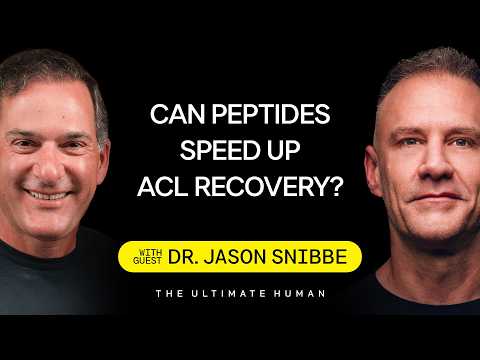
Dr. Jason Snibbe’s prehab philosophy turns surgery into a whole-patient process: months of inflammation-lowering diet, supplements like Perfect Amino and H2 tablets, and muscle activation drastically improve joint replacement outcomes—he calls the patient’s biology the “canvas.”
2
He uses Stryker robotic surgery with a CT-based 3D model that personalizes implant alignment to each patient’s ligament tension, plus haptic technology that prevents the saw from ever cutting beyond bone, preserving muscle and soft tissue.
3
His go-to peptides are BPC-157, TB-500, and an oral growth hormone secretagogue—he personally cured his chronic Achilles tendinitis in six weeks and uses them routinely for post-surgical and non-surgical healing.
4
Snibbe avoids arthroscopic meniscectomy, instead injecting PRP, exosomes, or hyaluronic acid for meniscus tears, often sparing patients from knee replacement; he walks joint replacement patients within an hour of surgery to boost confidence and speed recovery.
Protocols
Concrete recipes — what, when, how much, and why
5 items
Comprehensive prehab for joint replacement
What3–6 months of anti-inflammatory diet, biomarker testing (A1C, CRP, heavy metals), daily walking, targeted muscle activation, and supplements (Perfect Amino, H2 tablets, mineral salt) to prepare the body for surgery.
WhenInitiated as early as possible before joint replacement, ideally 3–6 months prior.
DoseMonths of preparation; daily walking and supplement intake; no specific dose for supplements mentioned.
For whomPatients scheduled for elective knee, hip, or shoulder replacement; especially those with metabolic syndrome or deconditioning.
WhyLow tissue quality and high systemic inflammation lead to complications and poor outcomes; prehab improves tissue metabolism, reduces inflammation, activates muscles, and builds patient confidence.
CaveatsRequires early referral and patient compliance; some arthritic joints cannot be fully mobilized preoperatively.
Dr. Snibbe uses the analogy of a painter needing a good canvas: even the best surgical technique fails if the patient’s biology is compromised. He checks inflammatory markers and heavy metals, then puts patients on a clean diet and supplements like Perfect Amino to preserve muscle. He emphasizes daily walking to activate the kinetic chain and improve synovial fluid exchange. The prehab also includes neuro‑muscular re‑education — retraining the muscles around the joint to fire properly before surgery, so they are easier to engage afterward. This comprehensive prehab reduces the risk of infection, wound breakdown, and muscle atrophy. He sees it as controlling the entire episode of care from the first consultation.
Mechanism
Lowering CRP and A1C reduces systemic inflammation that impairs healing. Muscle activation increases blood flow and neurotransmission to the joint’s surrounding muscles. Walking promotes circulation of synovial fluid, nourishing cartilage. Amino acid supplementation prevents catabolism, preserving muscle mass during the perioperative period.
We like to get to people many months before, let’s say three months, even maybe six months if possible to get them organized, especially with their inflammation in their body to lower the inflammation, to work on their diet and then also whatever supplements they need.
Walking within one hour after joint replacement
WhatAmbulate with full weight‑bearing within 60 minutes of waking from joint replacement anesthesia.
WhenImmediately post‑op, same day, targeting within the first hour.
DoseOne initial walk, then daily ambulation as tolerated.
For whomAll Snibbe’s joint replacement patients (knee, hip, shoulder) who are medically stable.
WhyImmediate walking boosts confidence that the new joint is strong and stable; large datasets show improved outcomes and reduced fear‑avoidance.
CaveatsRequires a coordinated team and patients who are physiologically ready; not all hospital settings support this protocol.
Snibbe insists that getting patients up immediately — sometimes within an hour — is a cornerstone of his program. He contrasts this with older practices where patients stay in bed, which leads to muscle loss, fear of weight‑bearing, and prolonged recovery. He tells patients that the implant is metal and plastic, extremely strong, and not fragile. This psychological shift, coupled with the early activation of muscles and the kinetic chain, accelerates functional return. His patients often shock home physical therapists by walking to the door unaided. He references data showing confidence and trust in the joint soar after that first walk.
Mechanism
Early weight‑bearing stimulates proprioceptive feedback, muscle spindle activation, and neuromuscular control, preventing muscle atrophy and joint stiffness. Weight‑bearing promotes bone‑implant integration and lymphatic drainage, reducing swelling. Confidence derived from the immediate experience reduces pain catastrophizing and fear‑avoidance, which correlate with better long‑term outcomes.
Our goal is to walk within an hour of the surgery. … There’s enormous amount of data showing that if you get up and walk on your joint replacement immediately, your confidence goes through the roof of trusting the joint.
Also said
“Your joint replacement is not like a delicate egg. It’s not going to break. It’s so strong. This is metal and plastic. It’s really strong.”— The message he gives patients to enable early mobility.
Perfect Amino supplement for surgery patients
WhatTake Perfect Amino tablets daily starting before surgery and continuing at least six weeks post‑op (often indefinitely).
WhenStart as soon as patient is seen before surgery; continue daily through six weeks post‑surgery, and many continue for life.
DoseDaily intake; exact number of tablets not specified.
For whomAny patient undergoing orthopedic surgery; also recommended for non‑surgical patients.
WhyProvides essential amino acids to prevent muscle loss during the perioperative period and accelerate muscle mass rebuilding after surgery.
CaveatsNone mentioned.
We will put them on perfect amino every day all the way up to the surgery and then at least for six weeks after. Most of the patients love it so much they stay on it.
H2 tablets and mineral salt for detoxification
WhatDaily H2 molecular hydrogen tablets plus mineral salt to help clear anesthesia, narcotics, and oxidative stress after surgery.
WhenDuring prehab and post‑surgery recovery, taken daily.
DoseDaily; no dose specified.
For whomSurgical patients who are exposed to anesthetics and narcotics.
WhySupports the body’s ability to eliminate the “poison” of anesthesia and pain medications, reduces oxidative damage, and promotes healing.
CaveatsNone mentioned.
Mechanism
Molecular hydrogen acts as a selective antioxidant, neutralizing hydroxyl radicals and reducing oxidative stress without interfering with beneficial signaling. This may accelerate detoxification of drug metabolites and support liver function. Mineral salt replaces electrolytes lost during stress.
Remember, we’re giving them a lot of poison. We’re giving them anesthesia. We’re giving them narcotics. … To rid themselves of all this stuff, these supplements are very key.
Biologic injections (PRP, exosomes, hyaluronic acid) as alternative to surgery
WhatInject platelet‑rich plasma (PRP), exosomes, or hyaluronic acid (or combinations) into the joint for meniscus tears, tendinitis, or mild/moderate arthritis to promote healing and avoid surgical intervention.
WhenWhen conservative measures fail and surgery is being considered; can be repeated if needed (e.g., a couple of injections over time).
DoseOne injection often yields 70‑80% improvement; occasionally a second injection is needed; no specific volume given.
For whomPatients with meniscus tears, rotator cuff tendinitis, early arthritic knees/hips who have not responded to physical therapy and lifestyle changes; not suitable for severe deformity or end‑stage collapse.
WhySurgery (especially meniscectomy) causes intra‑articular trauma that accelerates cartilage loss, with 30% of those patients needing a replacement within months. Biologics stimulate repair and reduce inflammation without the iatrogenic harm.
CaveatsNot a panacea; MRI must be carefully analyzed; some patients still need surgery. Works best when combined with prehab and lifestyle optimization.
Snibbe’s default for a meniscus tear is non‑operative. He describes drawing a patient’s own blood, centrifuging it for PRP, and injecting it along with hyaluronic acid if there is any arthritis. For more regenerative power, he uses exosomes. He reports that many patients experience dramatic relief and avoid the knife entirely, including the classic scenario where three other surgeons recommended surgery. He revisits the statistic that 30% of meniscectomy patients progress to knee replacement quickly, a risk he wants patients to understand. For arthritis, these injections can push the replacement down the road significantly, especially when combined with weight loss and muscle strengthening.
Mechanism
PRP delivers concentrated growth factors (PDGF, TGF‑β, VEGF) that stimulate fibroblast and chondrocyte activity, modulate inflammation, and promote matrix synthesis. Exosomes carry bioactive mRNAs and proteins that orchestrate tissue repair and immunomodulation. Hyaluronic acid restores synovial fluid viscoelasticity and provides a scaffold for healing. Together they create a regenerative microenvironment, contrasting with the destructive trauma of a shaver or scalpel.
Classically, if you tore your meniscus, an orthopedic surgeon like me would say, ‘Oh, we’re going to go in there and nibble away that meniscus.’ Well, guess what? 30% of those patients end up within 3 to six months with a knee replacement. … Those patients a simple injection would be platelet rich plasma... many patients get 70 to 80% better from one injection.
Also said
“I saw three surgeons. They all want to operate on me. And we do PRP and they’re like, ‘I got better and I can’t believe I was going to have a surgery.’”— A typical patient success story.
What's new
Personal practice updates, fresh positions, predictions
5 items
Prehab is the missing biohack
Dr. Snibbe argues that optimizing a patient’s biology — diet, inflammation markers, muscle activation — months before surgery is as important as the surgical technique itself, likening the patient’s condition to a canvas that must be healthy for a good outcome.
Why this matters: Reframes orthopedic surgery from a single procedure to a months-long whole-patient preparation, challenging the conventional focus solely on the operation.
Background
Traditionally, joint replacement preparation centers on the surgical event with little emphasis on metabolic and functional readiness. Physical therapy (“prehab”) is rarely formalized as a comprehensive biological optimization.
Dr. Snibbe stresses that no matter how minimally invasive or robotic the surgery, poor tissue quality, high inflammation, and weak muscles lead to complications like infection, wound healing problems, and muscle wasting. He begins working with patients three to six months ahead, checking biomarkers such as hemoglobin A1C, C-reactive protein, sedimentation rate, and even heavy metals. He puts them on a clean anti-inflammatory diet, supplements like Perfect Amino (to maintain muscle mass), and walking programs to activate the kinetic chain. This prehab builds neurotransmission to the muscles around the joint, so after surgery the patient can recruit those muscles faster. He uses the artist-canvas metaphor: if the canvas is poor, no great painting (surgery) will succeed. By controlling the entire episode of care, including preoperative optimization, he sees dramatically better functional returns and patient satisfaction.
We love to get to people many months before, let’s say three months, even maybe six months if possible to get them organized, especially with their inflammation in their body to lower the inflammation, to work on their diet and then also whatever supplements they need.
Also said
“If the canvas or the patient is not quality, they don't have good tissue or good metabolism and good health, no matter how great of a painting you draw, no matter how great of a surgery you do, you're going to have a bad outcome.”— The anchor metaphor he uses to explain why prehab matters.
“I think that the future of medicine in general is this whole patient approach. I think for so many decades we've only treated the one little narrow symptom that's presented.”— Reinforces his shift away from isolated symptom treatment.
Robotic surgery with personalized alignment and haptic boundaries
His robotic knee and hip replacements use a preoperative CT scan to model the patient’s exact anatomy, then during surgery he stresses the ligaments and adjusts implant positioning on a computer to match that individual’s ligament balance, while haptic technology keeps the saw confined to the bone.
Why this matters: Explains how robotics moves beyond one-size-fits-all alignment to truly patient-specific joint balancing, reducing the 20% dissatisfaction rate seen with conventional techniques.
Background
Before robotics, surgeons aligned implants based on generic averages, which left about 20% of knee replacement patients feeling the joint was “weird.” Traditional instruments could also exit the bone, cutting soft tissues and creating scar tissue.
Dr. Snibbe uses a Stryker robotic system that begins with a CT scan of the joint (e.g., knee from hip to ankle). This provides rotational alignment in three planes and exact sizing of the implant. In the operating room, he manually stresses the patient’s ligaments — not generic targets — to get a set of numbers that represent that individual’s ligament tension. He then adjusts the implant’s position on the computer screen to match the ligaments, so the center of rotation and alignment are perfectly personalized. The robotic arm incorporates haptic technology: a three-dimensional boundary that defines where the saw can cut, preventing any exit from the bone. This preserves muscle, ligaments, and other soft tissues, reducing trauma and scar tissue. For shoulders, the robot helps place the critical glenoid pin with extreme accuracy on the tiny bone. Snibbe believes this combination of personalization and tissue preservation will become even more automated in the future, with AI using outcome databases to recommend implant choices live.
What we do with robotics is we get a CT scan of the joint… I stress your ligaments, not somebody else’s, not based on some research number. It’s basically how your ligaments respond. And then based on those response of the ligaments, we get a set of numbers. And I adjust on a computer screen the implant to accept your ligaments.
Also said
“The robot knows exactly where the bone is in space. So the saw will never leave the bone.”— Succinctly captures the haptic technology’s key benefit.
“When we used to do knee replacements and people still do them without the robot, the saw would exit the bone and that would cut all your tissue and create more scar tissue, more trauma, more damage.”— Highlights the contrast with traditional methods.
Peptides BPC-157, TB-500, and oral growth hormone secretagogues as game-changers for healing
Snibbe uses BPC-157, TB-500, and an oral growth hormone stimulator for both non-surgical soft tissue injuries and post-surgical recovery, calling them a ‘gamechanger’ after seeing patients improve dramatically and personally curing his own chronic Achilles tendinitis in six weeks.
Why this matters: An orthopedic surgeon openly endorsing and clinically using research peptides, with a detailed personal success story that validates his patient outcomes.
Background
Peptides like BPC-157 and TB-500 are known in biohacking circles but rarely discussed by mainstream surgeons. Snibbe’s integration into a conventional orthopedic practice is unusual.
Snibbe lists his go-to peptides as BPC-157, TB-500, and an oral growth hormone secretagogue. He says he puts patients on these regimens and often sees them improve without surgery — for example, a patient with rotator cuff tendinitis who was 80% better after a month. His own story: he suffered from severe Achilles tendinitis for two years, so bad that patients commented on his limp. After putting himself on the same peptides, he was pain-free in six weeks, and the pain never returned. He views these peptides as part of a broader strategy to avoid unnecessary surgery, combined with biologic injections like PRP and exosomes. His enthusiasm is tied to the principle that if you can heal the tissue biologically, you can postpone or prevent more invasive procedures. He acknowledges that the field is early and will evolve towards condition-specific biologic cocktails.
Personal experience
Snibbe had chronic Achilles tendinitis for two years. It was so painful that if someone touched his Achilles he would “go through the roof.” He started the peptide protocol he used for his patients and was completely cured in six weeks. He says, “It literally just healed it.”
I had this horrendous Achilles tendinitis. It was so bad. I put myself on it, six weeks, cured. It was gone. Like not like if someone hit my Achilles, I’d like go through the roof. It was so painful. And so it literally just healed it.
Also said
“My go-tos are BPC-157, TB500, and oral, which is a stimulation of your own growth hormone. Those are the main ones that we use and those are the ones that we tend to see great results with.”— Exact list of his preferred peptides.
“The peptides have been a gamechanger because we’re putting people on these peptides and a lot of them are getting better without anything.”— Emphasizes that peptides can avert surgery entirely.
Avoiding arthroscopic meniscectomy with biologics (PRP, exosomes, hyaluronic acid)
Snibbe claims that 30% of patients who undergo arthroscopic partial meniscectomy end up needing a knee replacement within 3–6 months, so he instead uses PRP, exosome, or hyaluronic acid injections for meniscus tears, often achieving 70–80% improvement without surgery.
Why this matters: Directly contradicts the common practice of scoping a meniscus tear, citing high failure rates and offering a regenerative alternative that he says can prevent early joint replacement.
Background
Standard orthopedic teaching often recommends arthroscopy for symptomatic meniscal tears. Snibbe argues this creates intra-articular trauma that accelerates cartilage deterioration, leading to early arthritis and eventual replacement.
Snibbe explains that meniscus surgery—even a simple “clean up”—is traumatic to the joint and can trigger deterioration. He gives a stat: 30% of those patients progress to knee replacement within 3–6 months. In his practice, he instead draws platelet-rich plasma (PRP), spins it, and injects it into the knee, sometimes with hyaluronic acid if there’s mild arthritis, or uses exosomes. He says many patients get 70–80% better after one injection, though some need a second. He applies the same logic to arthritic knees, using these injections to manage pain and delay replacement when anatomical deformity isn’t severe. He tells patients, “I’m 53, if I tore my meniscus, I wouldn’t let anybody touch it.” This conservative, biology-first approach is a major reason patients travel to him—he is more famous for the surgeries he didn’t do. He emphasizes that every patient is different and MRIs are assessed carefully, but the default is to try regeneration before cutting.
Personal experience
Snibbe often has patients seek him out after seeing multiple surgeons who recommended surgery; he treats them with injections and they get better, avoiding an operation. He mentions a typical patient: “I saw three surgeons. They all want to operate on me. And we do PRP and they’re like, I can’t believe I was going to have a surgery.”
If I tore my meniscus, I wouldn’t let anybody touch it because I see so many problems with this meniscus surgery.
Also said
“30% of those patients, which is a big number, end up within 3 to six months with a knee replacement.”— The stark statistic he uses to argue against routine meniscectomy.
“I’m more popular from the people I didn’t operate on than the ones I did.”— Illustrates his conservative philosophy.
Building a hospital that integrates biohacking modalities to control the entire episode of surgical care
Snibbe is constructing a 70,000-square-foot inpatient hospital where he will offer hyperbaric oxygen, red light therapy, peptides, and nutritional optimization alongside robotic surgery, allowing him to bypass regulatory obstacles and deliver a fully controlled recovery process.
Why this matters: A surgeon building an entire facility designed around regenerative and biohacking adjuncts signals a shift toward institutionalizing whole-patient orthopedic care.
Background
Most hospitals impose regulatory barriers that prevent the incorporation of non-traditional modalities like hyperbarics and red light into post-surgical protocols. Snibbe’s current practice can only partially integrate these tools.
Snibbe explains that working inside a conventional hospital system restricts the ability to offer things like hyperbaric oxygen chambers and red light therapy because of red tape. To fully control the episode of care — from prehab through surgery to late-stage recovery — he is building a ground-up 70,000 sq ft hospital, set to open in early 2025. It will have physical therapy on site, hyperbaric chambers, red light therapy, and the capacity to manage both surgical and non-surgical patients with biologic injections and lifestyle optimization. He envisions a longevity-oriented recovery center where the whole experience is curated: the best physical therapists, lab testing, nutrition, and supplements all under one roof. This eliminates the fragmented care that often leads to poor outcomes and empowers him to deliver the same level of meticulous, muscle-sparing surgery while ensuring patients receive the full complement of biological support to heal faster and avoid complications.
I said to myself, how can I make the experience on all levels amazing? … We’re building a beautiful hospital … we can put hyperbaric red light inside of it because when you work in a hospital system there’s so much regulatory issues that restrict you.
Also said
“Put them in a hyperbaric oxygen chamber. Put them in red light to increase blood flow so their wound healing is better.”— Clarifies the specific modalities he’ll offer.
“I want you doing the red light and the hyperbaric and the peptides and the aminos. I want you on all this stuff to optimize your recovery even surgical or non-surgical.”— Shows his philosophy applies to all patients.
Recommendations
Products, supplements, and tools mentioned in the episode
3 items
Perfect Amino
Supplement
He uses Perfect Amino as a staple in his prehab and post‑surgery protocol to prevent muscle catabolism and speed recovery.
Snibbe says he takes Perfect Amino and H2 tablets and mineral salt every day himself. For patients, he starts them on Perfect Amino as soon as they come in for a surgical consult, continues through the operation, and for at least six weeks afterward. He believes it helps preserve muscle mass during the catabolic perioperative period and enables faster regaining of strength. Most patients like it so much they continue indefinitely. He pairs it with walking and physical therapy to maximize results.
Personal experience
Snibbe states he takes Perfect Amino, H2 tabs, and mineral salt daily.
We will put them on perfect amino every day all the way up to the surgery and then at least for six weeks after. Most of the patients love it so much they stay on it for the rest of the time.
He recommends H2 tablets to surgical patients to help eliminate the “poison” of medications and reduce oxidative stress.
Snibbe explains that surgery and its associated drugs (anesthesia, opioids) create a toxic burden. He uses H2 tablets and mineral salt to support the body’s natural detoxification and antioxidant systems. He takes them himself and incorporates them into his perioperative protocols alongside amino acids. The goal is to give patients the best chance for clean healing with minimal side effects from medications.
Personal experience
Snibbe says, “I take that H2 tabs and a mineral salt every single day.”
Remember, we’re giving them a lot of poison. We’re giving them anesthesia. We’re giving them narcotics. … To rid themselves of all this stuff, these supplements are very key.
Snibbe co‑developed Snibbs with a chef partner to create a shoe for people on their feet long hours—waterproof, anti‑slip, with a proprietary padding that lasts over a year, designed to reduce stress on joints and accommodate foot swelling.
DisclosureCo‑founder of Snibbs, the shoe brand he describes in detail.
He spent four years designing the shoe with materials and testing them in operating rooms and kitchens. The unique padding is a proprietary rubber that doesn’t break down like typical athletic shoe foam (e.g., Hoka), maintaining cushioning for 1‑1.5 years under daily standing. They are slip‑resistant and waterproof, and the design allows for foot swelling. In a trial at Caesar’s Palace, 300 employees wore them for six months with zero slip‑and‑fall incidents, indicating injury reduction. Snibbe says the goal is to let people end their day without foot pain, reducing stress on knees, hips, and back, and improving overall quality of life. The line includes clogs, work boots, and various styles.
vs alternatives
He contrasts with typical running shoes (like Hoka) whose cushioning compresses significantly after about 50 miles or three months, whereas Snibbs’ proprietary rubber retains resilience for a year or more.
Personal experience
Snibbe, a surgeon, and his chef partner developed the shoes based on their own needs for durable, comfortable footwear during long hours on hard floors.
I spent about four years. My partner is a chef and I’m a surgeon. … We created this amazing shoe. … The padding is a special rubber material that we proprietary designed that basically has resilience and cushioning, but it doesn’t wear out in three months.
Also said
“I want you not to think about your feet at the end of your day. I want you to come home and think about, okay, how am I going to enjoy my night?”— Conveys the human benefit he aimed for.
“We gave two 300 people shoes and none of them had a slip and fall over the course of about a six‑month period. … We can actually minimize injury.”— The safety outcome data he cites.
Lines worth pulling out — contrarian, specific, or perfectly phrased
6 items
I’m more popular from the people I didn’t operate on than the ones I did.
A surgeon openly valuing non‑surgical successes over his operative stats.
If I tore my meniscus, I wouldn’t let anybody touch it because I see so many problems with this meniscus surgery.
Powerful statement against the standard of care from an orthopedic surgeon.
Your joint replacement is not like a delicate egg. It’s not going to break. It’s so strong. This is metal and plastic. It’s really strong.
Memorable analogy to combat patient fear and promote early mobility.
I don’t operate on your MRI. I operate on how you feel.
Highlights his patient‑centric, functional approach over imaging findings.
Our goal is to walk within an hour of the surgery.
Concrete, aggressive rehabilitation benchmark that sets him apart.
If the canvas or the patient is not quality, they don't have good tissue or good metabolism and good health, no matter how great of a painting you draw, no matter how great of a surgery you do, you're going to have a bad outcome.
The artist‑canvas metaphor that distills his argument for prehab and biological optimization.
Sign in to share feedback
Tell us if this brief hit the mark or missed it — feedback feeds back into the next iteration of the prompt.
Reading is free for everyone. A free account adds the personal layer: save protocols, follow experts, and see how the other experts weigh in on this same topic.
Educational summary of the cited expert source — not medical advice. Open the source recording linked above and consult a qualified physician before acting on any protocol.