
UNFUCG
DashboardSearchChatBookmarksNotificationsActivityPremiumProfile
?
Home
Search
Chat
Saved
Profile
Episode
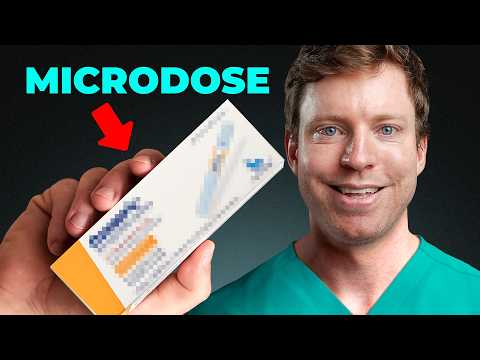
Microdosing THIS for Longevity is Exploding in Popularity
~12 min
Episode Brief·YouTube

Microdosing THIS for Longevity is Exploding in Popularity

Brad Stanfield
Watch on YouTube Add to chat My bookmarks← All sources

TL;DR

The four things you'd lose by not watching

4 items

TL;DR

The four things you'd lose by not watching

4 items
1

Longevity influencer Bryan Johnson microdosed tirzepatide (GLP-1/GIP) at 1/5th the typical dose for anti-aging but quit after 3 weeks due to a 7% increase in resting heart rate, a known drug effect he didn't anticipate at that dose.

2

Brad Stanfield warns that microdosing GLP-1s for longevity in healthy non-overweight, non-diabetic adults has completely hypothetical benefits, unknown long-term safety, and carries a key risk of unintended muscle loss.

3

The proposed mechanisms—anti-inflammatory effects and calorie restriction mimicry via the mTOR pathway—come from animal and observational studies; no human trials exist for microdosing in this population.

4

A clinical trial examining small doses of GLP-1 agonists in healthy adults is expected by end of 2025; until then, Stanfield does not recommend microdosing for this group, likening it to his stance on metformin.

Protocols

Concrete recipes — what, when, how much, and why

1 item

Exercise as the foundational longevity intervention

WhatEngage in regular physical activity (specifics teased in a follow-up video).
For whomAll patients, regardless of weight or diabetes status.
WhyStanfield calls it 'the closest thing that we have to the fountain of youth' and the one intervention he recommends without hesitation for combating aging and promoting healthy lifespan.

when it comes to combating the effects of aging and promoting a healthy lifespan, there's one intervention that I recommend to all of my patients without hesitation. And it really is the closest thing that we have to the fountain of youth.

What's new

Personal practice updates, fresh positions, predictions

3 items

The rise of microdosing GLP-1s for longevity in healthy individuals

Spurred by Bryan Johnson's experiment, a trend of microdosing tirzepatide (GLP-1/GIP) for anti-aging is growing rapidly among non-overweight, non-diabetic people seeking hypothetical calorie-restriction-mimicking benefits.

Why this matters: This is a new off-label use spreading widely despite the total absence of human safety or efficacy data for microdoses in healthy populations.

Background

GLP-1 medications were first approved for diabetes in 2005 and then for weight loss (semaglutide as Wegovy) in 2021. Recent research points to potential anti-inflammatory, cardioprotective, and calorie-restriction-mimicking effects that could extend healthy lifespan. That research, combined with microdosing to avoid weight loss, has driven interest in using these drugs solely for longevity.

The speaker traces the discovery of GLP-1 in 1986, its insulin-stimulating and gastric-emptying effects, and the excitement that led to diabetes and then obesity treatments. As studies began hinting at broader anti-aging mechanisms—reducing chronic inflammation, mimicking calorie restriction via the mTOR pathway, and potentially lowering risks for heart disease, Alzheimer's, and cancer—longevity influencers like Bryan Johnson looked to repurpose these drugs for aging itself. Johnson reasoned that if calorie restriction extends healthy lifespan in multiple organisms and GLP-1s can mimic that state, microdosing might deliver the benefits without causing weight loss. He used tirzepatide (a dual GLP-1/GIP agonist) at only 1/5th the typical dose. This logic, amplified by Johnson's visibility, ignited a wave of microdosing experimentation among healthy adults, even though the evidence is entirely based on animal models, observational correlations, and mechanistic speculation. The speaker emphasizes that no human microdosing studies have been completed, so the trend is a leap into unknown territory.

the idea here is to harness the benefits that we've looked at while avoiding the weight loss which wasn't his goal.

Bryan Johnson's 3-week microdosing experiment terminated due to elevated heart rate

Johnson ended his microdosing trial after only 3 weeks when his resting heart rate rose by about 7%, a known side effect of tirzepatide that surprised him even at the microdose.

Why this matters: Serves as a real-world caution that microdoses can still produce unexpected adverse effects, undermining the assumption that lower doses inherently avoid side effects.

Background

Johnson began his self-experiment in late 2024 aiming to test the anti-aging potential of tirzepatide in a non-overweight, non-diabetic individual using a fraction of the standard dose.

The speaker details that Johnson expected the microdose (1/5th typical) to provide longevity benefits without triggering the weight loss or side effects seen at full therapeutic doses. However, the 7% increase in resting heart rate—a known pharmacological effect of the drug class—was observed in Johnson, prompting him to quit. The speaker uses this example to illustrate that even small doses are not risk-free, and that individual responses can be significant. It highlights the naivety of assuming microdosing neatly sidesteps all pharmacological activity. The anecdote is presented as a helpful warning rather than evidence of overall safety or danger, but it underscores the lack of predictable safety margins with this off-label practice.

Johnson quit his micro doing experiment after just 3 weeks. And he did that because his resting heart rate moved upward by about 7%.

Also said
“An increase in heart rate is a known effect of toepide. But Johnson was surprised when he saw that effect with a micro dose.”— Highlights the discord between expectation and reality.

Brad Stanfield's firm clinical stance against microdosing GLP-1s for healthy aging

Stanfield explicitly does not recommend microdosing GLP-1 agonists for non-overweight, non-diabetic patients, paralleling his longstanding recommendation against metformin for anti-aging in the same group.

Why this matters: A prominent physician-researcher evaluating longevity interventions definitively pushes back on a hot trend, anchoring his position in risk of muscle loss and absence of human evidence.

Background

Stanfield has previously advised against off-label metformin for longevity in healthy adults due to similar evidence gaps. The current microdosing trend mirrors that pattern, with enthusiasts chasing hypothetical benefits before clinical trials report.

Stanfield systematically walks through the risks that make microdosing ill-advised. His leading concern is muscle loss: even modest weight loss from any strategy, including GLP-1s, can consist of 25–40% lean mass. In healthy older adults, this could accelerate frailty and undermine any longevity goal. He adds that gastrointestinal side effects, rare pancreatitis, kidney, gallbladder, and vision issues, and unresolve thyroid cancer signals are all documented for GLP-1s. While microdosing might mitigate these, there are no studies to confirm or refute that. He underscores that the benefits are entirely hypothetical—drawn from mice studies using doses that minimally impact food intake and body weight, and observational correlations in humans—while the risks are tangible and unquantified. A clinical trial expected by end of 2025 may provide the first data, but until then, Stanfield’s position is unequivocal: he would not recommend this to any patient meeting the described profile. He draws an explicit comparison to metformin, another drug with provocative anti-aging signals but insufficient evidence for off-label use in healthy individuals.

Personal experience

Stanfield does not say he personally tried microdosing, but he states clearly his clinical practice: 'for my patients who aren’t overweight or who aren’t trying to treat type 2 diabetes, I wouldn’t recommend micro doing GLP-1s.' He reiterates he applies the same logic as for metformin.

for my patients who aren't overweight or who aren't trying to treat type 2 diabetes, I wouldn't recommend micro doing GLP-1s. It's just like I don't recommend metformin for those same patients.

Also said
“My primary concern is this. Healthy older adults could be experimenting with GLP-1 medications and unintentionally shedding muscle mass at the very time that they could least afford it.”— Captures the most specific and severe risk he highlights.
“the benefits of micro doing GLP-1s are completely hypothetical. And on the other hand, there are some important risks that unknown.”— Succinctly states the evidence vacuum.

Recommendations

Products, supplements, and tools mentioned in the episode

2 items

Do not microdose GLP-1 agonists for longevity in healthy non-overweight, non-diabetic adults

Practice

The speaker warns against the trend of using low-dose tirzepatide or similar GLP-1 drugs for anti-aging purposes in people who are not overweight and not diabetic, citing hypothetical benefits and real but unquantified risks.

Stanfield argues that while GLP-1 medications are transformative for diabetes and obesity, the leap to microdosing in healthy individuals is unsupported by any human trial. He points to the calorie-restriction mimicking hypothesis—the mTOR pathway switch to repair mode seen in animal models—and the anti-inflammatory effects as attractive but unproven. The core risk is muscle loss: even if microdosing avoids significant weight loss, the dose-response for lean mass loss is unknown, and frailty in older adults could accelerate. Known side effects (GI issues, pancreatitis, gallbladder disease, potential thyroid cancer) may still occur at low doses, and there is no long-term safety profile. The speaker underscores that a clinical trial is underway, expected by end of 2025, but until data emerges, healthy individuals should not self-experiment. He contrasts this with his unequivocal endorsement of exercise as a proven, risk-free longevity intervention.

vs alternatives

He explicitly compares GLP-1 microdosing to metformin off-label use for anti-aging, which he also does not recommend due to similar lack of evidence and potential harms in non-diabetic, healthy people.

Personal experience

Stanfield states he would not recommend microdosing to his own patients, applying the same standard he uses for off-label metformin for aging.

My primary concern is this. Healthy older adults could be experimenting with GLP-1 medications and unintentionally shedding muscle mass at the very time that they could least afford it.

Also said
“the benefits of micro doing GLP-1s are completely hypothetical. And on the other hand, there are some important risks that unknown.”— Summarizes the asymmetry of evidence.
“There are currently no studies examining the effects of small doses of GLP-1 medications in non-obese non-diabetic healthy adults.”— States the evidence gap plainly.
“we still don't know the answer of what dose should be used. How small enough is the dose that we should be using to avoid the weight loss effects while still giving health benefits, if any, with the strategy.”— Highlights the critical unknown of dose-response.
Find Do

Regular exercise for healthy aging

Practice

Stanfield recommends exercise without hesitation to all patients as the single most effective intervention for combating aging and promoting lifespan.

there's one intervention that I recommend to all of my patients without hesitation. And it really is the closest thing that we have to the fountain of youth.

Find Regular

Notable quotes

Lines worth pulling out — contrarian, specific, or perfectly phrased

5 items
My primary concern is this. Healthy older adults could be experimenting with GLP-1 medications and unintentionally shedding muscle mass at the very time that they could least afford it.
Powerfully highlights the irony of a longevity trend potentially accelerating a major frailty driver.
the benefits of micro doing GLP-1s are completely hypothetical. And on the other hand, there are some important risks that unknown.
Pithy, memorable summary of the evidence vacuum.
Johnson quit his micro doing experiment after just 3 weeks. And he did that because his resting heart rate moved upward by about 7%.
Concrete, cautionary anecdote that punctures the 'low dose equals no side effects' assumption.
when it comes to combating the effects of aging and promoting a healthy lifespan, there's one intervention that I recommend to all of my patients without hesitation. And it really is the closest thing that we have to the fountain of youth.
The singular positive, actionable recommendation in an episode full of caution, left as a teaser.
It's just like I don't recommend metformin for those same patients.
Draws a direct parallel between two hot longevity drugs, reinforcing his consistent, evidence-based restraint.

Sign in to share feedback

Tell us if this brief hit the mark or missed it — feedback feeds back into the next iteration of the prompt.

Topics covered

glp1-discoverytirzepatidebryan-johnson-experimentmicrodosing-trendcalorie-restriction-mimicrymtor-pathwayanti-inflammatory-effectsmuscle-loss-riskglp1-side-effectsclinical-trial-awaitinglongevity-interventionexercise-fountain-of-youthmetformin-off-label
Free account

Make this library yours

Reading is free for everyone. A free account adds the personal layer: save protocols, follow experts, and see how the other experts weigh in on this same topic.

Create a free accountSign in

Where the experts disagree — weekly

One email a week: the sharpest new disagreements and protocols from the library. No spam, unsubscribe anytime.

Educational summary of the cited expert source — not medical advice. Open the source recording linked above and consult a qualified physician before acting on any protocol.