
UNFUCG
DashboardSearchChatBookmarksNotificationsActivityPremiumProfile
?
Home
Search
Chat
Saved
Profile
Episode
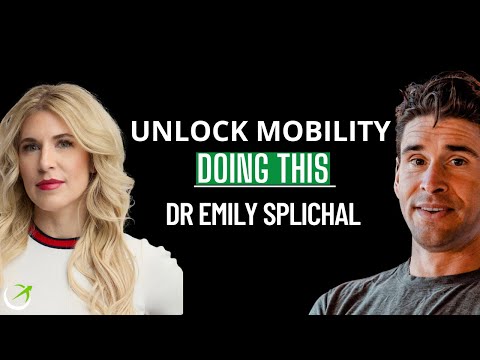
Unlock Lifelong Mobility With This Simple Daily Movement Routine
~210 min
Episode Brief·YouTube

Unlock Lifelong Mobility With This Simple Daily Movement Routine

Ben Greenfield
Watch on YouTube Add to chat My bookmarks← All sources

TL;DR

The four things you'd lose by not watching

4 items

TL;DR

The four things you'd lose by not watching

4 items
1

Dr. Emily Splick (functional podiatrist) reveals how lightweight weighted vests, compression apparel, and textured surfaces can 'turn up the volume' on your body's sensory awareness, making you move more efficiently and with less pain.

2

She details the 'anti-gravity pelvic floor exercise'—a 5% activation lift combined with toe pressure and tongue placement—to rebuild a healthy relationship with gravity and relieve low back and foot pain.

3

Walking speed is a hidden vital sign: Splick explains how to find your personal 'momentum' pace, where fascia-driven elastic recoil replaces muscular effort, hydrating your body and protecting your brain as you move.

4

Splick introduces the 'muscle tuning theory,' where your muscles and fascia learn to anticipate ground reaction forces like vibration, turning impact into elastic energy instead of injury.

Protocols

Concrete recipes — what, when, how much, and why

3 items

Forward lean exercise with weighted vest stacking

WhatStand tall, stiff as a board, barefoot on a textured surface, wearing a lightweight weighted vest and compression apparel. Lean forward slightly, exhaling as you lean; toes will automatically anchor, pelvic floor lifts, arch lifts, tongue goes to palate. Return to upright on inhale.
WhenDuring a sensory-based workout or as a standalone drill; can be integrated into warm-ups or breathwork sessions.
DoseRepeat for 5-10 reps, focusing on coordination of breath and activation; no time limit, as awareness dictates.
For whomAnyone wanting to improve movement awareness, foot strength, and core stability; particularly those with poor toe purchase or stiff feet.
WhyTrains the postural reflex of toe gripping and pelvic floor lift, enhances body schema through added weight and compression, and coordinates breath with anti-gravity activation.
CaveatsEnsure you have enough balance (can shut eyes only if comfortable). Not recommended on slippery surfaces. Use a weight load of only a few pounds to avoid fatigue and maintain sensory focus.

Splick contrasts common advice ('exhale on exertion') by explaining that in this movement, the exhale occurs on the forward lean, not the return. The reason is that the exhale lifts the diaphragm simultaneously with the toe-activated pelvic floor, 'stacking domes' in the body like yoga bandhas. This stacking creates a powerful anti-gravity column. She recommends combining this with a weighted vest, barefoot on a textured surface, holding textured sticks, and shutting eyes for maximum sensory input. This drill exemplifies her philosophy of directing mental focus toward sensation, not just performing the move. She stresses that the practitioner must actively guide their attention to the interplay of breath, texture, weight, and muscle tone.

Mechanism

Leaning forward shifts center of mass, eliciting an involuntary toe-gripping reflex to prevent falling. This toe anchor triggers posterior pelvic floor lift via fascial connections. Exhaling during the lean lifts the diaphragm, which in turn aids pelvic floor elevation (doming). The added weight intensifies proprioceptive input to the nervous system, making the body schema clearer. Compression amplifies sensory feedback. The tongue on palate engages the deep front line, linking the whole anterior fascial chain.

When your center of mass slightly leans forward, your toes are going to activate or grip into the ground. That's a postural reflex.

Also said
“Exhale, diaphragm lift. As your diaphragm lifts, your pelvic floor lifts. That's the anti-gravity. Tongue to pallet. So you are stacking.”— Explains the coordinated breath mechanism.

Cha cha assessment for pelvic mobility

WhatStand with feet together, hands on ASIS (hip bones). Bend one knee and straighten it, noticing how your pelvis moves (drops and rotates). Alternate legs, mimicking slow walking in place.
WhenAs a self-assessment before or after walking, or as part of a movement prep routine.
DosePerform for 30-60 seconds, focusing on left/right symmetry and pelvic rotation/drop.
For whomAnyone experiencing SI joint pain, piriformis syndrome, low back pain, or wanting to walk faster.
WhyChecks if your pelvis moves tri-planarly (forward/back, side/side, rotation) during gait; a stuck pelvis limits step length, decoupling, and walking speed.
CaveatsPerform on a stable surface; if pain occurs, reduce range of motion or consult a professional.

Splick stresses that to live long and healthy, you must be able to walk fast enough, which requires long steps. Long steps demand decoupling the spine—pelvis moves one way, rib cage moves opposite, aided by arm swing. If the pelvis is stuck, this decoupling fails, causing overuse injuries or slowing down. The assessment is simple: hands on hips, bend one knee, feel the drop and rotation, repeat other side, then alternate. She notes people often get SI joint pain when the pelvis is immobile. She has an instructional video on her YouTube channel for this.

Mechanism

During normal gait, the pelvis must nutate, counter-rotate, and shift laterally. The cha cha assessment mimics that movement in stationary stance, providing feedback on whether the pelvis is freely moving or locked. A locked pelvis forces stress into the rib cage (T-spine), impairing counter-rotation needed for long steps.

The way that the pelvis moves or needs to move to optimize walking... is designed to move in a triplanar mechanism.

Also said
“If our pelvis is stuck, obviously there's stress that kind of gets bottled up. So it has to go somewhere... often times it will also lock up your rib cage.”— Explains the chain reaction of pelvic lock.

Finding your momentous walking speed (fascial movement)

WhatGo for a walk (no bags, no texting, possibly with rhythmic music). Gradually increase pace until you feel an effortless momentum where stopping quickly would be difficult—that's your optimal fascial walking speed.
WhenDuring any dedicated walk, ideally daily.
DoseMaintain that pace for the duration of the walk; 20-40 minutes is beneficial, but the key is finding the pace.
For whomAll adults aiming for movement longevity, especially those feeling stiff after sitting.
WhyAt this speed, movement switches from muscular to fascial elastic recoil, increasing efficiency, hydrating fascia, and activating a circulatory-brain pump.
CaveatsEnsure sufficient joint mobility (big toe, ankle, hip, pelvis) to sustain pace without strain. Do not force an unnatural stride; if joints lock up, work on mobility first.

Splick differentiates between moving muscularly (robotic, high effort) and moving fascially (graceful, efficient). She shares her personal experience in NYC that returning to walking at her momentum pace dissolved stiffness. She warns against using a treadmill simply dialed faster because lack of mobility leads to grabbing rails and cheating. She suggests leaving backpacks/purses (which cause asymmetrical loading) at home, going to a mall or indoor track if weather is bad, and using rhythmic music to cue pace. She also reveals a fascinating link: we first learn rhythm in utero from our mother's walking, explaining why music aids walking cadence. The ultimate goal is not calorie burn, but movement longevity and brain protection.

Mechanism

Walking uses the pendulum theory: legs act as pendulums, loading the Achilles tendon and fascia like a spring at the right pace. That elastic recoil propels you forward with minimal muscular effort. The rhythm also activates a circulatory pump from the soleus muscles up, boosting brain oxygenation and BDNF. The spiraling decoupling of the spine wrings out vertebral segments, hydrating discs and crossbody slings.

Personal experience

Splick: 'I lived in New York City for 20 years. And as soon as I would come home from a trip... come back to New York City and I would find my fast momentous state and any stiffness in my lower back, my shoulders... would just kind of all dissipate because of the fluidity of finding momentous walking speed.'

You are not moving muscularly. I need people to find the fascial side of their movement because if you have momentum, there's almost like an elastic rebound type of component.

Also said
“The rubber band effect of the human body is where you find movement efficiency. That is where you find a grace and ease in your movement.”— Defines the sensation of optimal pace.

What's new

Personal practice updates, fresh positions, predictions

1 item

Walking speed as the sixth vital sign and the 'momentum state'

discussing walking speed and longevity

Research shows walking speed correlates with mortality; Splick teaches how to find your personal momentum pace where movement shifts from muscular to fascial, creating efficiency and a circulatory pump.

Why this matters: Offers a practical, subjective way to find optimal walking speed instead of a fixed number, and ties it to fascial elasticity.

Background

Many experts say walking speed is a predictor of longevity, but Splick adds a bio-mechanical explanation: at the right pace, your body moves via elastic recoil rather than muscle contraction.

She describes walking as a series of falls—the pendulum theory of locomotion—where one leg swings forward, strikes the ground, then reloads like a bow and arrow. Your ideal walking speed is when you feel you are 'catching momentum' and walking effortlessly; if someone stepped in front of you, you wouldn't be able to stop easily. That momentum indicates you are moving fascially, using the rubber-band effect of your connective tissue, not muscularly. Most people move stiffly after sitting, but as they reach the right pace, stiffness melts away because the fascial system kicks in. Additionally, this pace activates a circulatory pump that sends blood and oxygen to the brain, stimulating BDNF, protecting cognition, and hydrating the entire fascial system. She warns against simply increasing treadmill speed because you might lack joint mobility to sustain it, leading to cheating. Instead, she recommends walking with music/rhythm, leaving bags at home, and practicing on indoor tracks or malls to feel the momentum.

Personal experience

Splick used to live in New York City for 20 years and whenever she returned from travel, finding her fast momentum walking pace would dissolve any lower back or shoulder stiffness within minutes.

Your ideal walking speed is based around you feeling like you are catching momentum that there suddenly becomes this effortless ease at which you're walking.

Also said
“You are now in the rubber band of your body. The rubber band effect of the human body is where you find movement efficiency.”— Explains the fascial elastic mechanism.
“When you walk fast enough in this pace you activate this circulatory pump... making sure that enough blood oxygen and nutrients is getting to your brain.”— Links to brain health and BDNF.

Recommendations

Products, supplements, and tools mentioned in the episode

1 item

Counterpace heart rate monitor and app

Product

A wearable that trains you to sync your walking pace with the diastolic phase of your heart, potentially improving cardiovascular efficiency and body awareness.

Ben shares his experience using Counterpace for a couple of years, describing how it layers a beep onto music/podcasts to guide foot strike timing with heart rhythm. Splick praises it as a 'mic drop thing' that aligns with her circulatory pump concept. Ben cautions that such tech should be a training wheel; once your brain internalizes the rhythm, you can rely less on the device.

vs alternatives

Unlike standard heart rate monitors, Counterpace specifically times gait to diastolic phase, an approach used in cardiovascular rehab called enhanced external counterpulsation.

Personal experience

Ben: 'I literally wore it religiously for a couple years and I'm like I think my brain knows now my walking speeds.'

That is a huge part of what I'm also trying to advocate... That is like a mic drop thing.

Find Counterpace
Disclosed sponsorships1speaker disclosed

Naboso textured mats and insoles

Product Sponsored · disclosed

Textured surfaces stimulate the skin on the feet, enhancing proprioceptive feedback and microcirculation. Splick uses them for standing exercises, yoga, and inside shoes.

DisclosureEmily Splick is the founder of Naboso and frequently mentions her products as tools she uses and recommends.

Splick explains that tactile stimulation via skin is a core pillar of sensory awareness. She keeps a Naboso mat in her sauna for yoga and recommends Naboso insoles for footwear to maintain foot perception even when shod. The technology leverages the high density of nerve endings in the feet to improve balance, mobility, and brain-body connection. Ben Greenfield mentions using a Naboso mat regularly.

vs alternatives

Compared to standard smooth mats and insoles, textured versions provide constant cutaneous stimulation that other products lack.

Personal experience

Ben: 'I have your Naboso mat still in my sauna, by the way. So, I do all my yoga in the sauna on these tactile sensation mats.'

Texture of course yeah which rabbit hole by the way is why paradoxically wearing socks to bed can assist with cooling of the rest of the body... Recommend the Naboso soft for that.

Also said
“I always want something in the hands. This is where the Naboso sensory sticks could be used because they're weighted and they're textured.”— Shows another Naboso product for hand sensory input.
Find Naboso

Notable quotes

Lines worth pulling out — contrarian, specific, or perfectly phrased

2 items
People who work against gravity or they're not thinking about gravity are the people who have low back pain.
Directly links posture and back pain to a broken relationship with gravity.
When you walk fast enough in this pace you activate this circulatory pump... making sure that enough blood oxygen and nutrients is getting to your brain.
Explains the dual mechanical and neurological benefit of optimal walking speed.

Sign in to share feedback

Tell us if this brief hit the mark or missed it — feedback feeds back into the next iteration of the prompt.

Topics covered

gravity-sensingweighted-vest-for-proprioceptioncompression-apparel-neurologytactile-stimulation-for-feetfascial-brain-connectionanti-gravity-pelvic-floor-exerciseplantigrade-footsetting-your-baseforward-lean-exercisecha-cha-pelvic-assessmentwalking-speed-longevitymomentum-walking-fascialcirculatory-pump-walkingmicrocirculation-feetmuscle-tuning-theoryground-reaction-forces-vibrationsensory-breathworknaboso-productscounterpace-device
Free account

Make this library yours

Reading is free for everyone. A free account adds the personal layer: save protocols, follow experts, and see how the other experts weigh in on this same topic.

Create a free accountSign in

Where the experts disagree — weekly

One email a week: the sharpest new disagreements and protocols from the library. No spam, unsubscribe anytime.

Educational summary of the cited expert source — not medical advice. Open the source recording linked above and consult a qualified physician before acting on any protocol.