UNFUCG
DashboardSearchChatBookmarksNotificationsActivityPremiumProfile
?
Home
Search
Chat
Saved
Profile
Episode
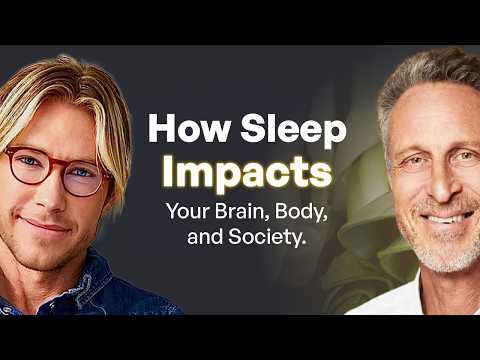
Sleep EXPERT Warns: Deprived Sleep Makes You Socially Isolated
~315 min
Episode Brief·YouTube

Sleep EXPERT Warns: Deprived Sleep Makes You Socially Isolated

Mark Hyman
Watch on YouTube Add to chat My bookmarks← All sources

TL;DR

The four things you'd lose by not watching

4 items

TL;DR

The four things you'd lose by not watching

4 items
1

Sleep-deprived people become socially repulsive to others — strangers rate them as less desirable company even without knowing they are under-slept, and brief contact with a sleep-deprived person makes the well-rested person feel lonelier, creating a viral transmission of social isolation.

2

One week of six-hour nights distorts the activity of 711 genes — upregulating tumor-promotion, inflammation, and cardiovascular-disease genes while downregulating immune-support genes — demonstrating damage at the DNA level within days.

3

Five nights of short sleep ages a healthy young man's testosterone by ten years; the same regimen pushes previously normal blood sugar into pre-diabetic range, underscoring that sleep is not negotiable.

4

Walker's QQRT framework — Quantity (7-9 hrs), Quality (sleep efficiency ≥85%), Regularity (same bed/wake time daily), and Timing (aligned with your chronotype) — predicts all-cause mortality, with regularity now showing equal or greater predictive power than total duration.

Protocols

Concrete recipes — what, when, how much, and why

8 items

QQRT sleep audit: assess your four macros before fixing anything

WhatBefore reaching for supplements or gadgets, score yourself on the four macros of sleep: Quantity (are you getting 7-9 hours?), Quality (is your sleep efficiency ≥85%?), Regularity (same bed and wake time 90% of the time?), and Timing (are you aligned with your actual chronotype?). Identify which macro is failing first.
WhenAs a baseline self-assessment before any sleep intervention. Revisit every few months.
DoseThree diagnostic questions: 1) Would you sleep past your alarm if it didn't go off? 2) Do you sleep more on weekends than weekdays? 3) Do you feel restored the next day? If yes to any, you have a deficit.
For whomAnyone with any sleep complaint, starting point for all intervention.
WhySupplements, gadgets, and sleep restrictions are minor interventions. Fixing the dominant macro — usually regularity or quantity — produces the largest improvement. Starting with supplements without addressing the macros is 'majoring in the minors.'

Walker is explicit: 'if you're focusing on supplements as your first line approach to getting your sleep corrected you are majoring in the minors.' The QQRT framework integrates the often-overlooked Timing dimension (chronotype alignment), which can make the difference between real insomnia and a simple chronotype mismatch. He notes that the new finding — regularity predicting mortality as strongly as duration — means the regularity macro deserves primary attention before duration.

good sleep for me is about four macros I've sort of thought about this and come up with this principle that there are four macros of good sleep and you can remember it by the acronym QQRT quantity quality regularity timing

Fixed bed and wake times 7 days a week (regularity protocol)

WhatGo to bed and wake up at the same time every day — including weekends — 90% of the time. Allow occasional late nights for social life but return to the anchor the next morning.
WhenStarting tonight. Do not 'sleep in' on weekends to catch up — this weakens the circadian signal for the following week.
DoseAt least 2-4 weeks before evaluating improvement; the circadian system takes time to recalibrate its amplitude.
For whomEveryone, but especially shift workers, parents with irregular schedules, and anyone who 'catches up' on weekends.
WhyRegularity is now shown to predict all-cause mortality as strongly as sleep duration. The fixed wake time is the most powerful lever because it anchors the circadian clock regardless of when you fall asleep.
CaveatsDo not go to bed early if you are not tired — this worsens insomnia. The rule is fixed wake time; bedtime follows naturally once the sleep drive builds.

Walker compares himself to a metronome: 'I am so metronome like in my regularity just because I know how powerful that anchor to my Circadian rhythm is.' He explicitly says there is nothing special about midnight — the correct bed time is whatever aligns with your chronotype. Forcing an early bedtime to be a 'morning person' when you are a night owl creates a chronotype-lifestyle mismatch that looks like insomnia but is not.

I am the most boring individual I get it but I am so metronome like in my regularity just because I know how powerful that anchor to my Cadian rhythm is to make sure that my sleep is high you go to bed and you wake up at the same time every day no matter weekday weekends for the most part

Warm bath or shower 1-2 hours before bed (the warm bath effect)

WhatTake a hot bath (Walker recommends Epsom salt + lavender drops for cortisol-reduction) or a warm shower roughly one to two hours before bed. Get out, let the heat radiate off the skin surface, and the resulting core body temperature drop will accelerate sleep onset.
When1-2 hours before target bedtime. Earlier than 90 minutes reduces the window for the core temperature to drop before lights-out.
Dose15-20 minutes in the bath or shower is sufficient to draw blood to the surface.
For whomAnyone with difficulty falling asleep, especially those in warm climates or with warm bedroom environments.
WhySleep onset requires a core temperature drop of about 1 degree C. The bath draws blood to the skin surface where it radiates quickly, dropping core temperature faster than passive cooling alone. This is so reliable it is called 'the warm bath effect' in sleep science.
CaveatsCold plunges before bed do not have the same evidence base. Ice baths may delay sleep by triggering a sympathetic rebound.

Walker describes the three-part thermal equation: 'you have to warm up to cool down to fall asleep, you have to stay cool to stay asleep, you have to then warm up to wake up.' The bath addresses part one; room temperature addresses part two; morning light and warmth address part three. Hyman describes his own 'ultra bath' — Epsom salt (transdermal magnesium) plus lavender drops — noting the lavender reduces cortisol and signals the parasympathetic system. Walker endorses this multi-factor approach but clarifies the core mechanism is the thermal shift, not the aromatherapy.

Mechanism

The bath acts as a snake charmer drawing trapped hot blood from the core to the skin surface. On exiting the bath, rapid surface-area heat radiation drops core temperature below its normal sleeping threshold, triggering the brain's sleep-onset circuitry.

when we have a hot bath or a shower what we do is we encourage all of the blood to race to the surface of the skin... the bath has acted like a snake charmer... when I get out the bath all of the blood at the surface of the skin radiates the heat very quickly and my core body temperature absolutely plummets

Sleep environment: cool (65F/18C), completely dark, quiet

WhatSet bedroom temperature to approximately 65 degrees F (18 C). Use blackout curtains or an eye mask — even low-level light through closed eyelids degrades sleep quality. Use earplugs or a white-noise machine only if in a high-noise urban environment.
WhenEvery night, built into your room setup rather than requiring active decision.
For whomEveryone. Partners with different thermal preferences benefit from a temperature-controlled smart mattress so each side can be independently calibrated.
WhyCore body temperature must drop to stay asleep throughout the night. Even low-level light penetrates the eyelid and infects the sleeping brain's light-sensitive circuits, degrading sleep quality without waking you. White noise machines help only where ambient noise is genuinely high.

Walker: 'your eyes are closed so it is dark but it is not — even if you were to have low-level overhead lighting still on during sleep even though you still sleep the quality of your sleep is worse because it is still penetrating through your eyelid onto your retina.' He personally uses an eye mask and earplugs when in noisy environments and a sound machine in urban hotels. He recommends downloading a lux meter app to check bedroom light levels — target below 10 lux. For temperature, he mentions 65 degrees F as personal but acknowledges men and women often differ, which is why smart mattresses with dual-zone temperature control are mechanistically justified.

I would say the best sleep I've had in decades was when I went winter camping... daylight during the day physical activity Darkness at night coldness at night... that is the perfect sort of prescription in a quote unquote manner for a good night of sleep

Also said
“Even if you were to sort of have low-level overhead lighting still on during sleep even though you still sleep the quality of your sleep is worse because it's still penetrating through your eyelid onto your retina and essentially light infecting your sleeping brain at night”— Quantifies the cost of ambient light even when eyes are closed and sleep is technically achieved — quality, not just onset, is affected.

Wind-down routine: 45-60 min of progressively deactivating activity before bed

WhatTreat sleep like landing a plane — you cannot go from 60 mph to stop instantly. Spend 45-60 minutes before bed in genuinely deactivating activity: hot bath, light reading (Kindle in dark mode rather than backlit phone), meditation, gentle yoga, light stretching, or a sleep story. The goal is to get the mind off itself.
WhenBeginning 60 minutes before target sleep time. Identical routine every night for the circadian anchoring benefit.
For whomAnyone who falls asleep fine but takes 30 or more minutes, and anyone who lies in bed ruminating.
WhyThe brain cannot switch from high-cortisol executive function to sleep onset without a transition window. Attempting to sleep immediately after stress or screens is biologically analogous to driving into your garage at 60 mph and slamming the brakes.
CaveatsIf you have insomnia, do not go to bed unless you are already drowsy. The wind-down routine prepares you; the actual move to bed happens only when sleepiness is present.

Walker's cognitive trick for those who resist meditation: close your eyes and take yourself on a mental walk of a familiar route in extraordinary spatial detail — color of the leash, which way you turn at the end of the driveway, what the traffic looks like. 'In that level of granularity what is the color of the leash that I am using today for the dog... I am distracting my mind and then usually the next thing I remember is my alarm going up in the morning.' This works because sleep is paradoxical — the harder you try, the more it recedes; the more you occupy the mind with low-stakes vivid detail, the more the default-mode rumination shuts down.

sleep is much more like Landing a plane it takes time to come down onto the sort of the Terra Firma of good sleep at night... sleep is like trying to remember someone's name the harder that you try the more you force it away and when you stop trying it comes back to you

Light management: dim lights 60 min before bed, bright daylight in the morning

WhatIn the last hour before bed, switch off half the lights in your home. Target below 10 lux in the bedroom (check with a free lux meter app). Separate the phone bedroom presence from its active use. In the morning, get bright outdoor light within 30-60 minutes of waking.
WhenEvery evening and every morning. The evening intervention reduces melatonin suppression; the morning intervention anchors the circadian clock.
For whomEveryone. Particularly important for urban dwellers with overhead LED lighting and anyone who works at home all day without outdoor exposure.
WhyLight suppresses melatonin, the hormone that times sleep onset. Modern homes are dark deprived — we get too much light at night and not enough bright light during the day, confusing the brain's internal clock in both directions simultaneously.
CaveatsBlue-light glasses do not address the primary mechanism (device attention capture). Simple dimming is more effective and far cheaper.

Walker: 'we are a dark deprived Society in this modern era and we get junk light at night and light will stamp the brakes on melatonin which is a natural hormone that times our sleep and it will make you it will fool your brain into thinking I am not tired.' The dual problem is symmetric: insufficient bright daylight means the arousal signal during the day is weak (daytime sleepiness), while excess evening light keeps the brain in an aroused state when it should be winding down. Walker recommends the last-hour-half-lights experiment as a 10-day trial with no downside: 'if it doesn't feel any different great.'

we don't have strong enough daylight during the day to ramp us up and make us awake so we're sleepy during the day and we don't have enough Darkness at night to make us sleepy so we're awake at night

Sleep supplement stack for sleep-disturbed individuals (magnesium, ashwagandha, phosphatidylserine, glycine)

WhatFor the tired but wired high-anxiety profile or for those with confirmed magnesium deficiency: try magnesium L-threonate (crosses the blood-brain barrier per MIT animal data), ashwagandha 400-600 mg, phosphatidylserine 300-400 mg, and/or glycine 2 g before bed. Address behavioral interventions first; supplements are secondary.
When30-60 minutes before bed. Test each supplement individually for 2-4 weeks before stacking to identify what is actually helping.
DoseMagnesium L-threonate: per product label. Ashwagandha: 400-600 mg. Phosphatidylserine: 300-400 mg. Glycine: approximately 2 g. Melatonin: avoid unless jet-lagged or over 50 — and if used, keep below 1-5 mg.
For whomPeople with confirmed high evening cortisol or anxiety-dominant insomnia, after ruling out Sleep Disorders and fixing behavioral macros.
WhyApproximately 45% of the population is magnesium deficient; restoring levels to normal can meaningfully improve sleep in the deficient subgroup. Ashwagandha and phosphatidylserine have cortisol-lowering data. Glycine may regulate circadian rhythm. These address the tired but wired cortisol-dominant state that blocks sleep onset.
CaveatsMagnesium supplementation above a normal level does not further improve sleep in normative individuals — the effect is corrective, not enhancing. Melatonin under 50 years and outside of jet-lag context adds only approximately 3.9 min to sleep onset (meta-analysis). GABA supplements have weak evidence and do not cross the blood-brain barrier effectively.

Walker explains why standard magnesium forms (citrate, oxide) do not directly improve brain sleep — they relax the body, which sends a vagus-nerve signal of calm to the brain indirectly. Magnesium L-threonate is the exception: MIT animal data suggests it crosses the blood-brain barrier, potentially acting more directly. Walker is candid about the evidence gap: 'there are no randomized control studies that I know of that have looked at magnesium L-threonate and sleep improvement' — but says it would be his first choice at gunpoint. He is notably skeptical of most melatonin use, calling 10-20 mg 'a super physiological dose the body never would normally release.'

there is a form of magnesium magnesium L-threonate that based on some animal data from MIT does seem to cross the blood brain barrier... if you put a gun to my head and said which form would you recommend for a patient I would probably say magnesium threonate because at least it's going to potentially get into the brain

Also said
“I would say melatonin I probably wouldn't favor it right now if you're going to do it you're probably taking too much right now you're taking maybe 10 20 milligrams... that's a super physiological dose melatonin that's a dose that the body never would normally release itself”— Corrects a near-universal melatonin dosing error: 10-20 mg is pharmacological, not physiological, and long-term consequences are unknown.

Use sleep tracker trends, not nightly absolute scores (orthosomnia prevention)

WhatIf using a sleep tracker (Oura ring or similar), review weekly trend lines rather than each night's score. If a nightly number change disturbs your sleep, put the tracker in a drawer for 2-4 weeks until your anxiety around it resolves, then return to tracking with a weekly-only review cadence.
WhenOngoing. Apply immediately if you notice anxiety about your sleep score is disrupting your sleep.
DoseWeekly reviews: 5 minutes on Sunday morning looking at the 7-day trend, not nightly absolute numbers.
For whomAnyone using a consumer sleep tracker who notices bedtime anxiety about their score.
WhyCurrent wearables are approximately 75% accurate in distinguishing sleep stages (best-in-class; a 4-class algorithm). Their power is in relative consistency: it's consistently inaccurate night after night so its power is when all of a sudden you see deviations in your Trend. Orthosomnia — sleep anxiety caused by tracking — is a real clinical entity that negates the benefit.
CaveatsWalker (Oura scientific adviser, disclosed) notes that the ring proximity to finger vasculature gives it a sensing advantage over wrist-worn devices. Different algorithms produce widely different absolute numbers between devices — do not compare absolute scores across brands.

Walker: 'its absolute accuracy is about 75% however its relative accuracy is much higher... it is consistently inaccurate night after night after night so its power is when you see deviations in your Trend because it cannot be the ring that is deviating it is consistent it must be you.' This is the same principle as repeated-measures medicine: within-person variation is far more informative than absolute level when the measurement instrument has a fixed systematic bias.

don't follow nightly headlines absolute accuracy follow weekly trend lines... this thing is 75% accurate let's say at separating all of those different categories but it's consistently inaccurate night after night after night so it's power is when all of a sudden you see deviations in your Trend

What's new

Personal practice updates, fresh positions, predictions

6 items

Sleep deprivation triggers viral social isolation

~opening

Walker's lab showed that sleep-deprived individuals not only withdraw from society themselves, but observers who don't know they are sleep-deprived rate them as more socially repulsive and choose not to interact. Worse, the well-rested person who does interact with a sleep-deprived individual feels significantly lonelier afterward.

Why this matters: Social isolation is a known mortality risk on par with smoking; that sleep deprivation both causes and transmits loneliness creates a compounding public-health loop that goes far beyond individual health.

Background

Walker frames this as new research from his lab — he calls it the 'biggest surprise most recently' in sleep science. Prior sleep research focused on organ-level damage; this work shows civilizational-level social erosion.

Walker explains the evolutionary logic: the brain detects insufficient sleep as a Red Alert emergency and goes into low-battery mode, withdrawing empathetic resources to self-preserve. Since no society has evolved without human cooperation, the effect cascades — sleep-deprived individuals are less likely to vote, engage charitably, or form new social bonds. The loneliness-transmission effect means even bystanders pay a tax on someone else's poor sleep. Walker cites data showing sleep-deprived people are more anxious, socially withdrawn, and depressogenic by default, which repels rather than attracts social engagement.

when people are sleep deprived you become asocial you withdraw from society you just don't want to interact... worse still other people who do not know that you are sleep-deprived... will find the person who sleep deprived more socially repulsive and they will choose not to interact with them

Also said
“worse still when you interact with a sleep-deprived individual and we ask you the Sleep rested individual you know how are you feeling right now are you feeling lonely they feel significantly more lonely as a consequence of interacting with the lonely sleep-deprived individual”— Quantifies the loneliness transmission: the well-rested person pays a cost for merely being near a sleep-deprived person.

711 genes distorted by one week of six-hour sleep

~early

A UK study restricted healthy adults to six hours for seven nights and measured gene expression changes versus each person's own eight-hour baseline. 711 genes showed distorted activity: tumor-promotion, inflammation, cardiovascular-disease, and cellular-stress genes were upregulated; immune-support genes were downregulated.

Why this matters: Sleep damage reaches down to the DNA alphabet within one week — not over years. This demolishes the popular belief that short-term sleep debt is harmless.

Background

This finding was highlighted in Walker's PLOS Biology paper 'The New Science of Sleep: From Cells to Large-Scale Societies', which frames sleep's influence from cellular level to societal level.

Walker frames the finding as showing that 'there is no aspect of your physiology that can retreat at the sign of sleep deprivation and get away unscathed — it will even tamper with the very DNA nucleic alphabet that spells out your daily health narrative.' The split of the 711 genes matters: about half were upregulated (bad actors: tumors, inflammation, cardiovascular risk) and half were downregulated (good actors: immune function). Six hours was the restriction — a level many people consider nearly adequate.

a sizable 711 genes were distorted in their activity caused by that short sleeping profile... about half of those genes were what we call upregulated they were overexpressed and those were genes that were associated with the promotion of tumors genes that were associated with inflammation and long-term chronic inflammation and genes that were associated with cellular stress and as a consequence cardiovascular disease whereas those genes that were actually downregulated were genes that were promoting the support of your immune system

Regularity predicts all-cause mortality as strongly as sleep duration

~mid

Recent replicated research — the second paper in two years — found that sleep regularity (going to bed and waking at the same time every day) carries equal or greater predictive power over all-cause mortality than total sleep duration. Walker describes this as one of the newest and most surprising findings in the field.

Why this matters: Most public-health messaging focuses on '8 hours.' The science now says when you sleep matters as much as how much you sleep — and this is actionable by anyone regardless of busy schedules.

Background

Walker notes the original finding came out roughly two years before the recording; a replication paper had just published. This is a very recent area of inquiry, largely enabled by large wearable-device datasets.

Walker is unusually explicit about applying this to himself: 'I am the most boring individual I am so metronome like in my regularity just because I know how powerful that anchor to my Circadian rhythm is.' He allows travel and social exceptions but frames 90% consistency as the operative target. The mechanism is that consistent bed/wake timing strengthens the Circadian amplitude, making the brain's internal clock more precise about when to release melatonin, drop core temperature, and organize sleep stage architecture.

regularity carries as if not more predictive power over your all cause mortality than quantity does... a paper came out two days [ago] that replicated that finding of about two years ago

Blue light is not the sleep villain — device activation is

~mid

Research by Michael Gradisar and others in Australia shows that blue-wavelength light is not the dominant driver of screen-related sleep disruption. The real mechanism is attentional capture and dopamine-driven cortical activation from the content itself, which causes 'sleep procrastination' — knowing you are tired but continuing to scroll.

Why this matters: The blue-light blocking glasses industry is built on a premise now challenged by experimental data. The intervention is content-disconnection, not spectral filtering.

Background

Walker says this was a serious revision of his own prior thinking. He cites Gradisar as 'almost pioneering' the skeptical re-examination of blue light dogma.

Walker explains the mechanism: modern devices are 'attention-capture machines whose sole purpose is to capture your attention economy and they do it ruthlessly well.' They stimulate dopamine and activate the cortex, causing sleep procrastination. His practical recommendation is digital detox — not blue-light glasses. For those who must use phones in bed, Gradisar's rule is to use the phone standing up only: after 7-8 minutes of standing, the body naturally wants to sit, and at that point the phone goes away. Walker also notes that desaturating the phone screen to black-and-white significantly reduces its attention-capturing pull.

it's not the blue light itself it's that these devices that we use that emit blue light... are activating they are attention capture devices they are hugely activating and their sole purpose now is to capture your attention economy and they do it ruthlessly well

Also said
“if you have to take your phone into the bedroom you can only use it standing up and after about seven or eight minutes you're standing there and you think I'm just going to sit down and at that point sorry phone goes away”— Gradisar's practical standing rule — uses fatigue and inconvenience to enforce detachment without willpower.

Gut microbiome and sleep have a bidirectional causal relationship

~mid

Walker's PLOS Biology paper addresses the gut-brain sleep axis: a healthy microbiome sends pro-sleep signals via the vagus nerve to the brain; poor sleep causes significant gut dysbiosis (most dramatically visible in jet lag, where gut trouble is a near-universal symptom). Jet lag experiments demonstrating dysbiosis are among the strongest evidence for the directionality.

Why this matters: Opens a new pathway for sleep intervention — microbiome optimization — that is almost entirely absent from conventional sleep medicine.

Background

Hyman notes that probiotic companies are marketing 'sleep probiotics,' with some users reporting dramatically increased deep sleep. Walker is cautious but says absence of evidence is not evidence of absence.

Walker frames this as bidirectional: when the gut is in balance, beneficial bacteria send health signals via the vagus nerve to the brain; when sleep is poor, the communication pathway carries a signal for gut dysbiosis downstream. He explicitly raises the question of whether the known age-related decline in both sleep quality and microbiome diversity might be mechanistically linked — and notes there is not yet longitudinal data linking both in the same cohorts. Hyman adds that 45% of the population is low in magnesium, contributing both to gut dysfunction and sleep disruption via overlapping pathways.

there is a bidirectional relationship between your gut health and your brain sleep Health meaning that when your gut is in balance with that collection of Flora and the Fauna in your gut microbiome it can send a health related signal through the nervous system by way of a major highway that connects your Gut to the brain called the Vagus nerve

Sleep deprivation in teens predicts suicide ideation, attempts, and completion

~mid

Emerging data — Walker says this was not available when he wrote Why We Sleep in 2017 — shows insufficient sleep in adolescents predicts suicidal ideation, suicide attempts, and suicide completion with approximately twofold increased risk. More surprising: bad dreams in teens are an even stronger predictor than insufficient sleep duration alone.

Why this matters: Sleep is a modifiable risk factor in the teen mental health crisis — and it is systematically disrupted by early school start times, which create a chronotype mismatch between adolescent biology and social schedules.

Walker explains the mechanism: adolescents have a biologically shifted chronotype — they are not being rebellious by staying up late, their brain chemistry pushes them toward later sleep. Early school start times then truncate their sleep from the morning end, removing REM-rich late-cycle sleep that is disproportionately important for emotional regulation. The squeeze is worst in the hours from about 5 to 7 AM, exactly the hours that produce the most REM. The additional finding about bad dreams is unexplained but suggests dreaming processes — not just sleep quantity — have independent protective effects on teen mental health.

insufficient sleep in teens will predict suicide ideation meaning thinking about suicide it will predict suicide attempts and tragically it will predict suicide completion... what we're finding is that a lack of sleep will have maybe a twofold increased risk for suicidality in teens

Also said
“bad dreams in teens seem to be even more predictive of suicide than insufficient sleep itself we've got no idea why it tells us something about dreaming above and beyond sleep that is predictive of our mental health”— Elevates dreaming — specifically bad dreams — to an independent suicide risk factor beyond just sleep duration, opening new clinical screening angles.

Recommendations

Products, supplements, and tools mentioned in the episode

1 item

Magnesium L-threonate for sleep support

Supplement

Among magnesium forms, Walker singles out L-threonate as the most theoretically justified for sleep because MIT animal studies suggest it crosses the blood-brain barrier — something magnesium oxide and citrate do not do. Evidence base is preclinical; no published RCTs in humans specifically for sleep improvement.

Walker situates this within a nuanced framework: standard magnesium forms help sleep only when the person is magnesium-deficient (about 45% of the population per Hyman). Once magnesium is normative, more magnesium does not further help. L-threonate is the exception because its putative blood-brain-barrier crossing means it could act directly on brain sleep circuits rather than indirectly via vagus-nerve relaxation signaling.

magnesium L-threonate that based on some animal data from MIT does seem to cross the blood brain barrier... if you put a gun to my head and said which form would you recommend for a patient I would probably say magnesium threonate because at least it's going to potentially get into the brain

Find Magnesium
Disclosed sponsorships3speaker disclosed

Why We Sleep by Matthew Walker

Book Sponsored · disclosed

Walker's 2017 comprehensive case for sleep's centrality to health, described by Hyman as having probably single-handedly changed how many people think about sleep. Walker himself warns that readers who are already sleep-anxious may find the book alarming; he suggests starting with his podcast.

DisclosureWalker is the author and the guest on this episode.

Hyman says: 'you wrote this book called why we sleep and it is something probably most people have never thought about and yet sleep it turns out is probably one of the most important things that we do.' Walker frames the book as a foundational document but acknowledges that since publishing in 2018 the field has advanced substantially — particularly on the societal and social dimensions, the REM-emotional-processing research, and the bidirectional gut-sleep axis. He says the podcast (70+ episodes) is the more current and comprehensive resource.

back in 2018 and now I think people are starting to really embrace it maybe it's the wearable movement maybe it's just more people speaking about it

Find Why

The Matt Walker Podcast and whywesleep.org global sleep assessment

Service Sponsored · disclosed

Walker recommends his podcast over the book for sleep-anxious listeners (70+ episodes, 20-40 minute monologues). whywesleep.org hosts the free QQRT global sleep assessment, personalized tips, and a 4-week action plan with optional donation to his public sleep education foundation.

DisclosureWalker's own podcast and public foundation — explicit self-promotion, disclosed.

Walker is building a public foundation specifically designed for Global sleep education — his stated motivation is that no first-world nation has had a major public health campaign for sleep, and there is no WHO educational module for children. The whywesleep.org assessment generates a sleep score on the four QQRT macros and produces targeted recommendations. Walker notes that Hyman himself reports using the podcast as a sleep story and wind-down aid.

if people have sleep problems which I know a lot of you do because it's rampant definitely read Matt's book Why We Sleep check out I would say the podcast is probably the best place the book May Scare You if you're not sleeping well

Find The

Oura Ring sleep tracker

Tool Sponsored · disclosed

Walker describes Oura as best in class among consumer trackers for the combination of finger-location sensing accuracy (approximately 80% wake/sleep, approximately 75% 4-stage), ring form factor (low friction to wear while sleeping), and algorithm quality.

DisclosureWalker is a scientific adviser to Oura; he discloses this explicitly.

Walker's key praise is the form factor: 'we don't put wrist watches on when we go to sleep... headbands or chest drops we take things off... but rings we are accustomed to that.' He notes the sensing advantage of the finger versus wrist (richer superficial vasculature gives photoplethysmography a cleaner signal). He qualifies: absolute accuracy is 75% for 4-stage classification; its power is in consistent within-person trend detection. His orthosomnia warning applies equally to Oura as to any other tracker.

vs alternatives

Walker says different wrist-based devices will produce wildly different numbers from the Oura ring because both the sensing location (wrist vs. finger) and the algorithms differ. A $50,000 polysomnography in his lab achieves 100% accuracy; a ring at a few hundred dollars achieving 75% of that is, in his words, bloody remarkable.

I know the algorithm and have helped with that algorithm... it's going to be about close to 80 maybe more percent accurate at determining wake from sleep

Find Oura

Notable quotes

Lines worth pulling out — contrarian, specific, or perfectly phrased

6 items
when people are sleep deprived you become asocial you withdraw from society you just don't want to interact... other people... will find the person who sleep deprived more socially repulsive and they will choose not to interact with them
Walker's single most surprising recent finding — sleep deprivation is contagious via social repulsion, creating a loneliness cascade that threatens social fabric at scale.
wakefulness from a brain perspective is low-level brain damage biochemically but sleep is your sanitary salvation
The cleanest one-liner for communicating why sleep is not recovery from activity but a fundamental biological necessity distinct from rest.
I can age a healthy young man by 10 Years by short sleeping them for a week
Makes abstract sleep importance concrete: five nights of 4-5 hours drops testosterone to the level of a man a decade older.
sleep is the foundation on which those two other things sit... if sleep doesn't serve an absolutely vital set of functions it was probably the biggest mistake the evolution process ever made and now we realize it didn't make a spectacular blunder
Reframes the diet and exercise are the pillars narrative — sleep is not the third pillar, it is the ground floor those pillars stand on.
regularity carries as if not more predictive power over your all cause mortality than quantity does
Shifts the clinical conversation from how many hours to how consistent — a more actionable target for most people.
it's not the blue light itself it's that these devices are attention capture machines they are hugely activating and their sole purpose now is to capture your attention economy
Corrects a widespread misunderstanding and re-directs intervention toward content and behavioral restriction rather than expensive blue-light hardware.

Sign in to share feedback

Tell us if this brief hit the mark or missed it — feedback feeds back into the next iteration of the prompt.

Topics covered

sleep-deprivation-social-isolationsleep-and-loneliness-transmissionrem-emotional-processingsleep-hygiene-protocolssleep-regularity-mortalityqqrt-frameworkchronotype-alignmentblue-light-myth-debunkeddevice-sleep-procrastinationsleep-and-testosteronesleep-and-blood-sugargene-expression-sleep-deprivationgut-microbiome-sleep-axissleep-and-alzheimersteen-sleep-suicide-riskbody-temperature-sleep-onsetwind-down-routinemagnesium-sleep-supplementsleep-trackers-oura-accuracyorthosomnia
Free account

Make this library yours

Reading is free for everyone. A free account adds the personal layer: save protocols, follow experts, and see how the other experts weigh in on this same topic.

Create a free accountSign in

Where the experts disagree — weekly

One email a week: the sharpest new disagreements and protocols from the library. No spam, unsubscribe anytime.

Educational summary of the cited expert source — not medical advice. Open the source recording linked above and consult a qualified physician before acting on any protocol.